An insulated, neutral, metal-coated polystyrene sphere is suspended from a lightweight thread. A positively charged glass rod is brought close to, but does not touch, the sphere, as shown in the diagram.
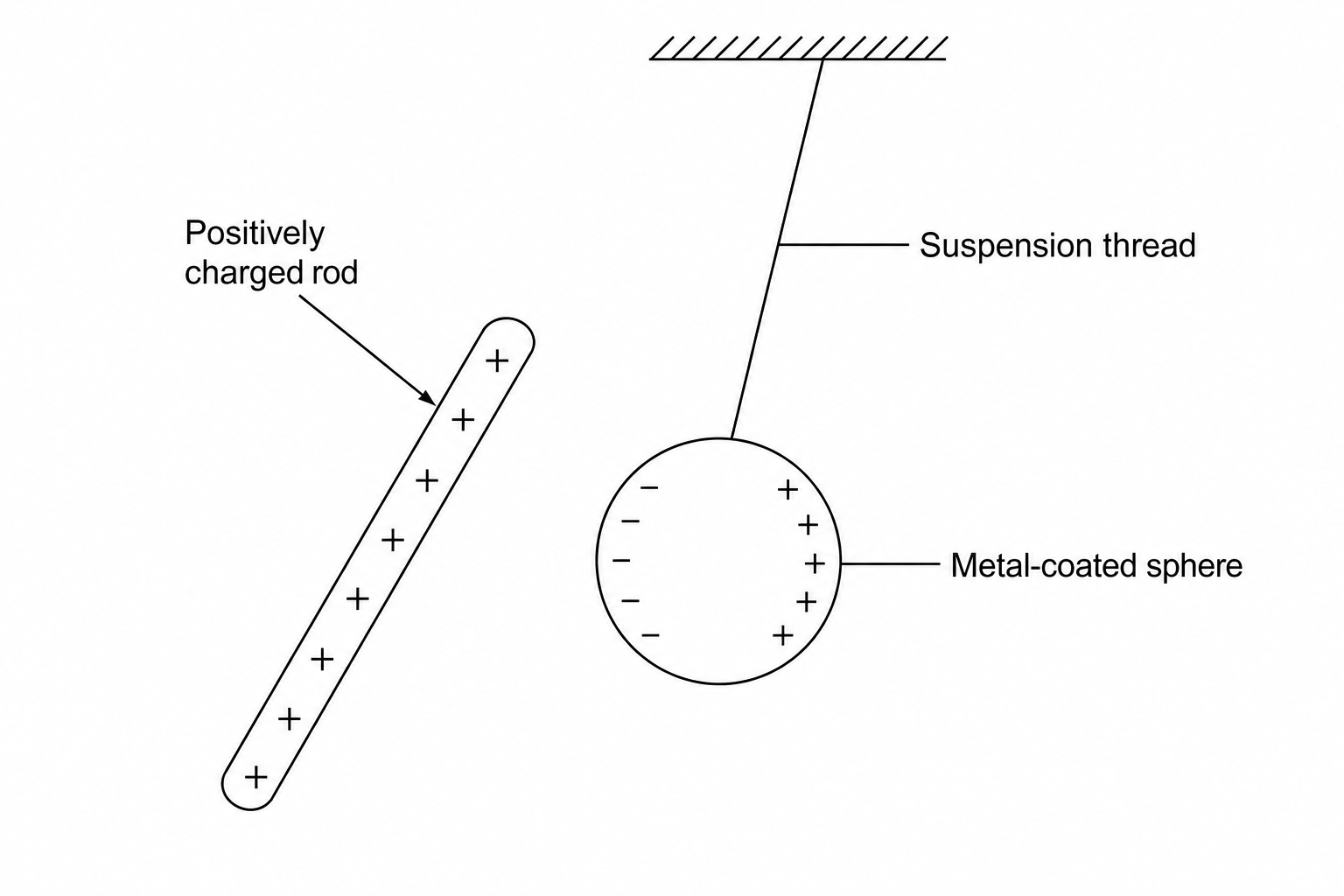
Which statement correctly explains why the sphere is attracted to the rod, and identifies the correct microscopic charge behavior in the metal coating?
Free electrons in the metallic coating migrate towards the side closest to the rod, leaving the far side with a net positive charge. The attractive force on the closer negative charges is stronger than the repulsive force on the more distant positive charges.
Positive ions in the metallic lattice migrate towards the side furthest from the rod, leaving the near side with a net negative charge. The attractive force on the closer negative charges is stronger than the repulsive force on the more distant positive charges.
Protons in the metallic coating are repelled to the far side of the sphere, while the electrons remain stationary. The repulsive force is weaker because the protons are further away.
The electric field of the positive rod ionizes the surrounding air, allowing negative ions from the air to be transferred to the sphere, giving it a net negative charge that is attracted to the rod.