A student investigates floating and sinking.
The student draws a bar chart to show the densities of five blocks, P, Q, R, S, and T.
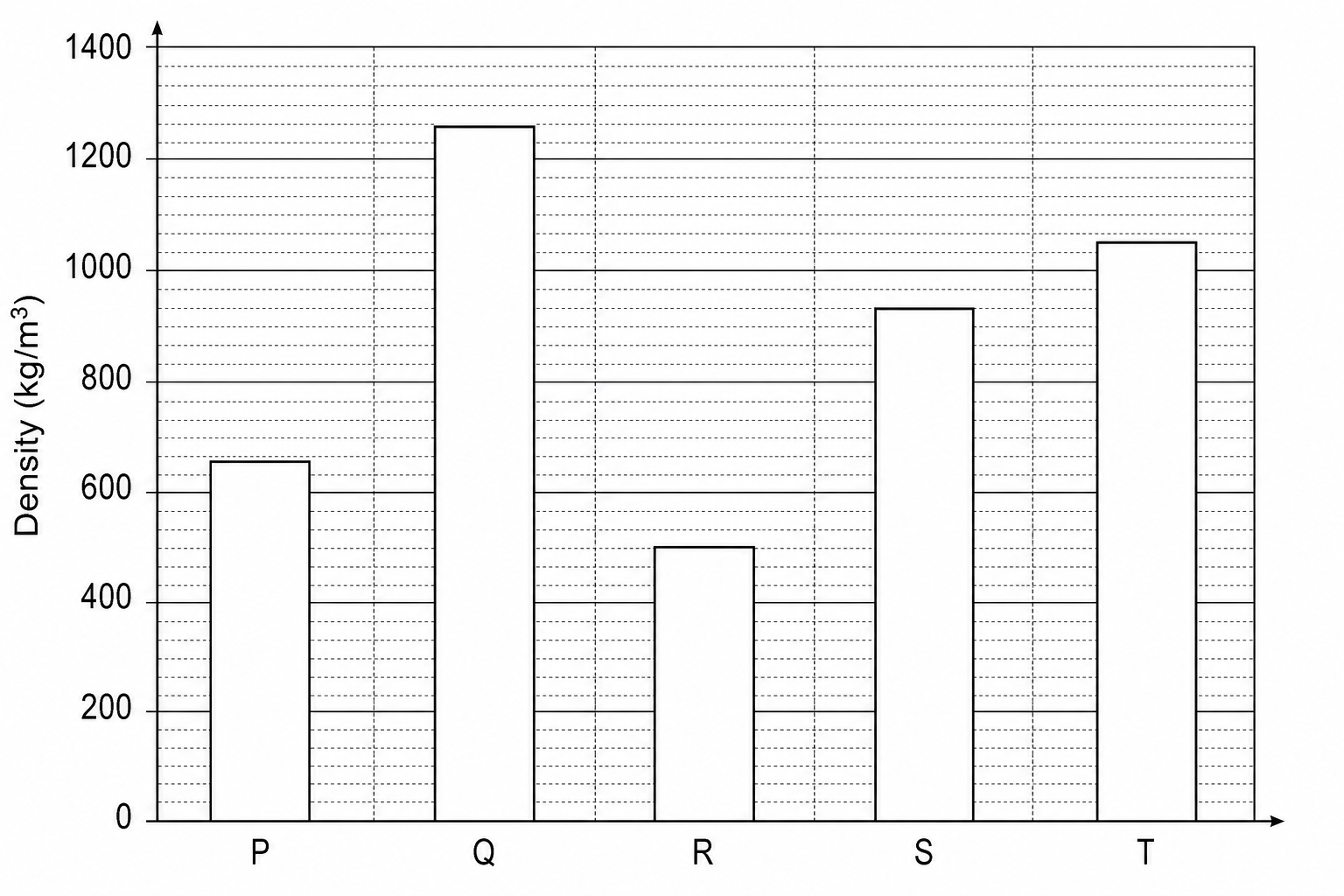
The student places the five blocks into an unknown liquid and observes if each block floats or sinks:
- Blocks P and R float.
- Blocks Q, S, and T sink.
Explain why some objects float and some objects sink in a liquid.
Use the bar chart to estimate the density of the liquid used.
The student researches the densities of five different liquids:
| Liquid | Density (kg/m3\text{kg/m}^3kg/m3) |
|---|---|
| Gasoline | 680 |
| Kerosene | 810 |
| Olive oil | 920 |
| Milk | 1030 |
| Honey | 1420 |
In which liquid would all five of the blocks P, Q, R, S, and T float?
A diver in a lake dives from a depth of 1.2 m to a depth of 4.5 m.
Calculate the change in pressure the diver experiences.
Use the gravitational field strength g=10 N/kgg = 10\text{ N/kg}g=10 N/kg and density of water ρ=1000 kg/m3\rho = 1000\text{ kg/m}^3ρ=1000 kg/m3.