Question 12
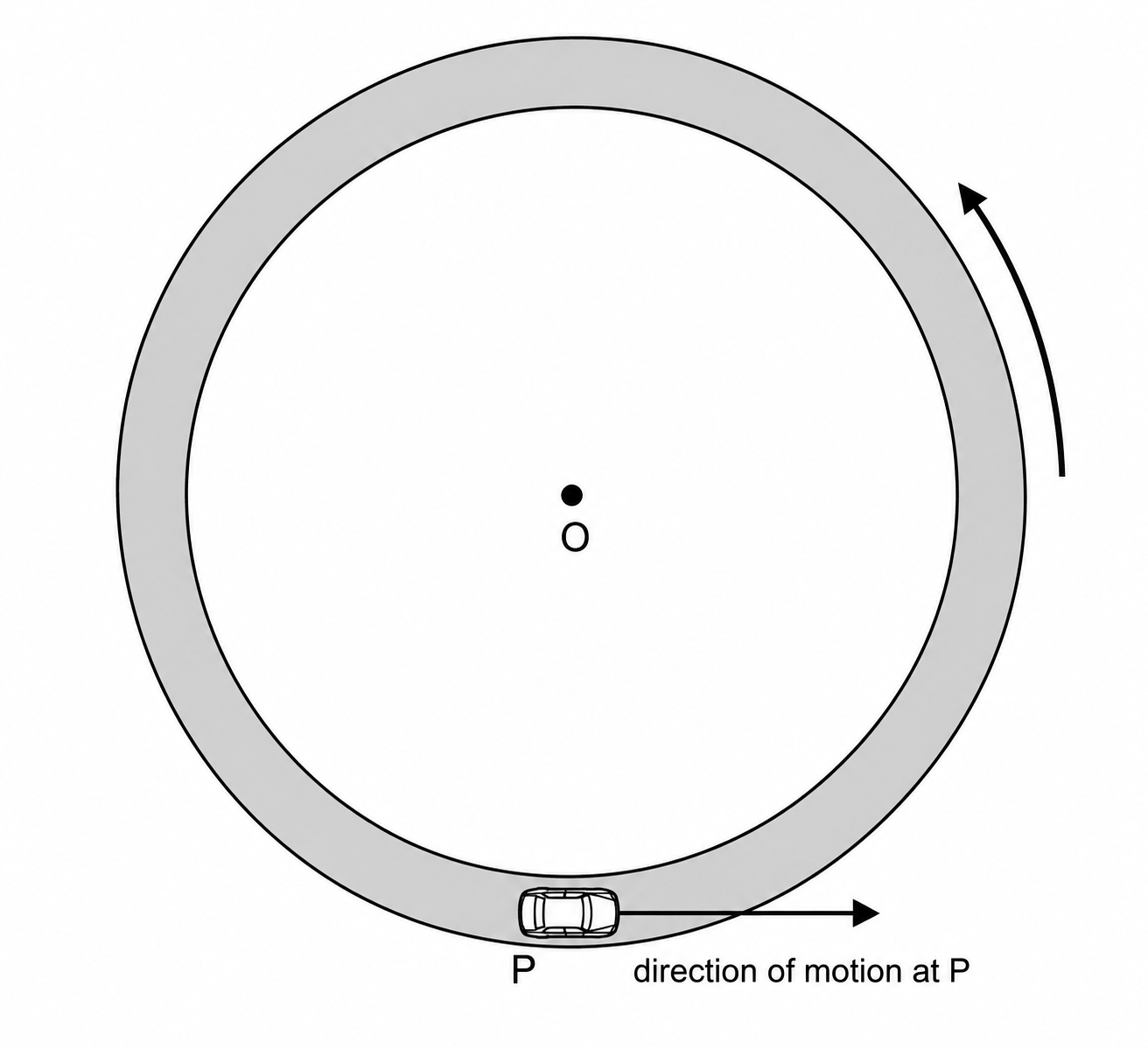
HA car is driven around a flat, circular test track at a constant speed.
The Figure shows the track from above.
Figure
a.[2]
Explain why the velocity of the car is changing, even though its speed is constant.
b.[2]
Explain why there must be a resultant force on the car.
c.[2]
As the car reaches P, it drives onto a patch of oil. The oil removes all of the friction between the tyres and the road.
Describe the path of the car immediately after P. Give a reason for your answer.
d.[2]
The car later travels at the same constant speed along a straight road.
State whether there is a resultant force on the car now. Explain your answer.
2.2 Newton’s laws Questions
50 exam-style questions on OCR GCSE Physics 2.2 Newton’s laws, covering 2.2.1 Interactions between objects, 2.2.2 Force pairs in interactions, 2.2.3 Forces as vectors, 2.2.4 Newton's first law, 2.2.5 Resolving forces with vector diagrams, 2.2.6 Forces acting on an isolated object, 2.2.7 Free body diagrams and resultant force, 2.2.8 Free body diagrams for balanced forces, 2.2.9 Newton's second law, 2.2.10 Inertia and inertial mass, 2.2.11 Momentum in collisions, 2.2.12 Relating force, mass, velocity and acceleration, 2.2.13 Work done by a force, 2.2.14 Work, stored energy and units of energy, 2.2.15 Power as the rate of energy transfer, 2.2.16 Newton's third law, and 2.2.17 Circular motion and changing velocity. Each one has a worked solution and a mark scheme showing where the marks go.