The diagram shows a model drone resting on a flat landing pad.
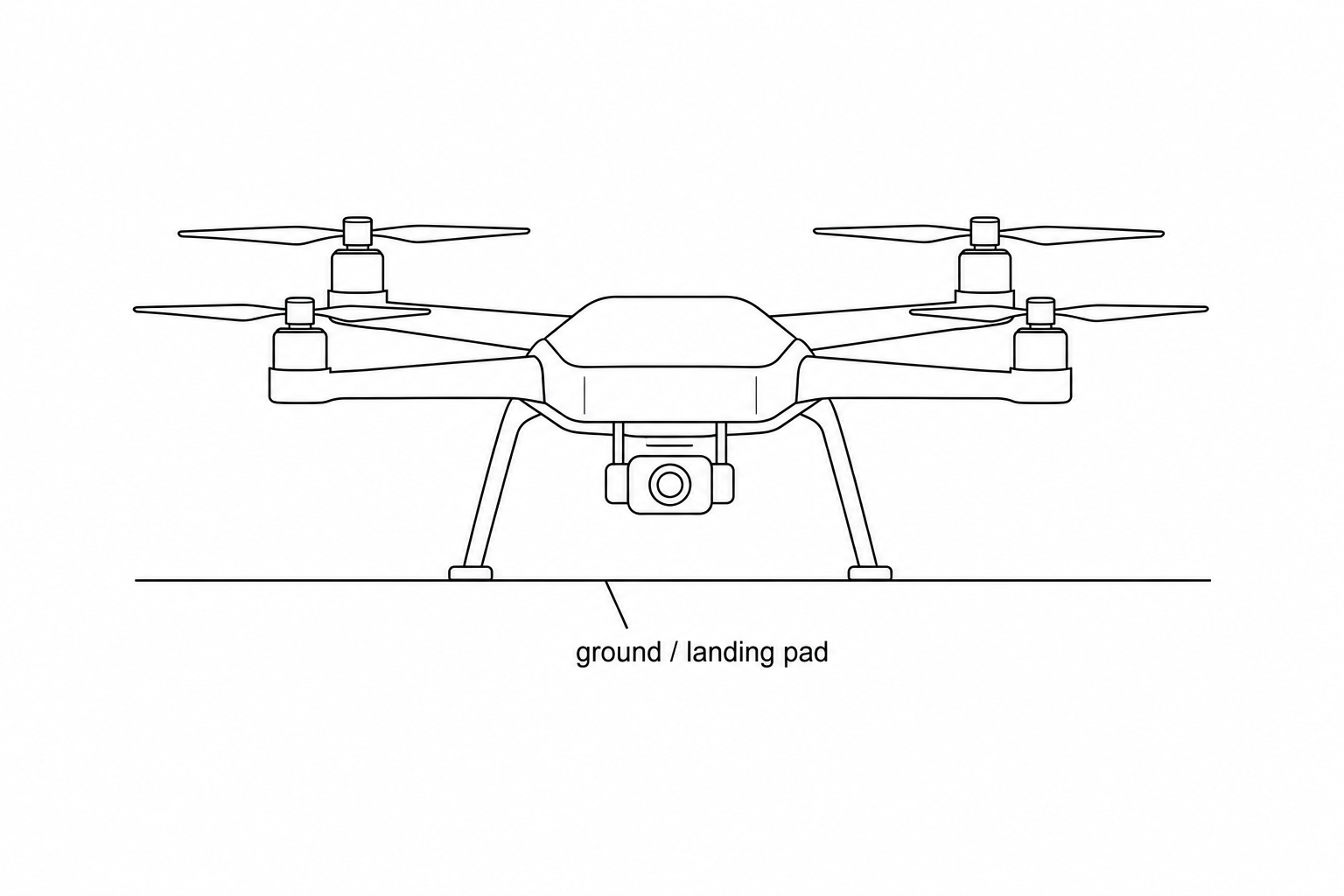
The drone is stationary on the ground.
What are the names of the upwards force and the downwards force on the drone?
Use words from the list:
- normal contact force
- tension
- drag
- weight
Upwards force: ………………………………\dots\dots\dots\dots\dots\dots\dots\dots\dots\dots\dots\dots………………………………
Downwards force: ………………………………\dots\dots\dots\dots\dots\dots\dots\dots\dots\dots\dots\dots………………………………
The drone lifts off the ground when the spinning blades push air downwards.
Explain how Newton's third law applies to the drone as it lifts off.
Use ideas about the force of the blades on the air and the force of the air on the blades.
…………………………………………………………………………………………………………\dots\dots\dots\dots\dots\dots\dots\dots\dots\dots\dots\dots\dots\dots\dots\dots\dots\dots\dots\dots\dots\dots\dots\dots\dots\dots\dots\dots\dots\dots\dots\dots\dots\dots\dots\dots\dots\dots\dots\dots…………………………………………………………………………………………………………
Describe the conditions needed for the drone to accelerate upwards.
Use ideas about the upwards force (lift) and the downwards force (weight).
…………………………………………………………………………………………………………\dots\dots\dots\dots\dots\dots\dots\dots\dots\dots\dots\dots\dots\dots\dots\dots\dots\dots\dots\dots\dots\dots\dots\dots\dots\dots\dots\dots\dots\dots\dots\dots\dots\dots\dots\dots\dots\dots\dots\dots…………………………………………………………………………………………………………
The drone has a mass of 1.8 kg1.8\text{ kg}1.8 kg and rises a vertical distance of 50 m50\text{ m}50 m.
Calculate the gravitational potential energy gained by the drone.
Use the equation: gravitational potential energy=mass×gravitational field strength×height\text{gravitational potential energy} = \text{mass} \times \text{gravitational field strength} \times \text{height}gravitational potential energy=mass×gravitational field strength×height
Gravitational field strength = 10 N/kg10\text{ N/kg}10 N/kg
Gravitational potential energy = ………………………………\dots\dots\dots\dots\dots\dots\dots\dots\dots\dots\dots\dots……………………………… J\text{J}J
A different model drone does 8400 J8400\text{ J}8400 J of work in 6 seconds6\text{ seconds}6 seconds when it rises upwards.
Calculate the power of this drone.
Use the equation: power=work donetime\text{power} = \frac{\text{work done}}{\text{time}}power=timework done
Include the correct unit.
Power = ………………\dots\dots\dots\dots\dots\dots……………… ……………\dots\dots\dots\dots\dots…………… Unit …………\dots\dots\dots\dots…………
A student writes a summary about gravitational fields.
The student has made two mistakes in their summary.
Gravitational Fields
Only large objects have a gravitational field.
Gravitational fields cause repulsion.
More massive objects have a greater gravitational field strength.
Identify the two mistakes and write down the correct word or phrase for each mistake.
Mistake 1: ………………………\dots\dots\dots\dots\dots\dots\dots\dots\dots……………………… ………………\dots\dots\dots\dots\dots\dots………………
Correct word/phrase 1: ………………………………………………\dots\dots\dots\dots\dots\dots\dots\dots\dots\dots\dots\dots\dots\dots\dots\dots\dots\dots………………………………………………
Mistake 2: ………………………………………\dots\dots\dots\dots\dots\dots\dots\dots\dots\dots\dots\dots\dots\dots\dots………………………………………
Correct word/phrase 2: ………………………………………………\dots\dots\dots\dots\dots\dots\dots\dots\dots\dots\dots\dots\dots\dots\dots\dots\dots\dots………………………………………………