Question 10
HA student investigates collisions between trolleys on a straight, horizontal track.
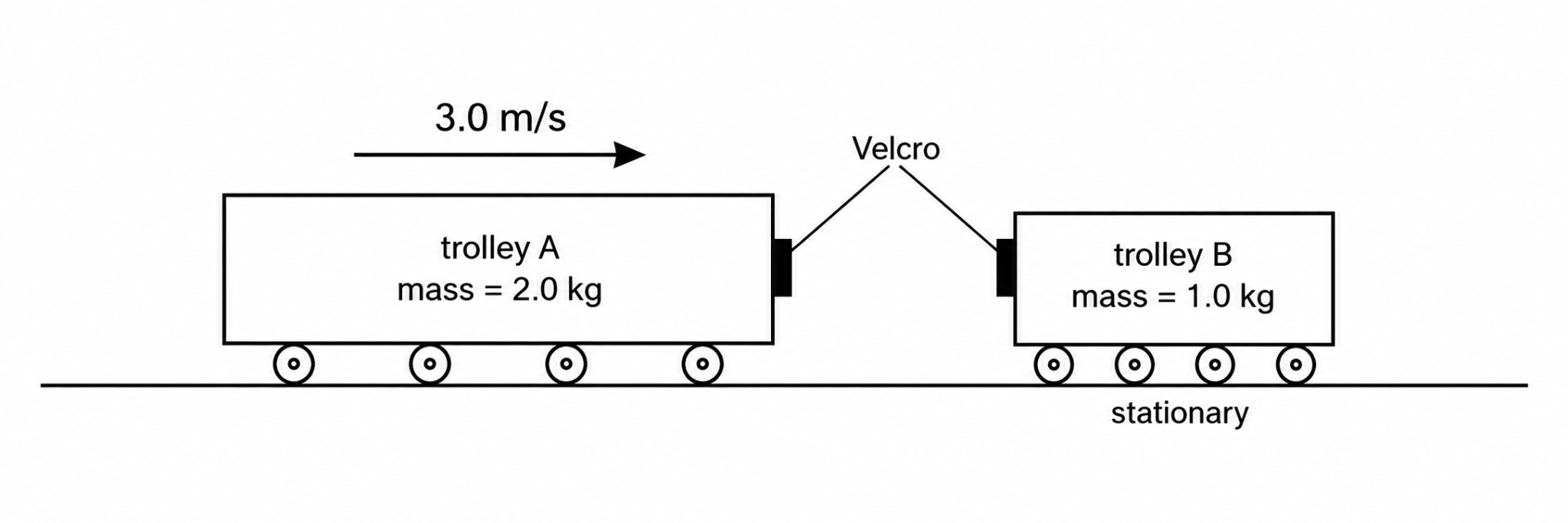
The Figure shows trolley A moving towards trolley B. Trolley B is stationary.
Figure
a.[1]
State the law of conservation of momentum.
b.[3]
Trolley A hits trolley B. The two trolleys stick together and move off together.
Calculate the velocity of the two trolleys after the collision.
c.[3]
The student then uses two different trolleys, C and D. Both trolleys are at rest, held together with a compressed spring between them.
The spring is released and the trolleys move apart.
Trolley C has a mass of 2.0 kg and moves to the left at 0.40 m/s. Trolley D has a mass of 0.50 kg.
Calculate the velocity of trolley D.
2.2 Newton’s laws Questions
50 exam-style questions on OCR GCSE Physics 2.2 Newton’s laws, covering 2.2.1 Interactions between objects, 2.2.2 Force pairs in interactions, 2.2.3 Forces as vectors, 2.2.4 Newton's first law, 2.2.5 Resolving forces with vector diagrams, 2.2.6 Forces acting on an isolated object, 2.2.7 Free body diagrams and resultant force, 2.2.8 Free body diagrams for balanced forces, 2.2.9 Newton's second law, 2.2.10 Inertia and inertial mass, 2.2.11 Momentum in collisions, 2.2.12 Relating force, mass, velocity and acceleration, 2.2.13 Work done by a force, 2.2.14 Work, stored energy and units of energy, 2.2.15 Power as the rate of energy transfer, 2.2.16 Newton's third law, and 2.2.17 Circular motion and changing velocity. Each one has a worked solution and a mark scheme showing where the marks go.