Forces that cause rotation
Definition
Pivot
The fixed point about which an object turns.
Definition
Line of action
The straight line along which a force acts.
- A force can make an object turn about a fixed point instead of moving the whole object along.
- The fixed point that an object turns about is called the pivot, or the fulcrum.
- A force produces a turning effect when its line of action does not pass through the pivot.
- A force whose line of action passes directly through the pivot has no turning effect, however large it is.
- Pushing on a door right at its hinges does not open it, because the force acts through the pivot.
- The turning effect of a force is larger when the force is larger or acts further from the pivot.
- The turning effect is greatest when the force acts at right angles to the line joining the point of action to the pivot.
Examples of turning forces
- A door turns about its hinges, which is why the handle is fitted at the edge furthest from them.
- A spanner turns a nut about the centre of the nut, and a longer spanner makes a tight nut easier to loosen.
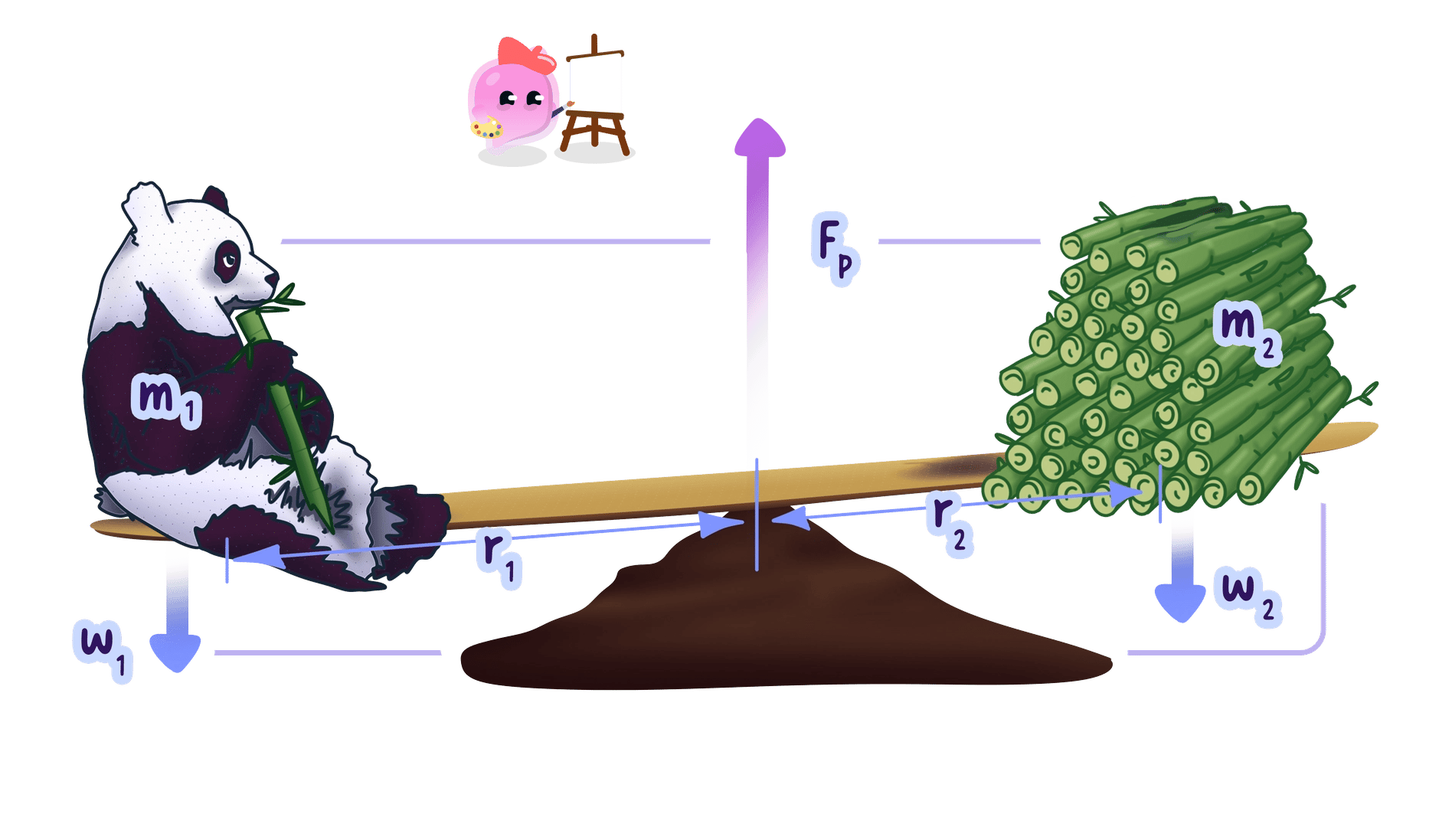
- A seesaw turns about its central support when children sit on either end.
- A bicycle pedal turns the crank about the axle, and pushing down when the crank is horizontal gives the largest turning effect.
- A steering wheel turns about the steering column when you push up on one side and pull down on the other.
- A tap handle, a screwdriver and a bottle cap are all turned by forces acting some distance from their central axis, which is the pivot.
- A wheelbarrow turns about the wheel axle when you lift its handles.
- Scissors and pliers turn about the rivet that joins the two blades or jaws.
Clockwise and anticlockwise turning
- A turning effect acts in one of two directions about a pivot, clockwise or anticlockwise.
- To find the direction, imagine the object is free to turn about the pivot and picture which way the force would swing it.
- Pushing down on the right-hand end of a horizontal seesaw with a central pivot turns it clockwise.
- Pushing down on the left-hand end turns it anticlockwise.
- Pushing up on the right-hand end turns it anticlockwise, because reversing the force reverses the direction of turning.
- When two forces act on an object, one may try to turn it clockwise while the other tries to turn it anticlockwise.
- The object turns in the direction of the larger turning effect, so the resultant turning effect decides which way it rotates.
- If the clockwise and anticlockwise turning effects are equal, there is no resultant turning effect, and the object stays balanced.
Example
Direction of turning on a seesaw
- Two children sit on a seesaw with its pivot at the centre, Amir at the left end and Beth at the right end.
- Amir's weight acts downwards on the left of the pivot, so it tries to turn the seesaw anticlockwise.
- Beth's weight acts downwards on the right of the pivot, so it tries to turn the seesaw clockwise.
- Beth weighs more and both children sit the same distance from the pivot, so her turning effect is larger.
- The resultant turning effect is clockwise, so Beth's end of the seesaw goes down.
Example
Opening a door
- Pushing a door at its handle, far from the hinges and at right angles to the door, turns it open easily.
- Pushing at the same point but along the face of the door towards the hinges does not turn it at all, because the line of action passes through the pivot.
- Pushing at right angles but close to the hinges needs a much larger force to give the same turning effect.
Common Mistake
- Do not assume that a large force always causes rotation, because a force acting through the pivot has no turning effect.
- Do not decide clockwise or anticlockwise from the direction of the force alone, because the same downward force turns a seesaw in opposite directions on opposite sides of the pivot.
- Do not confuse the pivot with the point where the force is applied.
Exam technique
Describing forces that cause rotation
- Name the pivot in every example, such as the hinges of a door or the centre of a nut.
- State the direction of turning as clockwise or anticlockwise, and say which side of the pivot the force acts on.
- When two forces act, compare their turning effects and say which is larger before stating the direction of the resultant turning effect.
- Mention both the size of the force and its distance from the pivot when explaining why one turning effect is larger than another.
Self review
- Define a pivot.
- Explain why pushing a door at its hinges does not open it.
- Identify the pivot when a spanner is used to turn a nut.
- State the direction of turning when you push down on the right-hand end of a seesaw pivoted at its centre.
- Describe how you decide which way an object turns when two forces act on opposite sides of its pivot.
