Definition
Moment
The turning effect of a force about a pivot, equal to the force multiplied by the perpendicular distance from the pivot to the line of action of the force.
Definition
Perpendicular distance
The shortest distance from a pivot to the line of action of a force, measured at right angles to that line.
- The turning effect of a force about a pivot is called the moment of the force.
- The moment depends on the size of the force and on the perpendicular distance from the pivot to the line of action of the force.
- The equation for the moment of a force is one you must recall.
- In words, moment of a force=force×distance\text{moment of a force}=\text{force}\times\text{distance}moment of a force=force×distance, where the distance is measured at right angles to the direction of the force.
- In symbols, the equation is M=FdM=FdM=Fd.
- MMM is the moment in newton metres, N m\text{N}\,\text{m}Nm.
- FFF is the force in newtons, N\text{N}N.
- ddd is the perpendicular distance from the pivot to the line of action of the force, in metres, m\text{m}m.
- Distances given in centimetres must be divided by 100100100 before substituting, so that the moment comes out in newton metres.
- A moment can be increased by using a larger force or by applying the force further from the pivot.
- A 20 N20\ \text{N}20 N push on the end of a spanner 0.25 m0.25\ \text{m}0.25 m long gives a moment of 5 N m5\ \text{N}\,\text{m}5 Nm, while the same push on a spanner 0.50 m0.50\ \text{m}0.50 m long gives 10 N m10\ \text{N}\,\text{m}10 Nm.
- Every moment acts in a direction, which is either clockwise or anticlockwise about the pivot.
The perpendicular distance
- The distance in the moment equation is the shortest distance from the pivot to the line of action of the force.
- When a force acts at right angles to a bar, the perpendicular distance is the distance along the bar from the pivot to the force.
- When a force acts at a slant, the perpendicular distance is shorter than the distance along the bar, so the moment is smaller.
- When the line of action passes through the pivot, the perpendicular distance is zero, so the moment is zero.
- A weight hanging from a horizontal ruler acts vertically downwards, so its perpendicular distance is the horizontal distance from the pivot to the point where it hangs.
The principle of moments
Definition
Principle of moments
For a balanced object, the total clockwise moment about a pivot equals the total anticlockwise moment about the same pivot.
Definition
Equilibrium
The state of an object when the resultant force acting on it is zero.
- An object that is balanced and not turning is in equilibrium.
- For a balanced object, the total clockwise moment about the pivot equals the total anticlockwise moment about the same pivot.
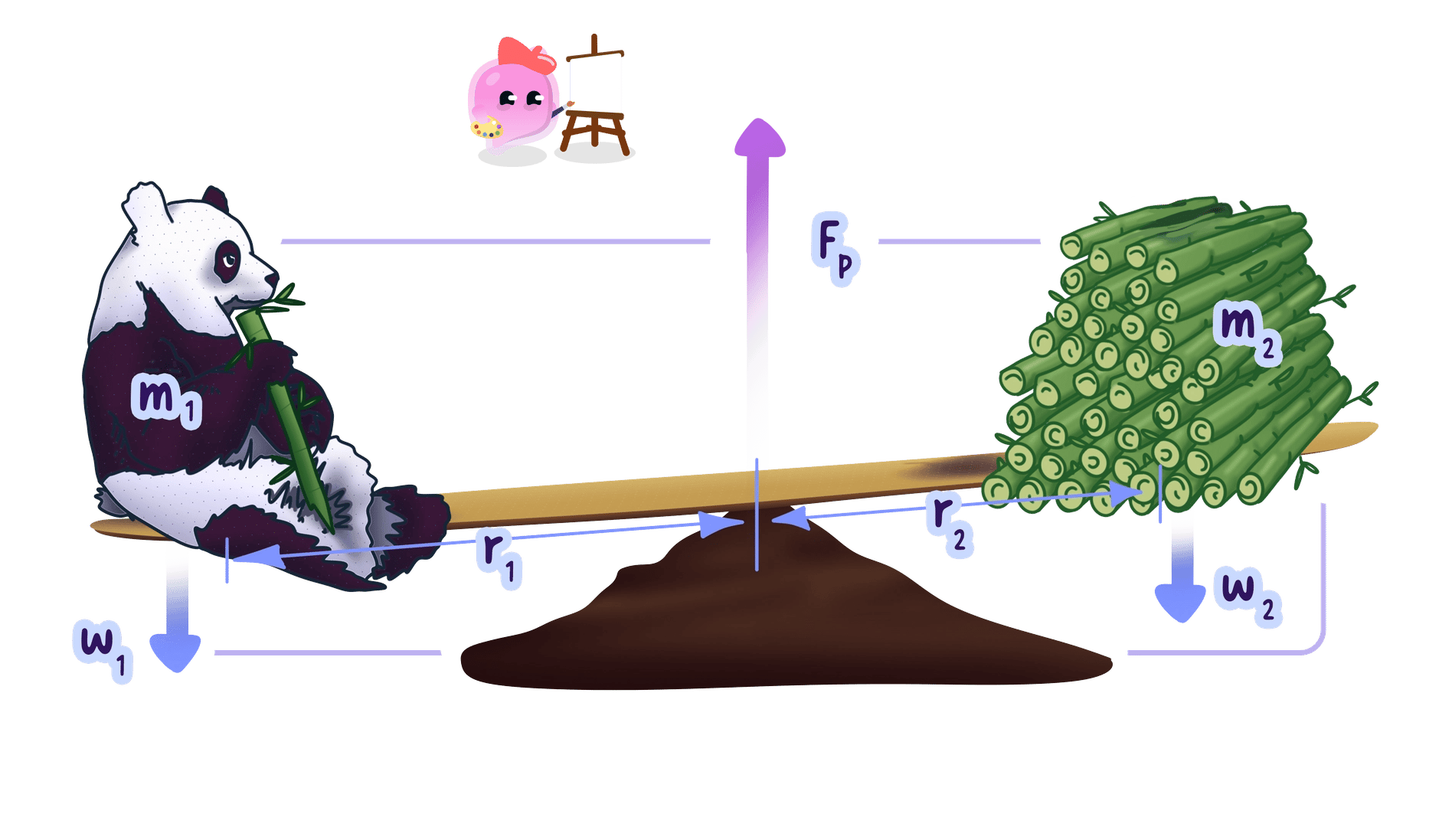
- With one force on each side of the pivot, the principle of moments can be written as F1d1=F2d2F_1d_1=F_2d_2F1d1=F2d2.
- When several forces act on the same side of the pivot, their moments are added to give the total moment on that side.
- If the total clockwise moment is larger than the total anticlockwise moment, the object turns clockwise, and if it is smaller, the object turns anticlockwise.
- The principle of moments lets you find an unknown force or an unknown distance for a balanced object.
- A light child can balance a heavy adult on a seesaw by sitting further from the pivot, because a smaller force multiplied by a larger distance can give the same moment.
Example
Moment on a spanner
- A plumber pushes with a force of 40 N40\ \text{N}40 N at right angles to a spanner, 0.30 m0.30\ \text{m}0.30 m from the centre of the nut.
- The moment of the force about the nut is 12 N m12\ \text{N}\,\text{m}12 Nm.
Example
Distance needed to undo a wheel nut
- A wheel nut needs a moment of 90 N m90\ \text{N}\,\text{m}90 Nm to loosen it, and a mechanic can push with a force of 300 N300\ \text{N}300 N at right angles to the wrench.
- The mechanic must push at least 0.30 m0.30\ \text{m}0.30 m from the centre of the nut.
Example
Balancing a seesaw
- A child weighing 300 N300\ \text{N}300 N sits 2.0 m2.0\ \text{m}2.0 m to the left of a seesaw's central pivot, and an adult weighing 750 N750\ \text{N}750 N sits on the right.
- The adult must sit 0.80 m0.80\ \text{m}0.80 m to the right of the pivot for the seesaw to balance.
Example
Two forces on one side
- A ruler is pivoted at its centre, with a 2.0 N2.0\ \text{N}2.0 N load hung 0.30 m0.30\ \text{m}0.30 m to the left and a 1.0 N1.0\ \text{N}1.0 N load hung 0.10 m0.10\ \text{m}0.10 m to the left.
- A single load is to be hung 0.40 m0.40\ \text{m}0.40 m to the right of the pivot to balance the ruler.
- A load of 1.75 N1.75\ \text{N}1.75 N on the right balances the ruler.
Practical
Investigating moments with a metre ruler
- Aim: to test the principle of moments by balancing a metre ruler on a pivot with loads hung on either side.
- Apparatus: a metre ruler with a hole drilled through its 50 cm50\ \text{cm}50 cm mark, a smooth rod held in a clamp stand to act as the pivot, a G-clamp, two 100 g100\ \text{g}100 g mass hangers with 10 g10\ \text{g}10 g and 50 g50\ \text{g}50 g slotted masses, loops of thin thread, a small lump of modelling clay and a spirit level.
- Variables: the load and its distance on one side are chosen, the distance on the other side is adjusted until the ruler balances, and the ruler and pivot stay the same throughout.
- Method:
- Fix the clamp stand to the bench, push the rod through the hole at the 50 cm50\ \text{cm}50 cm mark and check that the ruler balances level on its own, pressing a small piece of modelling clay onto the lighter end if it does not.
- Hang a 200 g200\ \text{g}200 g load, which has a weight of 2.0 N2.0\ \text{N}2.0 N, from a thread loop at the 30 cm30\ \text{cm}30 cm mark, which is 0.20 m0.20\ \text{m}0.20 m to the left of the pivot.
- Hang a 100 g100\ \text{g}100 g load, which has a weight of 1.0 N1.0\ \text{N}1.0 N, from a thread loop on the right-hand side.
- Slide the right-hand loop along the ruler until the ruler rests level, checking with the spirit level.
- Record each weight and its distance from the pivot, measured from the 50 cm50\ \text{cm}50 cm mark to the thread and converted into metres.
- Calculate the anticlockwise moment and the clockwise moment.
- Repeat with at least five different combinations of loads and positions, including two loads on the same side of the pivot.
- Results: the 2.0 N2.0\ \text{N}2.0 N load at 0.20 m0.20\ \text{m}0.20 m is balanced by the 1.0 N1.0\ \text{N}1.0 N load at about 0.40 m0.40\ \text{m}0.40 m, so both moments are about 0.40 N m0.40\ \text{N}\,\text{m}0.40 Nm, and every other arrangement gives clockwise and anticlockwise moments that agree closely.
- Conclusion: when the ruler is balanced, the total clockwise moment equals the total anticlockwise moment, which supports the principle of moments.
- Watch out: pivot the ruler at its centre so that its own weight acts through the pivot and has no moment, measure each distance to the thread and not to the edge of the hanger, and keep the threads thin and hanging vertically.
- Safety: keep the loads small, hold the ruler steady while adding masses so it does not swing round, and keep your feet clear of the hanging masses.
Common Mistake
- Do not measure the distance from the end of the object, because the distance in a moment is measured from the pivot.
- Do not use a mass in kilograms in the moment equation, because the moment needs the force in newtons.
- Do not confuse moment, measured in N m\text{N}\,\text{m}Nm, with momentum, measured in kg m/s\text{kg}\,\text{m/s}kgm/s.
Exam technique
Moments calculations
- Write M=FdM=FdM=Fd from memory and make clear that ddd is the perpendicular distance from the pivot.
- For a balanced object, write "clockwise moment = anticlockwise moment" as a line of working before you substitute any numbers.
- Convert masses into weights with W=mgW=mgW=mg, and distances into metres, before calculating any moment.
- Give each moment with the unit N m\text{N}\,\text{m}Nm, and state the direction of any resultant moment.
Self review
- Define the moment of a force.
- Write the equation for the moment of a force and give its unit.
- Calculate the moment of a 15 N15\ \text{N}15 N force acting at right angles to a lever 0.40 m0.40\ \text{m}0.40 m from the pivot.
- State the principle of moments.
- Explain why a light child can balance a heavy adult on a seesaw.
