The weight equation
Definition
Weight
The force acting on an object because of gravity, measured in newtons.
Definition
Mass
The amount of matter in an object, measured in kilograms.
- The weight of an object, its mass and the gravitational field strength are linked by an equation you must recall.
- In words, gravitational force=mass×gravitational field strength\text{gravitational force}=\text{mass}\times\text{gravitational field strength}gravitational force=mass×gravitational field strength.
- In symbols, the equation is W=mgW=mgW=mg.
- WWW is the weight, or gravitational force, in newtons, N\text{N}N.
- mmm is the mass in kilograms, kg\text{kg}kg.
- ggg is the gravitational field strength in newtons per kilogram, N/kg\text{N/kg}N/kg.
- Use g=10 N/kgg=10\ \text{N/kg}g=10 N/kg at the Earth's surface unless a question gives a different value.
- Convert a mass in grams into kilograms before substituting, by dividing it by 100010001000.
- A 250 g250\ \text{g}250 g apple has a mass of 0.250 kg0.250\ \text{kg}0.250 kg, so its weight on Earth is 0.250×10=2.5 N0.250\times10=2.5\ \text{N}0.250×10=2.5 N.
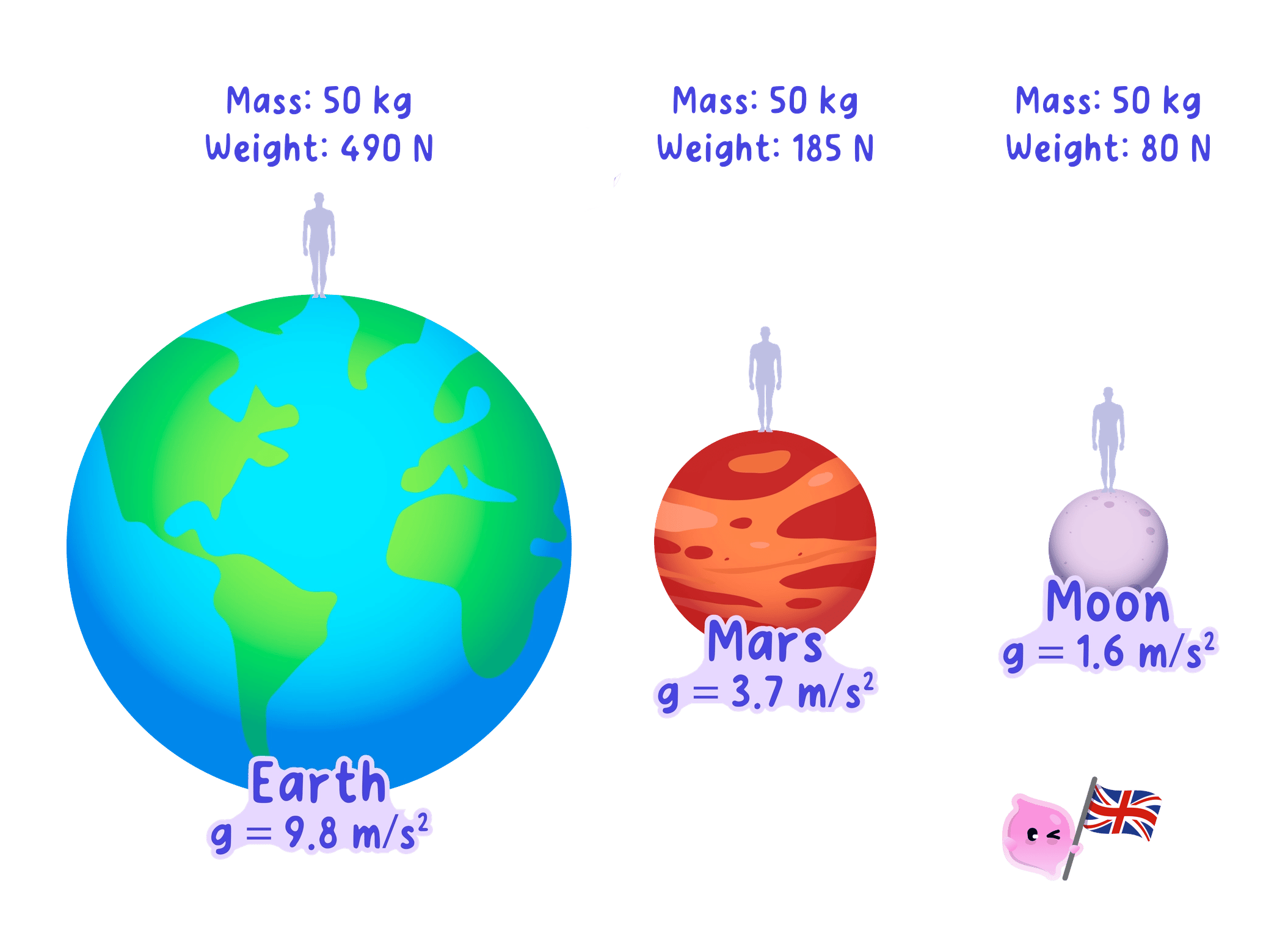
Rearranging the equation
- Rearranging W=mgW=mgW=mg gives m=Wgm=\dfrac{W}{g}m=gW, which finds a mass from a weight.
- Rearranging again gives g=Wmg=\dfrac{W}{m}g=mW, which finds the gravitational field strength from a weight and a mass.
- The equation W=mgW=mgW=mg is F=maF=maF=ma applied to an object in free fall, with the weight as the resultant force and ggg as the acceleration.
How the quantities are inter-related
Definition
Directly proportional
A relationship between two quantities in which multiplying one by a factor multiplies the other by the same factor.
- In W=mgW=mgW=mg, the weight is directly proportional to the mass when ggg stays the same.
- In the same place, a 6 kg6\ \text{kg}6 kg suitcase weighs three times as much as a 2 kg2\ \text{kg}2 kg suitcase.
- The weight is also directly proportional to ggg when the mass stays the same.
- Taking an object from Earth, where ggg is 10 N/kg10\ \text{N/kg}10 N/kg, to Mars, where ggg is 3.7 N/kg3.7\ \text{N/kg}3.7 N/kg, multiplies its weight by 0.370.370.37.
- For a fixed weight, mass and ggg are inversely proportional, so a place with half the field strength needs twice the mass to give the same weight.
- A weight of 1600 N1600\ \text{N}1600 N comes from a mass of 160 kg160\ \text{kg}160 kg on Earth but from a mass of 1000 kg1000\ \text{kg}1000 kg on the Moon, where ggg is 1.6 N/kg1.6\ \text{N/kg}1.6 N/kg.
- The ratio of one object's weights in two places equals the ratio of the field strengths, so W1W2=g1g2\dfrac{W_1}{W_2}=\dfrac{g_1}{g_2}W2W1=g2g1.
- The Moon's field strength is about one sixth of the Earth's, so any object on the Moon weighs about one sixth of its weight on Earth.
Gravitational potential energy
Definition
Gravitational potential energy
The energy held in the gravitational store of an object because of its height in a gravitational field.
- The gravitational field strength also appears in the equation for the energy in an object's gravitational store, which you must recall.
- In words, gravitational potential energy=mass×gravitational field strength×height\text{gravitational potential energy}=\text{mass}\times\text{gravitational field strength}\times\text{height}gravitational potential energy=mass×gravitational field strength×height.
- In symbols, the equation is Ep=mghE_p=mghEp=mgh.
- EpE_pEp is the gravitational potential energy in joules, J\text{J}J.
- mmm is the mass in kilograms, ggg is in newtons per kilogram, and hhh is the height in metres.
- Lifting an object through a height hhh at a steady speed needs a force equal to its weight, mgmgmg, so the work done, and the energy gained by the gravitational store, is mg×hmg\times hmg×h.
- For the same mass and height, the energy is directly proportional to ggg, so lifting a box 1 m1\ \text{m}1 m on the Moon needs about one sixth of the energy needed on Earth.
Example
Weight of a parcel
- A parcel has a mass of 3.2 kg3.2\ \text{kg}3.2 kg and sits on a shelf at the Earth's surface.
- The weight of the parcel is 32 N32\ \text{N}32 N.
Example
Mass from a weight
- A crate is found to weigh 450 N450\ \text{N}450 N on Earth.
- The mass of the crate is 45 kg45\ \text{kg}45 kg.
Example
Weight on the Moon from a weight on Earth
- An astronaut's spacesuit weighs 1200 N1200\ \text{N}1200 N on Earth, and the gravitational field strength on the Moon is 1.6 N/kg1.6\ \text{N/kg}1.6 N/kg.
- The spacesuit has the same mass of 120 kg120\ \text{kg}120 kg on the Moon, but its weight there is only 192 N192\ \text{N}192 N.
Example
Field strength of another planet
- A 2.0 kg2.0\ \text{kg}2.0 kg test mass on a space probe's arm weighs 7.4 N7.4\ \text{N}7.4 N on the surface of a planet.
- The gravitational field strength at the planet's surface is 3.7 N/kg3.7\ \text{N/kg}3.7 N/kg, which matches the value for Mars.
Example
Energy gained by a lifted bag
- A 0.60 kg0.60\ \text{kg}0.60 kg school bag is lifted from the floor onto a desk 1.5 m1.5\ \text{m}1.5 m higher.
- The gravitational store of the bag gains 9.0 J9.0\ \text{J}9.0 J.
Common Mistake
- Do not substitute a mass in grams into W=mgW=mgW=mg, because the mass must be in kilograms.
- Do not change the mass when an object moves to another planet, because only its weight changes.
- Do not confuse the gravitational field strength, ggg, with the abbreviation g\text{g}g for grams.
Exam technique
Calculations with gravitational field strength
- Write W=mgW=mgW=mg or Ep=mghE_p=mghEp=mgh from memory before substituting, because recalling these equations is part of what is assessed.
- In a two-step question, find the mass from the weight in one place first, then use it with the new value of ggg.
- When asked how one quantity changes as another changes, use proportional reasoning, such as "ggg is halved so the weight is halved", and support it with numbers.
- Give every answer with its unit, using newtons for weight, kilograms for mass and newtons per kilogram for field strength.
Self review
- Write the equation that links weight, mass and gravitational field strength.
- Calculate the weight on Earth of a 750 g750\ \text{g}750 g book.
- Calculate the mass of an object that weighs 85 N85\ \text{N}85 N on Earth.
- Describe what happens to an object's weight on a planet where the gravitational field strength is three times larger than on Earth.
- Calculate the gravitational potential energy gained by a 2.0 kg2.0\ \text{kg}2.0 kg bag lifted through 1.2 m1.2\ \text{m}1.2 m.
