Charging by friction
Definition
Charging by friction
The process in which rubbing two insulators together transfers electrons from one surface to the other, leaving them with equal and opposite charges.
Definition
Conservation of charge
The principle that charge cannot be created or destroyed, only moved from one place to another.
- Static electricity is explained by the movement of electrons, the negatively charged particles in the outer part of every atom.
- The protons carry the positive charge, but they are held inside the nucleus at the centre of each atom, so rubbing cannot move them.
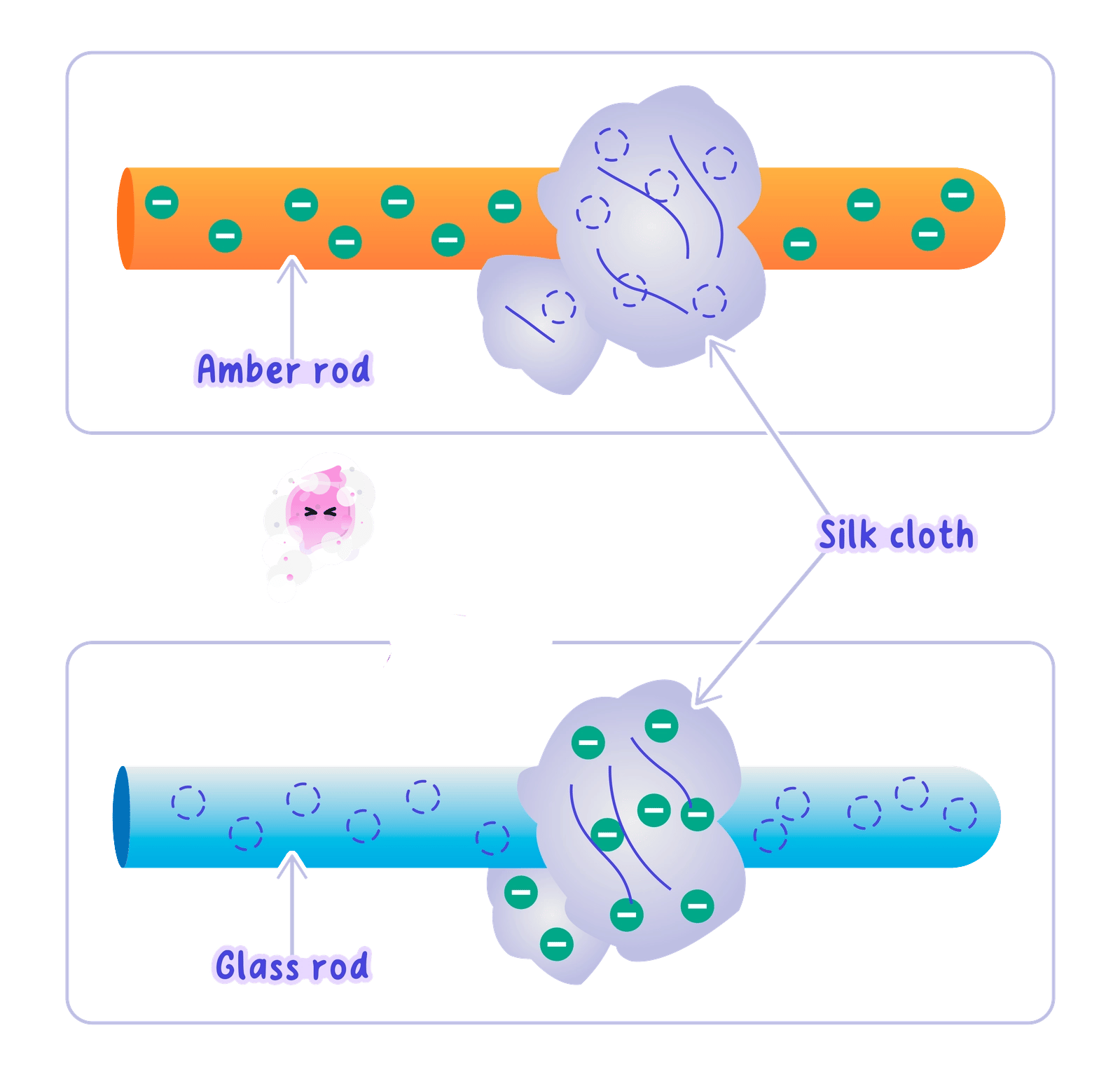
- When two different insulators are rubbed together, friction pulls some electrons off the surface atoms of one material and onto the surface of the other.
- Different materials hold on to their electrons with different strengths, so the material that holds its electrons less tightly loses electrons and the other material gains them.
- The material that gains electrons now has more electrons than protons, so it becomes negatively charged.
- The material that loses electrons now has fewer electrons than protons, so it is left positively charged.
- A positive charge is therefore caused by a shortage of electrons, never by extra protons.
- Every electron that leaves one surface arrives on the other, so the two objects gain charges that are equal in size and opposite in type.
- Charge is moved but not made or destroyed, so the total charge of the two objects is still zero after rubbing, just as it was before.
- The direction of electron transfer depends on the pair of materials, so the same cloth can make a polythene rod negative but an acetate rod positive.
Example
Charging a polythene rod and an acetate rod
- A neutral polythene rod is rubbed with a neutral woollen cloth, and 500500500 electrons move from the cloth onto the rod.
- The rod now has 500500500 more electrons than protons, so its net charge is −500-500−500 units and it is negatively charged.
- The cloth now has 500500500 fewer electrons than protons, so its net charge is +500+500+500 units and it is positively charged.
- The total is still zero, which shows that charge has been transferred, not created.
- When an acetate rod is rubbed with the same cloth, electrons move the other way, from the rod onto the cloth.
- The acetate rod has lost electrons, so it becomes positively charged, and the cloth has gained them, so it becomes negatively charged.
Why only insulators hold static charge
- In an insulator, electrons cannot move freely through the material, so electrons gained by rubbing stay on the patch of surface where they arrived.
- In the same way, a patch of an insulator that has lost electrons cannot quickly get them back from the rest of the material.
- In a metal, some electrons are free to move through the whole object.
- If a metal rod held in your hand gains electrons, they spread through the metal, into your hand and through your body to the ground, so the rod is left neutral.
- If the metal rod loses electrons, electrons flow up from the ground through your body to replace them, so again the rod is left neutral.
- A metal object standing on an insulating support keeps its charge, because the electrons have no path to or from the ground.
Discharging and sparks
Definition
Discharge
The removal of the charge on an object as electrons flow onto it or away from it.
Definition
Earthing
Connecting an object to the ground with a conductor so that electrons can flow between the object and the Earth until the object is neutral.
- A charged object loses its charge when electrons flow onto it or away from it until its numbers of protons and electrons are equal again.
- A negatively charged object is discharged when its extra electrons flow away from it.
- A positively charged object is discharged when electrons flow onto it to make up the shortage.
- Connecting a charged conductor to the ground with a metal wire is called earthing.
- The Earth is so large that it can give or take any number of electrons without its own charge changing noticeably.
- When a negatively charged object is earthed, electrons flow from the object to the Earth.
- When a positively charged object is earthed, electrons flow from the Earth to the object.
- A spark is a burst of electrons crossing an air gap when a large charge has built up on an object.
- If your body is negatively charged, the extra electrons jump from your fingertip to a metal door handle as you reach for it.
- If your body is positively charged, electrons jump the other way, from the handle to your fingertip.
- Either way, the flow of electrons stops as soon as your body is neutral again, which is why a static shock lasts only an instant.
Attracting neutral objects
- A charged object can also attract a neutral object, such as a rubbed balloon sticking to a wall or a charged comb picking up scraps of paper.
- When a negatively charged balloon is held near a wall, it repels electrons in the surface of the wall, pushing them a tiny distance away from the balloon.
- The surface of the wall nearest the balloon is left with a small positive charge, while the displaced electrons sit slightly further away.
- The balloon attracts the nearby positive charge more strongly than it repels the more distant negative charge, because the electrostatic force is stronger over shorter distances.
- The overall force is therefore attraction, and the balloon sticks to the wall.
- A positively charged object attracts a neutral object in the same way, except that it pulls electrons in the surface towards itself.
- The wall as a whole stays neutral, because no electrons have left it and they have only shifted slightly within it.
Example
Hair standing on end after a plastic slide
- A child slides down a plastic slide, and friction transfers electrons from the child's clothes onto the plastic.
- The child has lost electrons, so the child is left positively charged, and the slide has gained the same number of electrons.
- The charge spreads over the child's body, so every strand of hair carries positive charge.
- Like charges repel, so the strands push away from each other and the hair stands on end.
- When the child grabs a metal rail that is connected to the ground, electrons flow from the Earth onto the child.
- The shortage of electrons is made up, the child becomes neutral again and the hair falls back down.
Common Mistake
- Do not say a positive object has gained protons, because protons stay in the nucleus and only electrons move.
- Do not say positive charge moves from one object to another, because the moving charge is always carried by electrons.
- Do not say rubbing creates electrons, because every electron gained by one object was lost by the other.
- Do not say the wall becomes charged when a balloon sticks to it, because its electrons only shift slightly and its net charge stays zero.
Exam technique
Explaining static with electrons
- State the direction in which electrons move, for example “electrons move from the cloth to the rod”.
- Link each charge to that movement, using gains electrons for a negative object and loses electrons for a positive object.
- Say that the two charges are equal and opposite, because the number of electrons lost by one object equals the number gained by the other.
- For a discharge, say which way the electrons flow, to the Earth or from the Earth, rather than writing that “the charge disappears”.
Self review
- Name the particle that is transferred when two insulators are rubbed together.
- Explain why an object that loses electrons becomes positively charged.
- Explain why two objects rubbed together always gain equal and opposite charges.
- Describe the direction of electron flow when a negatively charged object is earthed.
- Explain why a negatively charged balloon is attracted to a neutral wall.
