Charging by rubbing
Definition
Static electricity
Electric charge that builds up on the surface of an insulator and stays there instead of flowing away.
Definition
Electrical insulator
A material that does not allow electric charge to flow through it.
Definition
Electrical conductor
A material that allows electric charge to flow through it easily.
- When two different materials are rubbed together, charge is moved from one surface to the other, so both surfaces become charged.
- The two objects always end up with opposite charges, so one becomes positively charged and the other becomes negatively charged.
- Charge that builds up on a surface and stays there is called static electricity, because it stays in one place instead of flowing.
- Rubbing does not make new charge, it only separates charge that was already in the two materials.
- Familiar examples include a balloon rubbed on dry hair, a plastic comb pulled through hair, a polythene rod rubbed with a duster and a jumper pulled off over your head.
- Walking across a nylon carpet in rubber-soled trainers charges your body, and sliding across a car seat charges both you and the seat.
- Static charge only builds up on insulators, such as plastic, rubber, glass, wool, nylon and dry hair.
- In an insulator, charge cannot move through the material, so it stays on the patch of surface where the rubbing put it.
- In a conductor, such as a metal, charge moves freely through the material.
- If you rub a metal rod held in your hand, any charge on it flows through the metal and through your body to the ground, so no charge builds up.
- A metal object can only hold static charge if it is insulated from the ground, for example by standing it on a plastic block.
- Static effects are strongest on dry days, because in damp air a thin film of water forms on surfaces and lets the charge leak away.
Forces between charged objects
Definition
Electrostatic force
The non-contact force of attraction or repulsion that acts between charged objects.
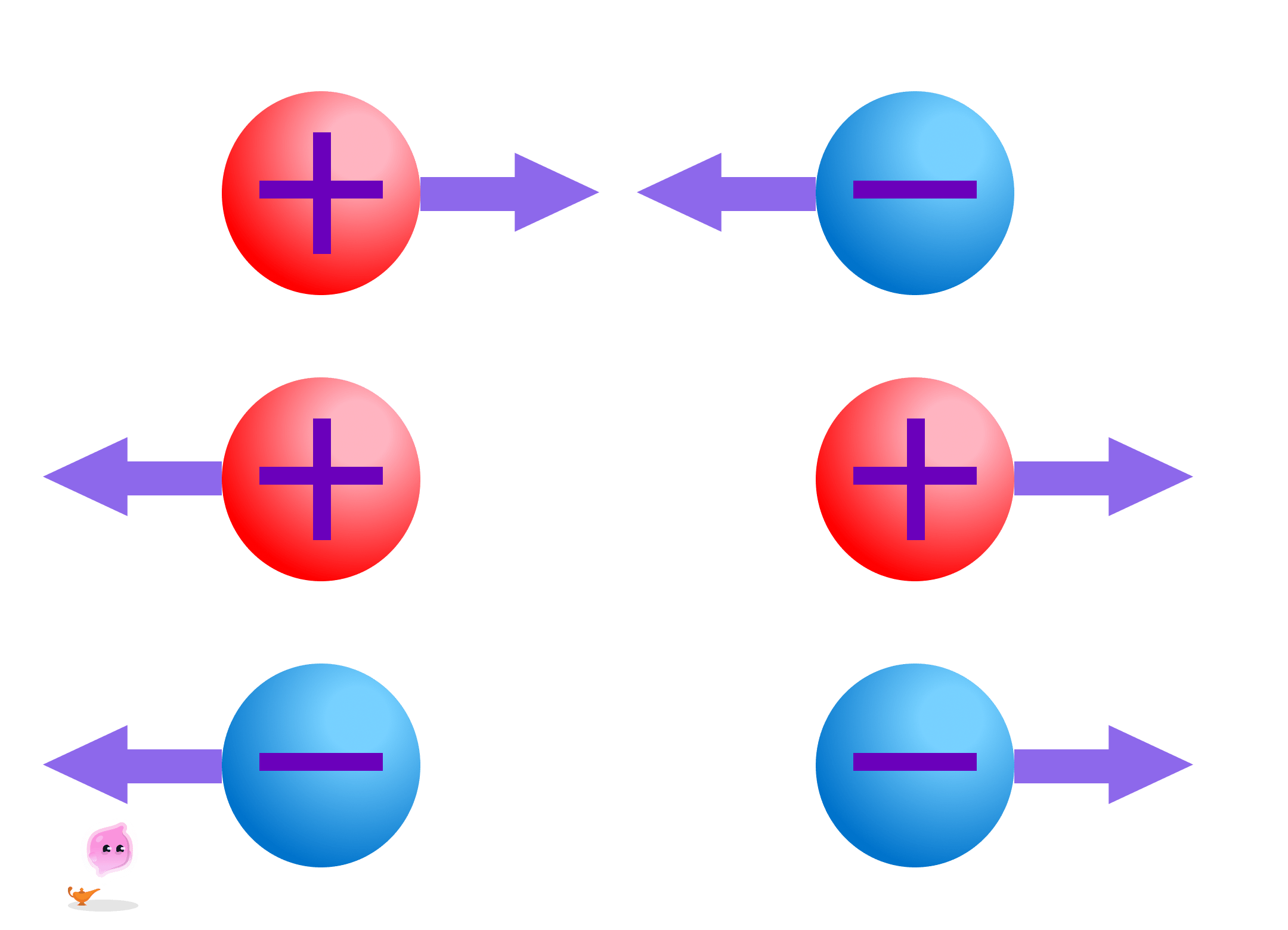
- Charged objects push or pull on each other, and this push or pull is called the electrostatic force.
- Objects with the same type of charge, called like charges, repel each other.
- Two positively charged objects repel, and two negatively charged objects repel.
- Objects with different types of charge, called unlike charges, attract each other.
- A positively charged object and a negatively charged object attract.
- The electrostatic force is a non-contact force, which means it acts across a gap without the objects touching.
- The force is larger when the charged objects are closer together and becomes weaker as they move apart.
- The force is also larger when the objects carry more charge.
- The evidence that charged objects exert forces without contact comes from seeing them move before they touch.
- A rubbed balloon held a few centimetres above small pieces of paper makes them jump up to it before the balloon reaches them.
- Strands of hair lift towards a rubbed balloon held just above your head, even though the balloon does not touch the hair.
- A thin, smooth stream of water from a tap bends sideways towards a charged comb held close to it.
- A rubbed rod hanging from a thread swings round when another charged rod is brought near it, even though there is a clear gap between the rods.
- In each case an object starts to move across a gap, and a change in motion needs a force, so a force must be acting at a distance.
Practical
Investigating forces between charged rods
- Aim: to show that charged objects exert forces on each other without touching, and to find which pairs of charged rods attract and which repel.
- Apparatus: two polythene rods, two cellulose acetate rods, a dry woollen or cotton cloth, a paper stirrup, a length of nylon thread, a clamp stand with a boss and clamp.
- Method, setting up:
- Tie the nylon thread to the clamp so that the paper stirrup hangs freely about 30 cm30\ \text{cm}30 cm below it, well away from walls, metal objects and draughts.
- Check that the rods and the cloth are clean and completely dry, and warm them gently near a radiator if the room is damp.
- Hold the first polythene rod by one end only and rub the other end firmly with the cloth, stroking about twenty times in the same direction.
- Lay the rod in the stirrup without touching the rubbed end, so that it hangs level and can turn freely, then wait until it stops swinging.
- Method, testing the pairs:
- Rub the second polythene rod in exactly the same way, then bring its rubbed end slowly towards the rubbed end of the hanging rod.
- Stop when the ends are about 2 cm2\ \text{cm}2 cm apart, never letting them touch, and watch which way the hanging rod turns.
- Record whether the hanging rod turns towards the second rod or away from it.
- Repeat the test with a rubbed acetate rod brought towards the hanging polythene rod.
- Replace the hanging rod with a rubbed acetate rod and test it first with the second acetate rod and then with a polythene rod.
- Finally, bring the cloth that was used to rub the hanging rod towards it and note the movement.
- Repeat every test at least twice, recharging the rods each time, to check that the movement is the same.
- Results: two polythene rods repel, two acetate rods repel, a polythene rod and an acetate rod attract, and the cloth attracts the rod it rubbed.
- Conclusion: rubbing with a cloth leaves polythene negatively charged and acetate positively charged, so like charges repel and unlike charges attract.
- Evidence of a non-contact force: the hanging rod starts to turn while there is still a gap between the rods, so the force acts without contact.
- Watch out: damp rods or a damp cloth let the charge leak away, touching the rubbed end removes charge, and draughts can turn the stirrup, so shield it from moving air.
- Safety: this investigation is low risk, but keep the rods well away from faces while rubbing them and clamp the stand firmly so that it cannot tip over.
Example
Charging a balloon on your hair
- A balloon is rubbed several times on clean, dry hair.
- Both the rubber of the balloon and the hair are insulators, so the charge moved by rubbing stays on their surfaces.
- The balloon and the hair end up with opposite charges.
- Every strand of hair carries the same type of charge, so neighbouring strands repel each other and the hair spreads out and stands up.
- When the balloon is held a few centimetres above the head, the hair lifts towards it, because unlike charges attract.
- The hair moves before the balloon touches it, which shows that the electrostatic force acts across a gap.
Sparking
Definition
Spark
A sudden flow of charge through the air from a highly charged object, seen as a flash of light and heard as a crack.
- The longer and harder an insulator is rubbed, the more charge builds up on it.
- When a large charge has built up, it can suddenly jump across an air gap to a nearby conductor, such as a metal tap, radiator or door handle.
- This sudden flow of charge through the air is a spark, and it gives out light and a crackling sound.
- Air is normally an insulator, but a large build-up of charge can make the air conduct for an instant so that the charge crosses the gap.
- The bigger the charge, the wider the gap that the spark can jump.
- Sparks usually jump just before contact, which is why you feel a sharp shock when your fingertip is a few millimetres from a metal door handle after walking across a nylon carpet.
- Pulling off a synthetic jumper in a dark room often produces tiny sparks that you can see and hear crackling.
- Lightning is the same effect on a huge scale, when charge built up in a thundercloud jumps through the air to the ground or to another cloud.
Example
A shock from a car door
- A passenger slides across a fabric car seat while wearing a nylon coat, and the rubbing charges the passenger.
- The passenger is standing in rubber-soled shoes, which are insulators, so the charge cannot flow away to the ground.
- As the passenger reaches for the metal door frame, the fingertip gets very close to a conductor.
- The charge jumps across the last few millimetres of air as a spark.
- The passenger hears a crack and feels a small shock, and after the spark the passenger is no longer charged.
Common Mistake
- Do not say that rubbing creates charge, because rubbing only moves charge that was already in the materials from one surface to the other.
- Do not say that metals can never be charged, because a metal standing on an insulating block can hold charge, while a metal held in your hand cannot.
- Do not say that charged objects have to touch to attract or repel, because the electrostatic force acts across a gap.
Exam technique
Describing evidence for electrostatic forces
- Describe what moves and in which direction, such as “the hanging rod turns away from the other rod”.
- Add that the movement happens before the objects touch, because this is the part that shows the force is non-contact.
- Finish with the rule that explains the direction: like charges repel or unlike charges attract.
- When explaining why a metal held in the hand does not become charged, say that the charge flows through the metal and your body to the ground.
Self review
- Explain why static charge builds up on insulators but not on a metal held in your hand.
- State what happens when two objects with like charges are brought close together.
- Describe one observation showing that charged objects exert a force on each other without touching.
- Explain why a spark is more likely after walking across a nylon carpet than after walking across a damp floor.
- A rubbed polythene rod repels a second rubbed polythene rod but attracts a rubbed acetate rod. State what this shows about their charges.
