What an electric field is
Definition
Electric field
A region around a charged object in which another charged object experiences a force.
- Every charged object is surrounded by an electric field, a region of space in which any other charged object feels a force.
- The field is there whether or not a second charge is present, and a second charged object placed in it shows up the field by being pushed or pulled.
- The field explains how charged objects can affect each other without touching, because each object is acted on by the field of the other.
- The field is strongest close to the charged object and gets weaker with distance, so a charge feels a larger force the closer it is.
- An object carrying more charge produces a stronger field, so it exerts a larger force on a charge at the same distance.
- A positive charge placed in a field is pushed in the direction of the field.
- A negative charge, such as an electron, is pushed in the opposite direction to the field.
- An uncharged particle, such as a neutron, feels no force in an electric field.
- Electric fields are invisible, so their shape and direction are shown on diagrams using field lines.
Drawing electric field patterns
Definition
Electric field line
A line showing the direction of the force that a small positive charge would experience at each point in an electric field.
Definition
Uniform electric field
An electric field that has the same strength and direction at every point, shown by parallel, equally spaced field lines.
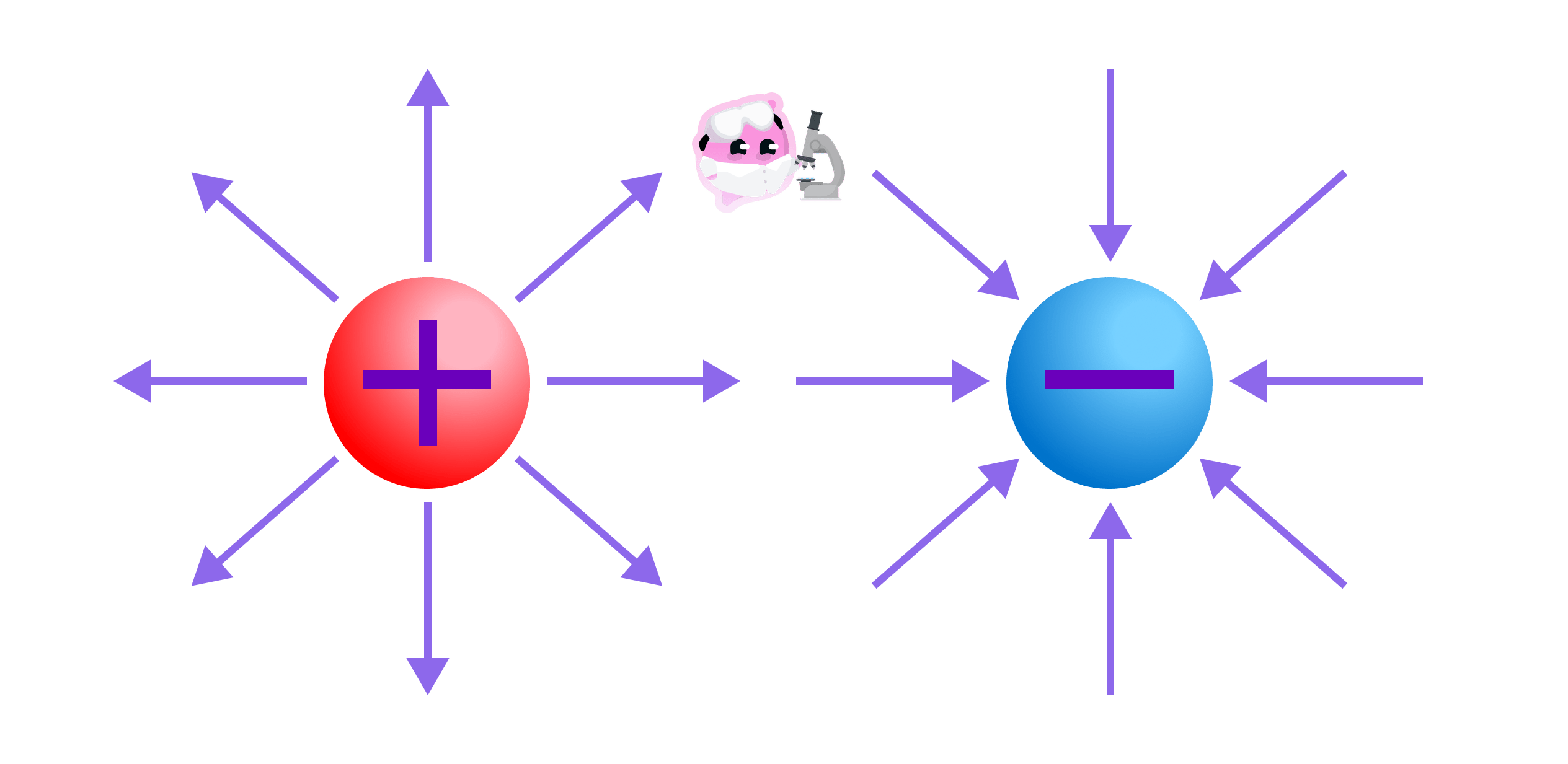
- A field line shows the direction of the force on a small positive charge placed at that point, and an arrow on the line shows that direction.
- Field lines point away from positive charges and towards negative charges.
- Around an isolated charged sphere, the field lines are straight and radial, spreading out from the centre like the spokes of a bicycle wheel.
- For a positively charged sphere the arrows point outwards, and for a negatively charged sphere they point inwards.
- Where field lines are close together the field is strong, and where they are spread out the field is weak.
- Radial field lines spread apart as they get further from the sphere, which shows the field becoming weaker with distance.
- Field lines never cross, because a charge at any point can only be pushed in one direction.
- Between two parallel metal plates with opposite charges, the field lines are straight, parallel and equally spaced, running from the positive plate to the negative plate.
- This is a uniform field, so a charge between the plates feels the same force wherever it is placed.
- A positively charged particle between the plates is pushed along the field lines towards the negative plate.
- A negatively charged particle, such as an electron, is pushed against the field lines towards the positive plate.

Example
Reading forces from a field diagram
- Two horizontal metal plates are connected so that the top plate is positive and the bottom plate is negative.
- The field lines run straight down from the top plate to the bottom plate, so the field points downwards.
- A proton placed between the plates is positive, so it is pushed downwards, along the field, towards the negative plate.
- An electron placed between the plates is negative, so it is pushed upwards, against the field, towards the positive plate.
- The lines are parallel and evenly spaced, so each particle feels the same size of force anywhere between the plates.
- A neutron placed between the plates has no charge, so it feels no force and stays where it is.
How fields explain static effects
- Two charged objects each sit in the field of the other, so each one feels a force.
- Near two positive objects, the field of each object points away from it, and the other positive object is pushed along that field, so the objects are pushed apart.
- Near two negative objects, the field of each object points towards it, and the other negative object is pushed against that field, so these objects are also pushed apart.
- Near a positive and a negative object, the field of the positive object points away from it, and the negative object is pushed against that field, so it is pulled towards the positive object.
- These field rules give the same results as like charges repel and unlike charges attract, and they also explain how the force reaches across the gap.
- The field also explains why the force between charged objects weakens as they move apart, because each object is then in a weaker part of the other's field.
- The same field acts on the electrons inside a nearby neutral object, which is how a charged balloon can attract an uncharged wall or scraps of paper.
- Fields explain sparking too, because as more charge builds up on an object, the field near its surface becomes stronger.
- When the field is strong enough, it pulls electrons off the air molecules near the object, and the air is then able to conduct.
- Charge rushes across the gap as a spark, with a flash of light and a crack.
- A spark only jumps from your hand to a door handle once your hand is very close, because the field in a small gap is much stronger than the field across a wide gap.
Example
Two balloons pushing apart
- Two balloons hang side by side on threads after both have been rubbed on the same woollen jumper.
- Each balloon gains electrons from the jumper, so both balloons are negatively charged.
- Each balloon has an electric field around it that points towards the balloon.
- Each balloon sits in the field of the other, and a negative charge is pushed against the field direction.
- Each balloon is therefore pushed away from the other, and the threads hang apart at an angle.
- Pushing the tops of the threads closer together moves each balloon into a stronger part of the other's field, so the repulsion increases and the balloons swing further apart.
Common Mistake
- Do not draw field lines pointing towards a positive charge, because field lines always point away from positive charges and towards negative charges.
- Do not let field lines cross, because a charge can only be pushed in one direction at any point.
- Do not describe the field as a substance given off by the object, because it is a region in which a charge feels a force.
- Do not move a negative charge along the field lines, because a negative charge is pushed against the field direction.
Exam technique
Explaining static effects with fields
- Start by saying that the charged object has an electric field around it.
- Then say that the other charged object is in that field and so experiences a force.
- Give the direction of the force, using either the field direction or the rule like charges repel, unlike charges attract.
- When drawing the field around a charged sphere, draw at least eight straight lines evenly spaced around it with a ruler, and put an arrow on every line.
- For a question about sparks, link a large charge to a strong field, and the strong field to the air conducting.
Self review
- Define an electric field.
- State the direction of the field lines around a negatively charged sphere.
- Describe how the spacing of field lines shows where a field is strongest.
- Explain, using fields, why two positively charged objects repel.
- Explain how a strong electric field near a charged object can produce a spark.
