6.2.4a Uses and applications of electromagnetic waves
Each band of the spectrum is matched to the job its properties suit
Definition
Application
An application is a practical use of an electromagnetic wave, chosen because that band interacts with materials in a way that suits the task.
- Different parts of the electromagnetic spectrum are useful for different jobs because they have different wavelengths and frequencies, so they interact with matter in different ways.
- For each use, learn the pairing of wave and application so you can match either to the other.
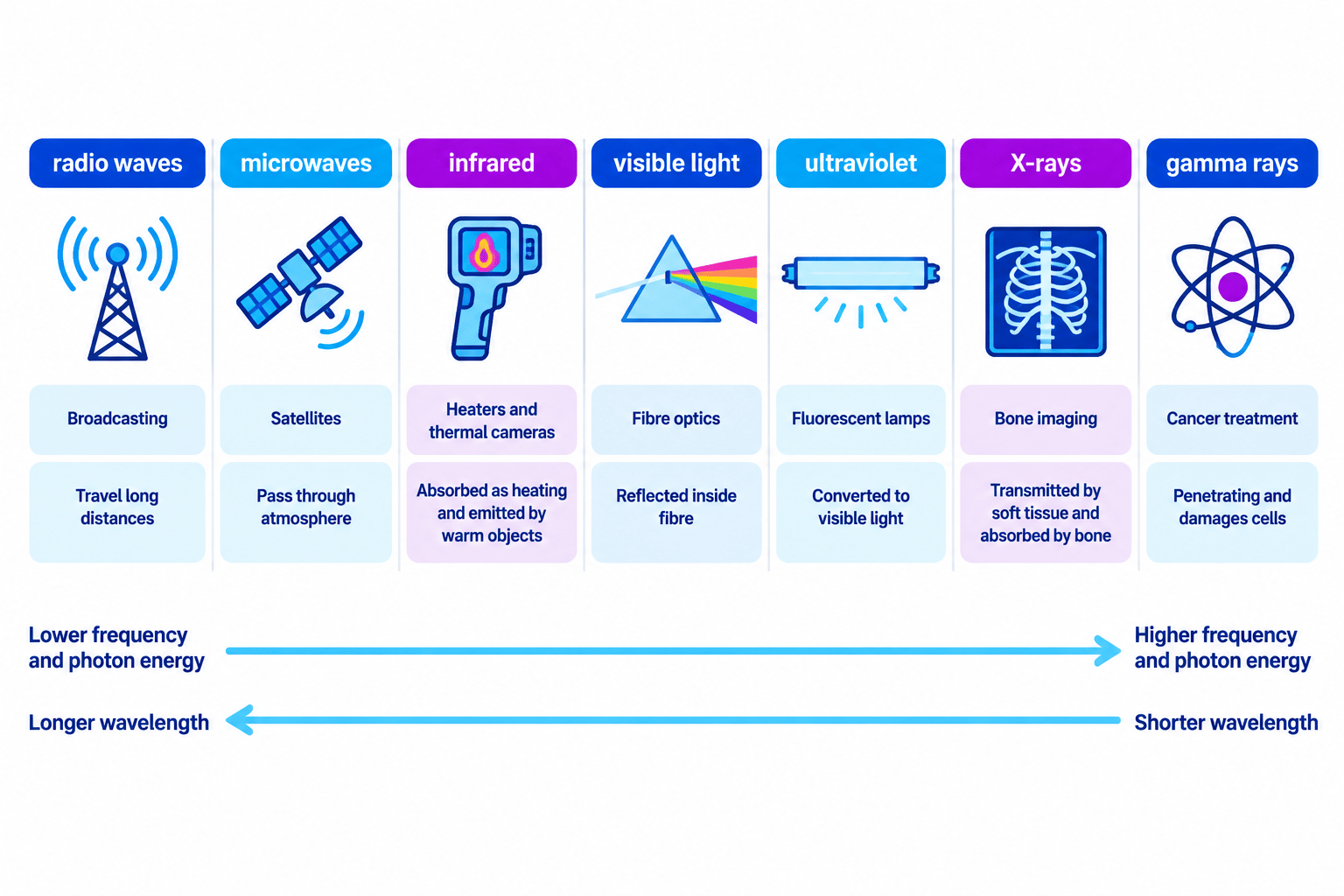
Radio waves: television and radio
- Radio waves are used for television and radio broadcasting.
- A broadcasting station transmits the radio waves, and an aerial in the television or radio receives them and recovers the sound or picture signal.
Microwaves: satellite communications and cooking food
- Microwaves are used for satellite communications and for cooking food.
- For satellite communications, a signal is sent up from a ground station to a satellite in orbit, which sends it back down to a receiver elsewhere on Earth.
- In a microwave oven, the microwaves transfer energy to the water in the food, which heats the food through.
Infrared: electric heaters, cooking and infrared cameras
- Infrared is used in electric heaters, in cooking, and in infrared cameras.
- An electric heater and a grill emit infrared, which is absorbed by objects and food, raising their temperature.
- An infrared camera detects the infrared a warm object emits, so it can form an image showing temperature differences even in the dark.
Visible light: fibre optic communications
- Visible light is used in fibre optic communications.
- Information is sent as fast pulses of light that travel along thin glass or plastic fibres, carrying data quickly over long distances.
Ultraviolet: energy-efficient lamps and sun tanning
- Ultraviolet is used in energy-efficient lamps and in sun tanning.
- In an energy-efficient lamp, ultraviolet is produced inside the tube and a coating converts it into visible light.
- Sunbeds use ultraviolet to darken the skin, which is why over-exposure is a risk to health.
X-rays and gamma rays: medical imaging and treatments
- X-rays and gamma rays are used in medical imaging and treatments.
- X-rays pass through soft tissue more easily than through bone, so they produce images that show bones inside the body.
- Gamma rays can be aimed at a tumour to damage or kill cancer cells in treatment.
Common Mistake
- Do not treat ultraviolet as visible light: it lies beyond the violet end of the spectrum, so the eye cannot see it.
- Do not just name the use: if a question says explain, give a reason why that wave suits the job.
Exam technique
Learn the exact pairings and quote them:
- radio waves: television and radio
- microwaves: satellite communications and cooking food
- infrared: electric heaters, cooking and infrared cameras
- visible light: fibre optic communications
- ultraviolet: energy-efficient lamps and sun tanning
- X-rays and gamma rays: medical imaging and treatments
Self review
- Which wave is used for satellite communications, and why does it suit that job?
- Name two uses of infrared radiation.
- Which wave carries information along fibre optic cables?
- Give one use of ultraviolet radiation.
- Why can X-rays produce an image of the bones in your hand?
6.2.4b Explaining the suitability of EM waves (HT)
Why each wave suits its use comes down to how it interacts with matter
Definition
Suitability
A wave is suitable for a use when its properties, such as how it is transmitted, absorbed or reflected, match what the job needs.
- To explain a use, do not just name it: link a property of the wave to the requirement of the application.
- The main properties to weigh up are whether a material transmits, absorbs or reflects the wave, and how deeply the wave can penetrate.
- Frequency also matters: a higher frequency wave carries more energy, so it tends to have a stronger effect on the matter it meets.
Radio waves and microwaves: reaching a distant receiver
- Radio waves are suitable for broadcasting because they can travel long distances through the air and are not strongly absorbed, so they reach many receivers.
- Microwaves are suitable for satellite communications because they can pass through the Earth’s atmosphere, so a signal can reach a satellite and return without being absorbed on the way.
- Microwaves are suitable for cooking because they are absorbed by water in food, transferring energy that heats the food throughout.
Infrared: energy transfer by heating
- Infrared is suitable for heaters and grills because it is readily absorbed by objects and food, transferring energy that raises their temperature.
- Infrared is suitable for cameras because a warmer object emits more infrared than a cooler one, so differences in emission map onto differences in temperature.
Visible light: staying inside the fibre
- Visible light is suitable for fibre optics because it can be sent as fast pulses that stay inside the fibre and travel long distances carrying a large amount of information.
- The pulses stay inside because the light is reflected at the walls of the fibre each time it reaches them, so almost none escapes.
- Visible light is also only weakly absorbed by the glass of the fibre, so the signal stays strong enough to travel a long way.
Ultraviolet, X-rays and gamma rays: higher frequency, deeper effect
- Ultraviolet is suitable for energy-efficient lamps because its energy can be absorbed by a coating and re-emitted as visible light.
- X-rays are suitable for imaging bones because they are transmitted by soft tissue but absorbed by denser bone, so bones show up as shadows on the image.
- Gamma rays are suitable for treating cancer because they are penetrating and can be directed at deep tissue to damage the cancer cells.
Common Mistake
- Do not answer an explain question by naming the use alone: state the property that makes the wave fit.
- Match the property to the wave: microwaves pass through the atmosphere, infrared is absorbed and transfers energy by heating, X-rays pass through soft tissue but are absorbed by bone.
Exam technique
Build each answer as a two-part chain:
- name a property of the wave (transmitted, absorbed, reflected, penetrating, high frequency)
- link it to what the application needs
Self review
- Why can microwaves be used to communicate with satellites?
- Why is infrared well suited to an electric heater?
- Why do X-rays show bones but not most soft tissue?
- Why is visible light used rather than another wave in fibre optic cables?
- Which property of gamma rays makes them useful for treating deep tumours?