6.2.3a Radio wave oscillations (HT)
Radio waves are born from oscillating charges
Electrical oscillation
An electrical oscillation is a repeated back-and-forth variation in the current, or in the movement of charge, in a circuit.
- When charges in a circuit oscillate back and forth, they produce a radio wave that travels away from the circuit.
- The oscillating circuit is the source: energy is transferred from the circuit to the radio wave, which can then travel through space.
An electrical circuit produces radio waves when the charges or current in it oscillate.
An absorbed radio wave drives a matching alternating current
Alternating current
An alternating current (a.c.) is a current that repeatedly changes direction.
Frequency
Frequency is the number of complete oscillations each second, measured in hertz, Hz\text{Hz}Hz.
- When a radio wave is absorbed by a suitable circuit, it transfers energy to the circuit and pushes its charges back and forth.
- This creates an alternating current in the circuit, even though the two circuits are not connected by any wire.
- The alternating current has the same frequency as the radio wave that was absorbed.
- For example, if the radio wave makes 100010001000 oscillations each second, the induced current also completes 100010001000 oscillations each second, a frequency of 1000 Hz1000\ \text{Hz}1000 Hz.
- So the radio wave has induced an electrical oscillation: it has set up an alternating current in the receiving circuit without any direct connection.
- Radio waves do not carry a current across the gap: the wave transfers energy, and only when it is absorbed does it create a new current.
- The induced current matches the radio wave in frequency, not in amplitude.
Answer with a linked chain rather than “sent and received”:
oscillations in a circuit →\rightarrow→ radio waves produced →\rightarrow→ radio waves absorbed →\rightarrow→ alternating current at the same frequency.
Use the key terms oscillations, absorbed, alternating current and same frequency to make each point clear.
- What must the charges in a circuit do for it to produce radio waves?
- What is created when a suitable circuit absorbs radio waves?
- Why is the induced current described as alternating?
- How does the frequency of the induced current compare with that of the radio wave?
- Do radio waves carry a current directly from one circuit to another?
6.2.3b Generation and absorption of EM waves; gamma rays
Changes in atoms make and unmake electromagnetic waves
Generation of an electromagnetic wave
Generation is the production and emission of an electromagnetic wave following a change in an atom or in its nucleus.
Absorption of an electromagnetic wave
Absorption is the transfer of energy from an electromagnetic wave to an atom or its nucleus.
- Changes inside atoms and their nuclei can cause electromagnetic waves to be generated or absorbed.
- When a wave is generated, energy is transferred away from the atom or nucleus by the wave.
- When a wave is absorbed, energy is transferred to the atom or nucleus.
- These changes can produce or absorb waves across a wide range of frequencies, so different changes are linked to different parts of the electromagnetic spectrum.
- For example, an electron moving between energy levels in an atom can generate or absorb visible light: it gives out a wave when it drops to a lower level and absorbs one when it moves to a higher level.
- For example, a change in the nucleus can generate a very high frequency wave, a gamma ray.
Electromagnetic waves transfer energy: generating a wave carries energy away from an atom or nucleus, while absorbing a wave delivers energy to it.
Gamma rays come from the nucleus
Gamma ray
A gamma ray is an electromagnetic wave produced by a change in the nucleus of an atom.
- Gamma rays have a different origin from waves made by changes elsewhere in the atom: they come specifically from the nucleus.
- So the origin of a gamma ray is not just “an atom” but a change in the nucleus of an atom.
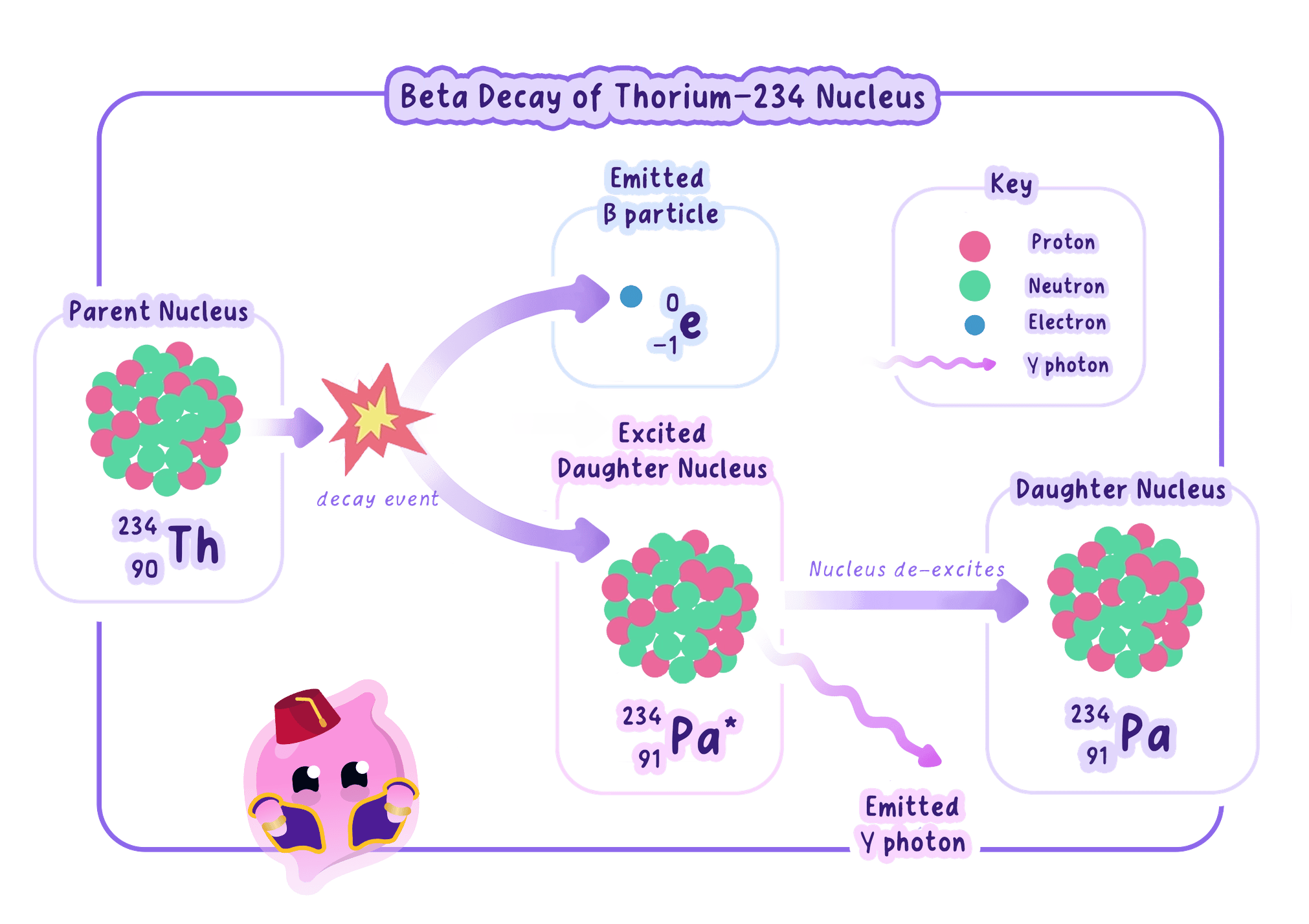
- Do not say gamma rays come from the “whole atom”: the correct source is a change in the nucleus.
- Do not confuse gamma rays with particles from the nucleus: gamma rays are electromagnetic waves.
- For the origin of gamma rays, include both key words: change and nucleus.
- For a general question, state that changes in atoms and nuclei can generate or absorb waves over a wide range of frequencies.
- What kinds of change can generate or absorb electromagnetic waves?
- When a wave is generated, which way is energy transferred?
- When a wave is absorbed, which way is energy transferred?
- Over what range of frequencies can waves be generated or absorbed?
- Where exactly do gamma rays originate?
6.2.3c Hazards of ultraviolet, X-rays and gamma rays; radiation dose
Some electromagnetic waves can harm living tissue
Radiation dose
Radiation dose is a measure of the risk of harm to the body from an exposure to radiation, measured in sieverts, Sv\text{Sv}Sv.
- Ultraviolet, X-rays and gamma rays are electromagnetic waves that can have hazardous effects on human body tissue.
- How much harm is done depends on two things: the type of radiation and the size of the dose.
- So a small dose carries a much lower risk than a large dose, and different waves harm the body in different ways.
Radiation dose measures risk, not certainty
- Radiation dose measures the risk of harm from exposure: a higher dose means a higher risk, but it does not make harm certain.
- Doses are given in sieverts (Sv\text{Sv}Sv) or millisieverts (mSv\text{mSv}mSv), where 1000 mSv=1 Sv1000\ \text{mSv} = 1\ \text{Sv}1000 mSv=1 Sv.
- To compare doses, first convert them into the same unit, for example 1 mSv=0.001 Sv1\ \text{mSv} = 0.001\ \text{Sv}1 mSv=0.001 Sv.
- When given data, compare the values in the same unit and then link the larger dose to a higher risk of harm.
- Question: One patient receives an X-ray dose of 0.008 Sv0.008\ \text{Sv}0.008 Sv, and another receives 12 mSv12\ \text{mSv}12 mSv from a different scan. Who has the greater dose?
- Convert to the same unit using 1 Sv=1000 mSv1\ \text{Sv} = 1000\ \text{mSv}1 Sv=1000 mSv: 0.008 Sv×1000=8 mSv0.008\ \text{Sv} \times 1000 = 8\ \text{mSv}0.008 Sv×1000=8 mSv.
- first patient: 8 mSv8\ \text{mSv}8 mSv
- second patient: 12 mSv12\ \text{mSv}12 mSv
- The second patient has the greater dose, and so the greater risk of harm.
Ultraviolet damages the skin
- Ultraviolet waves can damage skin tissue.
- The main harmful effects are the skin ageing prematurely and an increased risk of skin cancer.
- Ultraviolet from the Sun or from sunbeds damages cells in the skin, and a higher dose gives a greater risk of these effects.
X-rays and gamma rays are ionising
Ionising radiation
Ionising radiation is radiation that can knock electrons off atoms to make ions, which in body tissue can damage cells and cause mutation of genes.
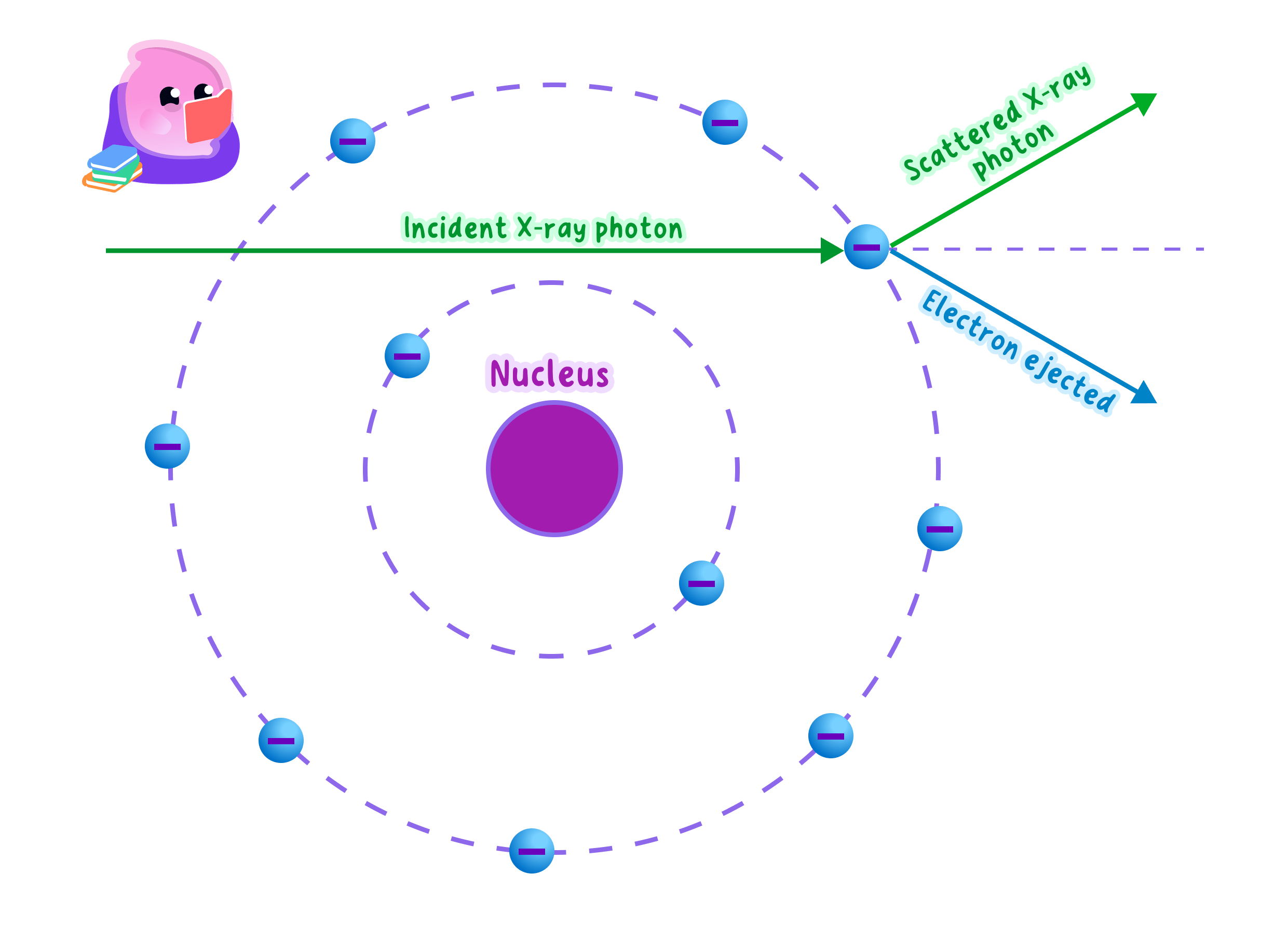
- X-rays and gamma rays are ionising radiation.
- They can cause mutation of genes, a change in a gene, and mutated genes in body cells can lead to cancer.
- The hazard depends on the dose: a larger dose of X-rays or gamma rays gives a greater risk of gene mutation and cancer.
- Do not say all electromagnetic waves are equally hazardous: the hazard depends on the type of radiation and the dose.
- Do not say a higher dose means someone will get cancer: it means a higher risk of harm.
For a data question:
- convert all doses into the same unit before comparing them
- identify which dose is larger and link it to a higher risk of harm
- name the correct effect:
- ultraviolet: premature skin ageing and increased risk of skin cancer
- X-rays and gamma rays: ionising radiation, gene mutation and cancer
Use the word risk whenever the question is about radiation dose.
- What does radiation dose measure?
- How many millisieverts are in one sievert?
- What two harmful effects can ultraviolet cause?
- What type of radiation are X-rays and gamma rays?
- What two factors decide how harmful an exposure is?
