x

Revision notes for AQA GCSE Physics The National Grid. Open the guide for explanations and worked examples. Written against the AQA GCSE Physics (8463) specification, so the content matches what's examinable rather than general Physics background.

The National Grid

What you'll learn

  • What the National Grid is and why we need it.
  • How step-up and step-down transformers are used.
  • Why transferring electrical power at a high potential difference makes the system more efficient.
  • How to explain the efficiency argument using P=IVP = IVP=IV.

Why do we need a grid?

Power stations are often far away from the people and places using the energy. For example, a power station might be near the coast, while the homes, schools, hospitals and factories using the energy are many kilometres away.

Electrical energy is transferred from power stations to consumers using a huge network called the National Grid.

Definition

National Grid

The National Grid is a system of cables and transformers linking power stations to consumers.

A consumer is anything that uses the electrical energy supplied by the grid, such as a home, school, shop, hospital or factory.

The National Grid does not just “store electricity”. Its job is to transfer electrical power from where it is generated to where it is needed.

The basic journey of electrical energy

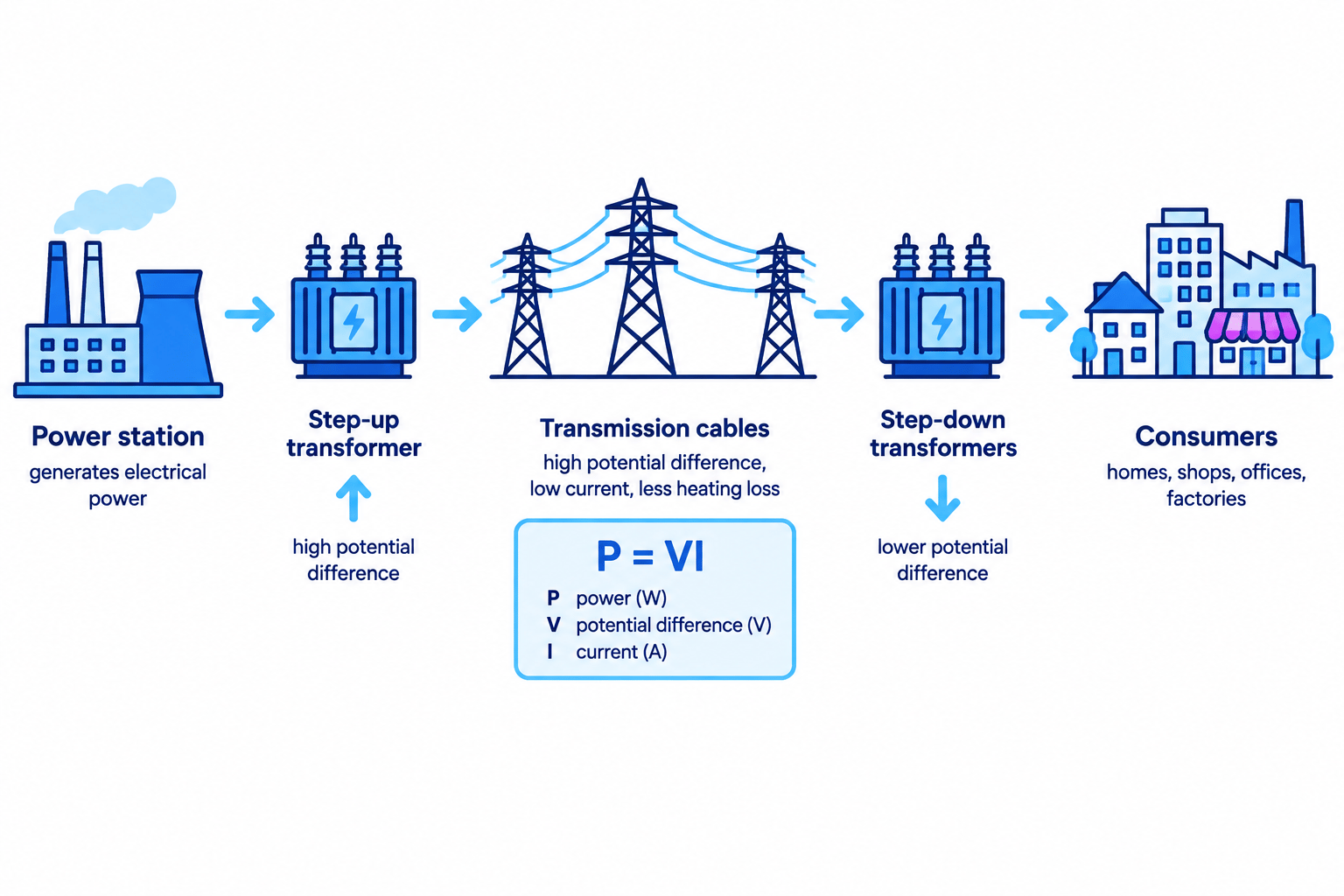
A simplified journey looks like this:

  1. A power station generator produces an alternating potential difference.
  2. A step-up transformer increases the potential difference.
  3. Electrical power is transferred through long-distance transmission cables.
  4. A step-down transformer decreases the potential difference.
  5. Electrical power is supplied to consumers at a much lower, safer potential difference.

Schematic of the National Grid showing power station, step-up transformer, high-voltage transmission cables, step-down transformer and consumers

Definition

Transformer

A transformer is a device that changes the potential difference of an alternating electrical supply. In this topic, you mainly need to know what step-up and step-down transformers do, not their internal construction.

Step-up transformers

A step-up transformer increases the potential difference before the electrical power travels through the long transmission cables.

For example, the potential difference might be increased from a few thousand volts to hundreds of thousands of volts.

Step-down transformers

A step-down transformer decreases the potential difference before the supply reaches consumers.

For domestic use in the UK, the mains supply is about 230 V.

Key Idea

The transformer pattern

The National Grid uses step-up transformers before long-distance transmission and step-down transformers before consumers.

Key electrical quantities

To understand why the National Grid is efficient, you need three electrical ideas.

Definition

Potential difference

Potential difference is the energy transferred per unit charge. It is measured in volts, V. It is often informally called voltage.

Definition

Current

Current is the rate of flow of charge. It is measured in amperes, A.

Definition

Power

Power is the rate of energy transfer. It is measured in watts, W. In electrical circuits:

P=IVP = IVP=IV

where PPP is power in watts, III is current in amperes, and VVV is potential difference in volts.

The important point is that the same power can be transferred using different combinations of current and potential difference.

If the power transferred stays the same, increasing the potential difference means the current must decrease.

Tip

Useful relationship

For a fixed power transfer, higher potential difference means lower current, because P=IVP = IVP=IV.

Example

Comparing current at different potential differences

A power station transfers 2.0 MW of power. Compare the current if the potential difference is 10 kV with the current if the potential difference is 400 kV.

  1. Convert the power and potential differences into base units:

    2.0 MW=2.0×10⁶ W2.0\ \text{MW} = 2.0 \times 10^6\ \text{W}2.0 MW=2.0×10⁶ W 10 kV=1.0×10⁴ V10\ \text{kV} = 1.0 \times 10^4\ \text{V}10 kV=1.0×10⁴ V 400 kV=4.0×10⁵ V400\ \text{kV} = 4.0 \times 10^5\ \text{V}400 kV=4.0×10⁵ V
  2. Rearrange P=IVP = IVP=IV to calculate current:

    I=PVI = \frac{P}{V}I=VP​
  3. Calculate the current at 10 kV:

    I=2.0×1061.0×104=200 AI = \frac{2.0 \times 10^6}{1.0 \times 10^4} = 200\ \text{A}I=1.0×1042.0×106​=200 A
  4. Calculate the current at 400 kV:

    I=2.0×1064.0×105=5.0 AI = \frac{2.0 \times 10^6}{4.0 \times 10^5} = 5.0\ \text{A}I=4.0×1052.0×106​=5.0 A
  5. Compare the results: increasing the potential difference from 10 kV to 400 kV reduces the current from 200 A to 5.0 A.

Why high potential difference makes the grid efficient

The long transmission cables in the National Grid have some resistance.

Definition

Resistance

Resistance is how much a component or wire opposes the flow of current. It is measured in ohms, Ω.

When current flows through a cable with resistance, energy is transferred to the thermal energy store of the cable and surroundings. In everyday language, the cable heats up.

This energy transfer by heating is wasted energy because it is not usefully transferred to consumers.

The bigger the current in the cables, the more energy is wasted by heating. So the National Grid aims to keep the current in the long-distance cables as low as possible.

The way to do that is to use a very high potential difference for transmission.

Key Idea

Why the National Grid is efficient

The National Grid is efficient because step-up transformers increase the potential difference, which reduces the current in the transmission cables. A lower current means less energy is wasted by heating the cables.

If you have met the equation P=I2RP = I^2RP=I2R, you can use it to see why current matters so much: doubling the current would make the heating power loss four times bigger, if the cable resistance stayed the same.

Example

Using current to compare heating losses

Two transmission options use cables with the same resistance of 20 Ω. In option A, the current is 200 A. In option B, the current is 5.0 A. Compare the power wasted by heating in the cables.

  1. Use the power loss equation for a current through a resistance:

    P=I2RP = I^2RP=I2R
  2. Calculate the wasted power for option A:

    P=2002×20=800000 WP = 200^2 \times 20 = 800000\ \text{W}P=2002×20=800000 W
  3. Calculate the wasted power for option B:

    P=5.02×20=500 WP = 5.0^2 \times 20 = 500\ \text{W}P=5.02×20=500 W
  4. Compare the losses: option B wastes far less power because its current is much smaller.

Why not send high potential difference straight into homes?

High potential differences are dangerous and unsuitable for domestic appliances. The National Grid uses very high potential differences for transmission because that is efficient, but homes need a much lower potential difference for safety and for appliances to work correctly.

That is why step-down transformers are used near consumers.

Common Mistake

High potential difference is dangerous

High potential difference is useful for long-distance transmission, but it is not safe for normal domestic use. The supply must be stepped down before it reaches homes.

The full explanation in exam language

A strong GCSE explanation usually links these ideas in order:

  1. Electrical power is transferred from power stations to consumers by the National Grid.
  2. A step-up transformer increases the potential difference before transmission.
  3. For the same power transfer, increasing the potential difference decreases the current, using P=IVP = IVP=IV.
  4. A lower current means less energy is wasted by heating the transmission cables.
  5. Step-down transformers then reduce the potential difference to a safer, lower value for consumers.
Common Mistake

Mixing up fixed resistance and fixed power

Do not simply say “higher potential difference means lower current” in every situation. For a fixed resistor, increasing potential difference increases current. In the National Grid explanation, the key idea is for the same power transfer, a higher potential difference means a lower current.

Common Mistake

Saying transformers save energy

Transformers do not create energy. Their role is to change the potential difference so that less energy is wasted during transmission.

A simple model to remember

Think of the National Grid as choosing the “best settings” for different parts of the journey.

Near homes, the priority is safety and suitability, so the potential difference is low.

Across long distances, the priority is reducing wasted energy, so the potential difference is very high and the current is low.

Analogy

Moving the same delivery more efficiently

If power is like the size of a delivery, the grid can deliver the same “amount per second” using a high potential difference and a low current. The lower current is like having less traffic causing losses along the route.

What you do and do not need here

For this sub-topic, you should be able to describe the National Grid and explain why it is efficient.

The detailed construction and operation of transformers is treated separately, especially for Higher Tier physics. Here, focus on the role of each transformer in the energy transfer chain.

Exam technique

In the exam

  1. If asked why the National Grid is efficient, mention step-up transformer → high potential difference → low current → less heating of cables.
  2. Use P=IVP = IVP=IV if numbers are given, especially to show that current decreases when potential difference increases for the same power.
  3. Finish explanations by saying that step-down transformers reduce the potential difference to a much lower value for consumers.
Self review

Check yourself

  • What is the job of a step-up transformer in the National Grid?
  • Why does a lower current reduce wasted energy in transmission cables?
  • Why must the potential difference be stepped down before electricity is supplied to homes?
You've reached the end

Test yourself on this topic, or move on to the next guide.

FlashcardsSelf-test with active recall
Static chargeUp next

How was this guide?

The National Grid Revision Guide

  1. GCSE
  2. /Physics
  3. /The National Grid