2.4.2a Energy transfers in everyday appliances
Appliances are designed to bring about energy transfers
Electrical appliance
A device designed to transfer energy from an electrical supply to other energy stores.
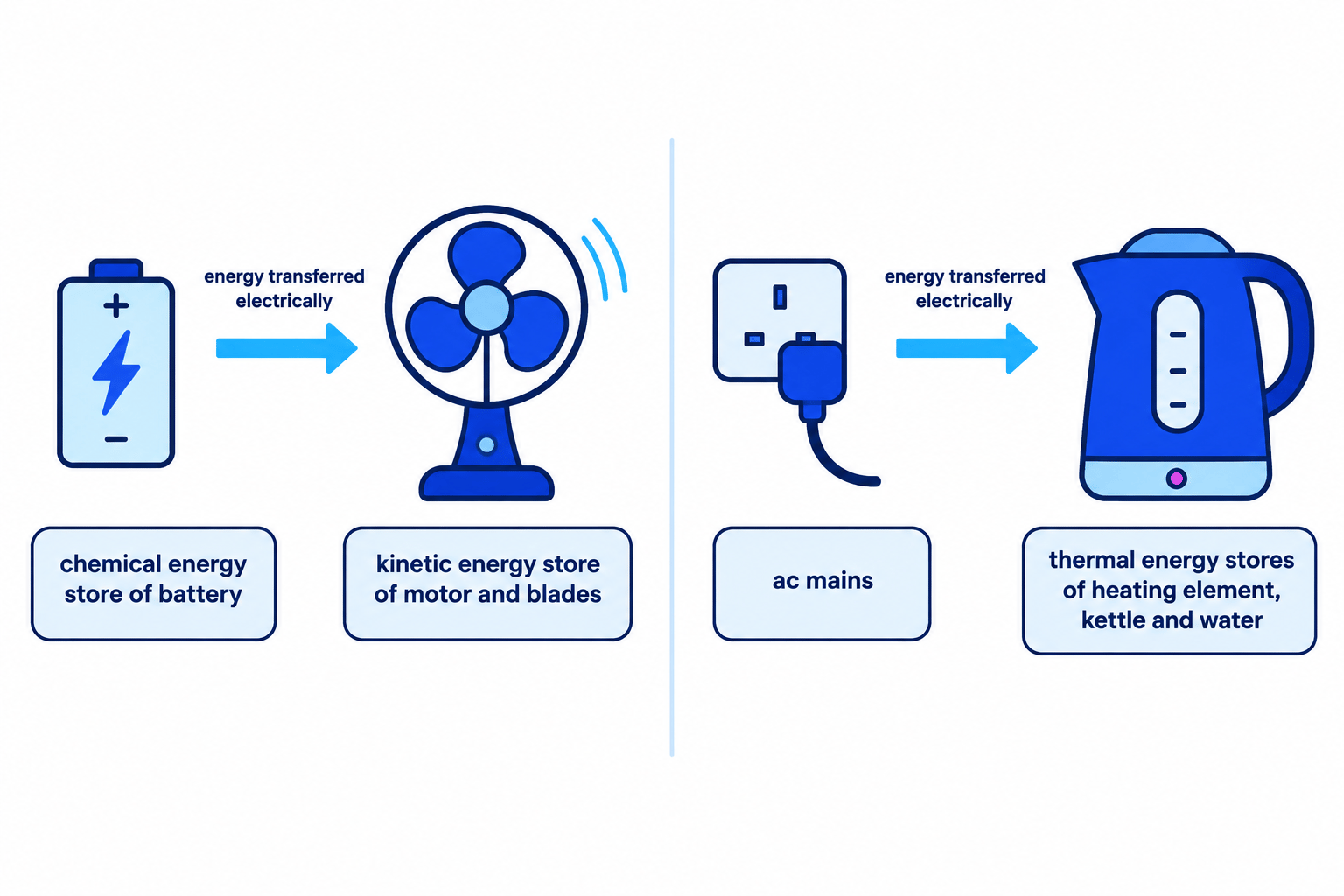
- Everyday appliances are built to produce a particular energy transfer; a kettle raises the thermal energy store of water, while a fan raises the kinetic energy store of its motor and blades.
- The electrical supply can be a battery or the alternating potential difference of the ac mains.
- In a battery-powered appliance the chemical energy store of the battery decreases, and energy is transferred electrically to the appliance.
- In a mains appliance energy is transferred electrically from the ac mains to the appliance.
- An appliance never creates energy; it only transfers it from one store to another.
Energy transferred grows with power and with time
Power
The rate at which energy is transferred, measured in watts (W\text{W}W).
- A power of 1 W1\ \text{W}1 W means 1 J1\ \text{J}1 J of energy is transferred every second, so a more powerful appliance transfers more energy each second.
- The energy an appliance transfers depends on its power and on how long it is switched on, linked by E=PtE = PtE=Pt, where EEE is energy transferred in joules (J\text{J}J), PPP is power in watts (W\text{W}W), and ttt is time in seconds (s\text{s}s).
- For the same time, a higher-power appliance transfers more energy.
- For the same power, leaving the appliance on for longer transfers more energy.
A 2.0 kW2.0\ \text{kW}2.0 kW kettle is switched on for 180 s180\ \text{s}180 s. Calculate the energy transferred.
- Write the equation: E=PtE = PtE=Pt.
- Convert the power to watts: 2.0 kW=2000 W2.0\ \text{kW} = 2000\ \text{W}2.0 kW=2000 W.
- Substitute the values: E=2000 W×180 sE = 2000\ \text{W} \times 180\ \text{s}E=2000 W×180 s.
- Calculate: E=360 000 JE = 360\,000\ \text{J}E=360000 J.
- The kettle transfers 360 000 J360\,000\ \text{J}360000 J (that is 360 kJ360\ \text{kJ}360 kJ), raising the thermal energy stores of the element, kettle and water.
Motors gain kinetic stores, heaters gain thermal stores
- Different appliances are designed to raise different useful energy stores.
- In appliances with an electric motor, energy is transferred electrically to the kinetic energy store of the moving parts; examples include an electric toothbrush, a washing machine, a fan and a vacuum cleaner.
- In heating appliances, energy is transferred electrically to thermal energy stores; examples include a kettle, a toaster, an electric oven, an electric heater and a hairdryer.
- A full description names the supply and the store that changes, for example: a battery-powered fan transfers energy electrically from the chemical energy store of the battery to the kinetic energy store of the motor and blades.
Power rating and the change in stored energy
Power rating
The amount of energy an appliance transfers each second when working normally.
- Power ratings are shown in watts or kilowatts, and a high-power appliance causes a greater change in stored energy each second than a low-power one.
- A 3000 W3000\ \text{W}3000 W kettle transfers 3000 J3000\ \text{J}3000 J each second, mostly to the thermal energy store of the water and kettle, while a 10 W10\ \text{W}10 W lamp transfers only 10 J10\ \text{J}10 J each second.
- Run for the same time, the kettle transfers far more energy because its power rating is greater.
- Total energy also depends on time, so a low-power appliance left on for a long while can transfer more energy overall than a high-power appliance used briefly.
- Do not write that an appliance uses up energy; energy is conserved and transferred between stores.
- Do not confuse power in watts with energy in joules: power is the rate of transfer.
- The ac mains is an electrical supply, not an energy store, so say energy is transferred electrically from the ac mains.
- When you describe an appliance, name the source (battery or ac mains), the electrical transfer pathway, and the store that increases.
- When you compare power ratings, say the higher-power appliance transfers more energy each second; if times are given, use E=PtE = PtE=Pt rather than judging from power alone.
- What does the power rating of an appliance tell you?
- Write the equation linking energy transferred, power and time.
- Which energy store decreases when a battery powers an appliance?
- Which energy store increases in the moving parts of a motor?
- Why can a low-power appliance sometimes transfer more energy than a high-power one?
2.4.2b Work done by an electric current: E = P t and E = Q V
Work is done when charge flows through a component
Electrical work
The energy transferred when charge flows through a circuit.
- When a circuit is complete, charge flows through the components, and as it passes through a component energy is transferred.
- In a lamp, electrical work transfers energy from the battery to the lamp, which then transfers energy to the surroundings by light and by heating.
- The energy transferred depends on how much charge flows and on the potential difference across the component.
Potential difference
The energy transferred per coulomb of charge passing between two points, measured in volts (V\text{V}V).
- A larger potential difference means more energy is transferred for each coulomb that passes through the component.
- This is why a potential difference of 1 V1\ \text{V}1 V means 1 J1\ \text{J}1 J is transferred for every 1 C1\ \text{C}1 C of charge.
Energy from power and time
- The energy transferred by electrical work can be found from the power and the time: E=PtE = PtE=Pt, where EEE is energy transferred in joules (J\text{J}J), PPP is power in watts (W\text{W}W), and ttt is time in seconds (s\text{s}s).
- Power is the rate of energy transfer, so a device with greater power transfers more energy each second; a 2000 W2000\ \text{W}2000 W kettle transfers 2000 J2000\ \text{J}2000 J every second.
A hairdryer has a power of 1200 W1200\ \text{W}1200 W and is used for 180 s180\ \text{s}180 s. Calculate the energy transferred.
- Write the equation: E=PtE = PtE=Pt.
- Substitute the values: E=1200 W×180 sE = 1200\ \text{W} \times 180\ \text{s}E=1200 W×180 s.
- Calculate: E=216 000 JE = 216\,000\ \text{J}E=216000 J.
- The energy transferred is 216 000 J216\,000\ \text{J}216000 J.
Energy from charge and potential difference
- The energy transferred can also be found from the charge that flows and the potential difference: E=QVE = QVE=QV, where EEE is energy transferred in joules (J\text{J}J), QQQ is charge flow in coulombs (C\text{C}C), and VVV is potential difference in volts (V\text{V}V).
- The energy transferred increases if more charge flows.
- It also increases if the potential difference is larger, because each coulomb then carries more energy; raising the potential difference across a motor means every coulomb transfers more energy to it.
A charge of 35 C35\ \text{C}35 C flows through a component with a potential difference of 6.0 V6.0\ \text{V}6.0 V across it. Calculate the energy transferred.
- Write the equation: E=QVE = QVE=QV.
- Substitute the values: E=35 C×6.0 VE = 35\ \text{C} \times 6.0\ \text{V}E=35 C×6.0 V.
- Calculate: E=210 JE = 210\ \text{J}E=210 J.
- The energy transferred is 210 J210\ \text{J}210 J.
Power links potential difference and current
- Power depends on the potential difference across a device and the current through it: P=IVP = IVP=IV, where PPP is power in watts (W\text{W}W), III is current in amperes (A\text{A}A), and VVV is potential difference in volts (V\text{V}V).
- A higher potential difference means each coulomb transfers more energy, and a higher current means more charge flows each second, so raising either one raises the power.
- Power is also the energy transferred over a given time, P=EtP = \frac{E}{t}P=tE, which is the same relationship as E=PtE = PtE=Pt rearranged and shows that power measures how quickly energy is transferred.
A motor has a current of 2.5 A2.5\ \text{A}2.5 A through it and a potential difference of 12 V12\ \text{V}12 V across it. Calculate the power.
- Write the equation: P=IVP = IVP=IV.
- Substitute the values: P=2.5 A×12 VP = 2.5\ \text{A} \times 12\ \text{V}P=2.5 A×12 V.
- Calculate: P=30 WP = 30\ \text{W}P=30 W.
- The power of the motor is 30 W30\ \text{W}30 W.
- Do not confuse energy transferred in joules with power in watts.
- Power is the rate of energy transfer, so a higher-power device does not automatically transfer more energy overall unless you know the time.
- A high-power device used briefly can transfer less energy than a low-power device used for a long time.
- For a calculation, give the correct equation, correct substitution, and a final answer with units.
- Check units first: time in seconds, charge in coulombs, potential difference in volts, power in watts, energy in joules.
- For an explain question, use that power is the rate of energy transfer, linking a larger current to more charge each second and a larger potential difference to more energy per coulomb.
- What happens to energy when charge flows through a component?
- Write the equation linking energy transferred, power and time, with units.
- Write the equation linking energy transferred, charge and potential difference, with units.
- Why does a greater current increase the power of a device?
- Why does a greater potential difference transfer more energy per coulomb?