x

Revision notes for AQA GCSE Physics Static charge. Open the guide for explanations and worked examples. Written against the AQA GCSE Physics (8463) specification, so the content matches what's examinable rather than general Physics background.

Static charge

What you'll learn

  • How rubbing insulating materials can make them electrically charged.
  • Why gaining electrons makes an object negative, while losing electrons leaves it positive.
  • How charged objects attract or repel without touching.
  • How static charge can lead to sparking.

This topic is part of the GCSE Physics-only static electricity content, so exam answers usually need you to explain what happens in terms of electrons.

The basic particles you need first

Matter is made of atoms. An atom has a central nucleus, containing protons and neutrons, with electrons around the outside.

  • A proton has positive electric charge.
  • An electron has negative electric charge.
  • A neutral object has no overall charge because its positive and negative charges balance.

In static electricity, the important moving particles are electrons. Protons are locked inside nuclei, so they are not rubbed from one object onto another in this topic.

Definition

Electric charge

Electric charge is a property that can make objects experience forces of attraction or repulsion. There are two types of charge: positive and negative.

What “static” charge means

Static means “not moving around in a continuous flow”. A static charge is a build-up of electric charge on an object, often on its surface.

This is different from an electric current in a circuit, where charge flows continuously around a complete path.

An insulator is a material that does not let charge move through it easily. Examples include plastic, rubber, glass and dry cloth. Insulators are important here because any transferred electrons can remain trapped, causing a build-up of static charge.

A conductor is a material that lets charge move through it easily. Metals are good conductors.

Charging by rubbing

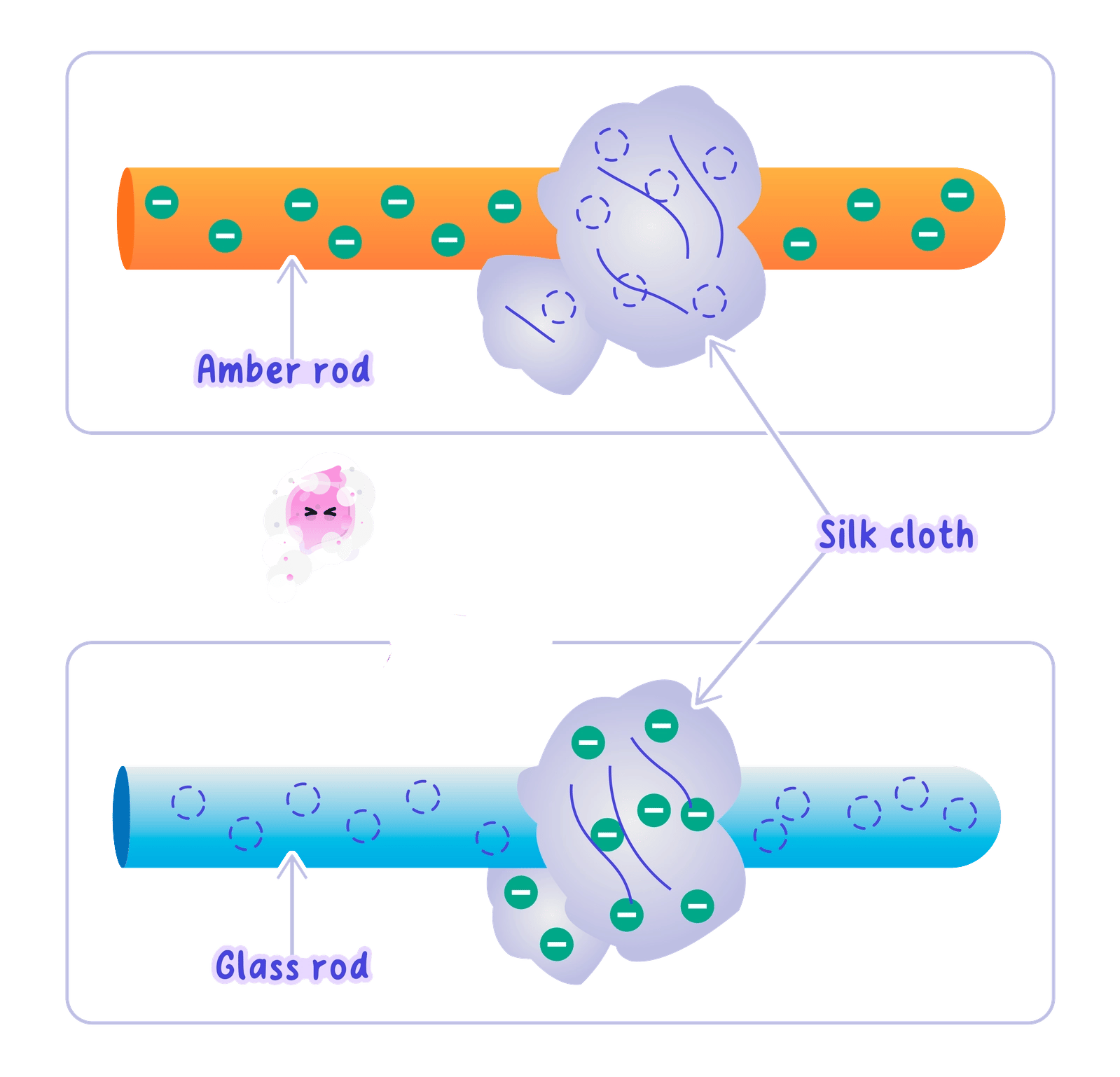
When certain insulating materials are rubbed against each other, electrons can be transferred from one material to the other.

Rubbing does not create charge from nothing. It gives the surfaces lots of close contact, which allows some electrons to move from one object onto the other.

The rule is:

  • The material that gains electrons becomes negatively charged.
  • The material that loses electrons is left positively charged.
  • The positive charge and negative charge are equal in size, because the electrons lost by one object are gained by the other.

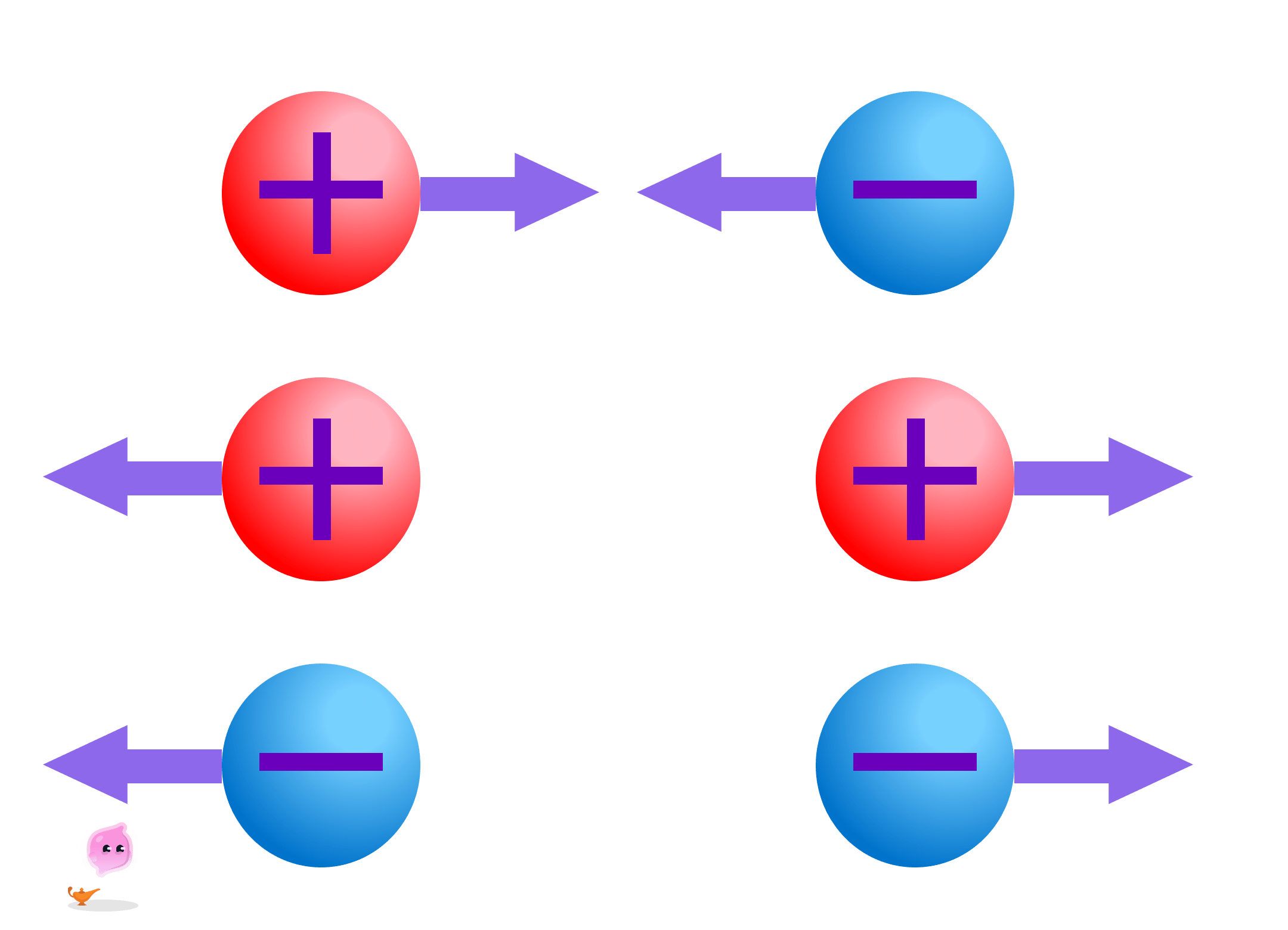
The diagram below summarises electron transfer during rubbing and the force rules you will use next.

Diagram showing electrons transferring during rubbing and charged objects attracting or repelling

Key Idea

The electron-transfer rule

In static electricity, electrons move. The object that gains electrons becomes negative, and the object that loses electrons becomes positive.

What happens to the object?Overall chargeWhy?
Gains electronsNegativeIt now has extra negative charge
Loses electronsPositiveIts positive protons are no longer balanced by enough electrons
Example

Deciding the charge after rubbing

A plastic rod and a cloth are rubbed together. Electrons move from the cloth to the rod. What charge does each object end up with?

  1. The electrons move onto the rod, so the rod has gained negatively charged particles.
  2. Gaining electrons makes the rod negatively charged overall.
  3. The cloth has lost those electrons, so it is left with an equal-sized positive charge.
Common Mistake

Moving the wrong particle

Do not say that positive charges, protons, or “positive electrons” move from one material to another. At GCSE, static charge from rubbing is explained by electrons transferring.

Forces between charged objects

A force is a push or a pull. Charged objects can exert forces on each other when they are close together.

There are two key rules:

  • Two objects with the same type of charge repel each other.
  • Two objects with different types of charge attract each other.

Repel means push apart. Attract means pull together.

Definition

Non-contact force

A non-contact force is a force that acts between objects even when they are not touching. Attraction and repulsion between charged objects are examples of non-contact forces.

You can see evidence for this using lightweight charged objects hanging from threads. If they move towards or away from each other while there is still a gap between them, a force must be acting without contact.

For example:

  • Two negatively charged rods brought close together repel.
  • Two positively charged objects repel.
  • A positively charged object and a negatively charged object attract.
Example

Predicting attraction or repulsion

Two small charged spheres hang from threads. Sphere A is positively charged. Sphere B has lost electrons. What happens when A is brought near B?

  1. Sphere B has lost electrons, so it has fewer negative charges than before and is positively charged overall.
  2. Sphere A is also positive, so the two spheres have the same type of charge.
  3. Same charges repel, so the spheres push away from each other before touching. This is a non-contact force.
Tip

Use the exact charge rule

For this part of the course, if the question says both objects are charged, use: same charges repel, opposite charges attract.

Sparking and discharge

If static charge builds up enough, it can suddenly move through the air as a spark.

Air is normally an insulator, so charge does not easily flow through it. But if the build-up is large enough and the gap is small enough, electrons can jump across the gap. This sudden movement of charge is called a discharge.

Definition

Spark and discharge

A discharge is a sudden movement of charge that reduces a build-up of static electricity. A spark is a discharge through air, often producing a flash, crack or tiny shock.

Common examples include:

  • A small shock when you touch a metal door handle after walking on carpet.
  • Crackling when taking off a synthetic jumper.
  • Tiny sparks caused by charged objects being brought very close together.
Example

Explaining a spark from a door handle

After walking across a carpet, you reach for a metal door handle and feel a tiny spark. Explain what happened.

  1. As your shoes rub against the carpet, electrons are transferred between the materials, so your body and the carpet become oppositely charged.
  2. The charge can build up because insulating materials stop the charge spreading away quickly.
  3. When your finger gets close to the metal handle, electrons suddenly move through the small air gap.
  4. This sudden discharge is the spark, and it reduces the static charge build-up.

How to build a good explanation

Many GCSE questions on static electricity ask you to “explain” what happens. That means you should link the visible effect to electron transfer.

A strong explanation often follows this pattern:

  1. Name the objects being rubbed.
  2. State that electrons are transferred.
  3. Say which object gains electrons and which loses electrons.
  4. Give the resulting charges.
  5. Apply the force rule: same charges repel or opposite charges attract.
  6. If relevant, say the force acts without contact.

For example, a good sentence might be:

“Electrons are transferred from the cloth to the rod. The rod gains electrons and becomes negatively charged, while the cloth loses electrons and becomes positively charged. Because the charges are opposite, the rod and cloth attract each other by a non-contact force.”

Common Mistake

Saying friction creates charge

Rubbing does not create new charge. It transfers electrons between materials, so one object becomes negative and the other becomes equally positive.

Exam technique

In the exam

  1. Always mention electrons when explaining how static charge is produced by rubbing.
  2. Link electron movement to charge: gain electrons means negative, lose electrons means positive.
  3. For force questions, state the rule clearly: same charges repel, different charges attract.
  4. For sparks, describe a build-up of static charge followed by a sudden discharge through air.
Self review

Check yourself

  • A plastic rod gains electrons when rubbed with a cloth. What charge does each object have?
  • Two charged spheres repel each other before touching. What does this tell you about their charges?
  • Explain why a tiny spark can happen when a charged person reaches for a metal door handle.
You've reached the end

Test yourself on this topic, or move on to the next guide.

FlashcardsSelf-test with active recall
Electric fieldsUp next

How was this guide?

Static charge Revision Guide

  1. GCSE
  2. /Physics
  3. /Static charge