Question 3
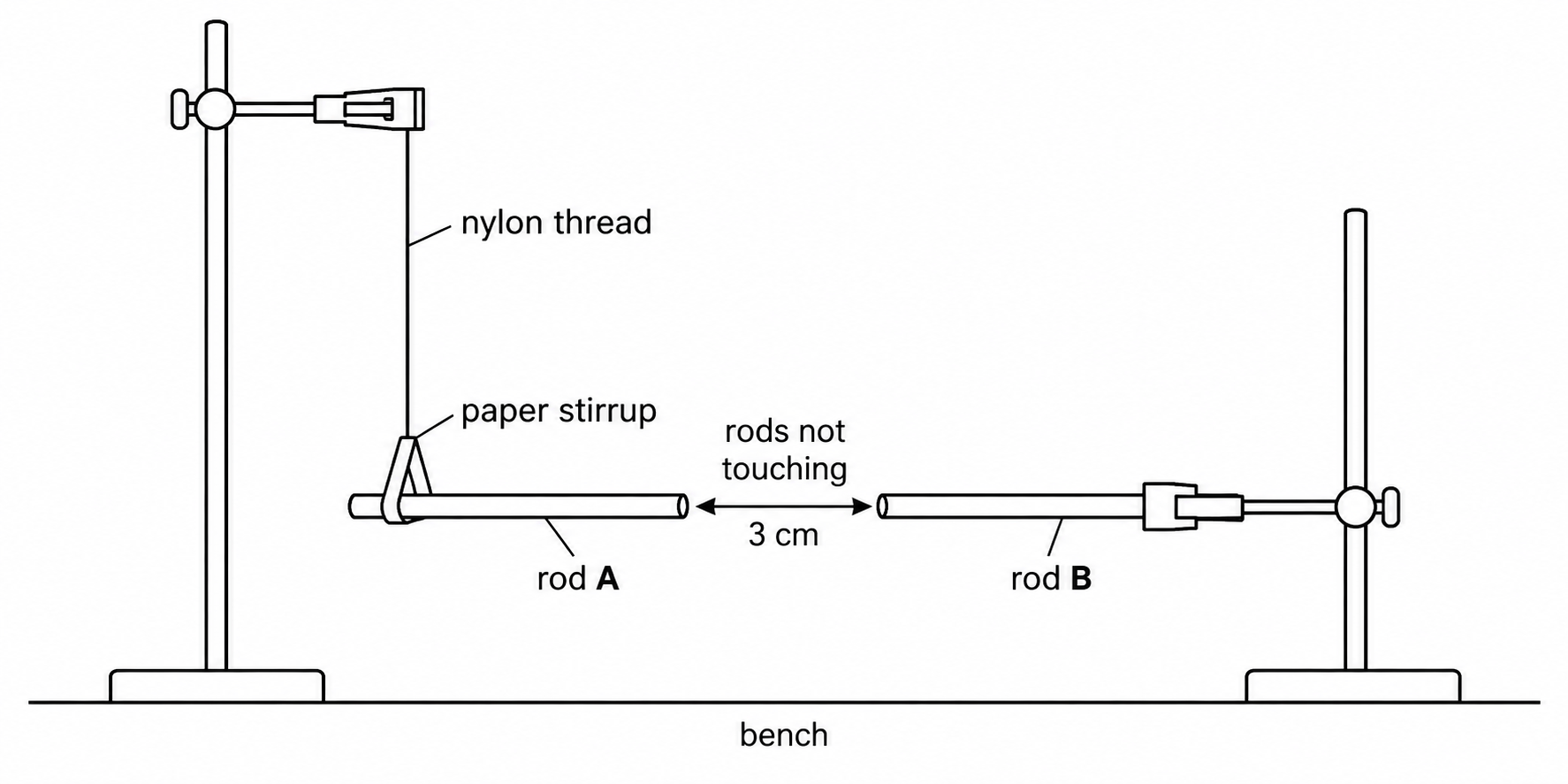
FA student sets up the apparatus shown in the figure to test whether two charged rods exert a force on each other when they are not touching. Rod A hangs from a nylon thread. Rod B is held in a clamp a short distance away. Both rods are made of polythene and both have been rubbed with the same dry cloth.
Figure: Apparatus used to test the force between two charged polythene rods that are not touching
a.[1]
Give the type of charge on each of the two polythene rods.
b.[1]
Describe what the student will see happen to rod A.
c.[2]
Rod B is moved closer to rod A. Rod A now swings further away than it did before.
Explain why rod A swings further when rod B is moved closer.
d.[2]
The student replaces rod B with an acetate rod that has been rubbed with the same cloth. Rod A now swings towards rod B.
Explain what this shows about the charge on the acetate rod.
2.5 Static electricity Questions
40 exam-style questions on AQA GCSE Physics 2.5 Static electricity, covering 2.5.1 Static charge and 2.5.2 Electric fields. Each one has a worked solution and a mark scheme showing where the marks go.