A charged object is surrounded by an electric field
Definition
Electric field
The region around a charged object where another charged object experiences a force.
- A charged object creates an electric field around itself, which is how it can affect other charged objects without touching them.
- The field is strongest close to the charged object.
- The further you move away, the weaker the field becomes, which is why electrostatic effects are strongest when charged objects are close together.
- The field is not a material object; you cannot see it, but you can see its effects, such as attraction, repulsion and sparking.
Key Idea
An electric field explains how a charged object can exert a non-contact force on another charged object.
Charges in a field feel a force that grows as they get closer
- A second charged object placed in the field of another feels a force.
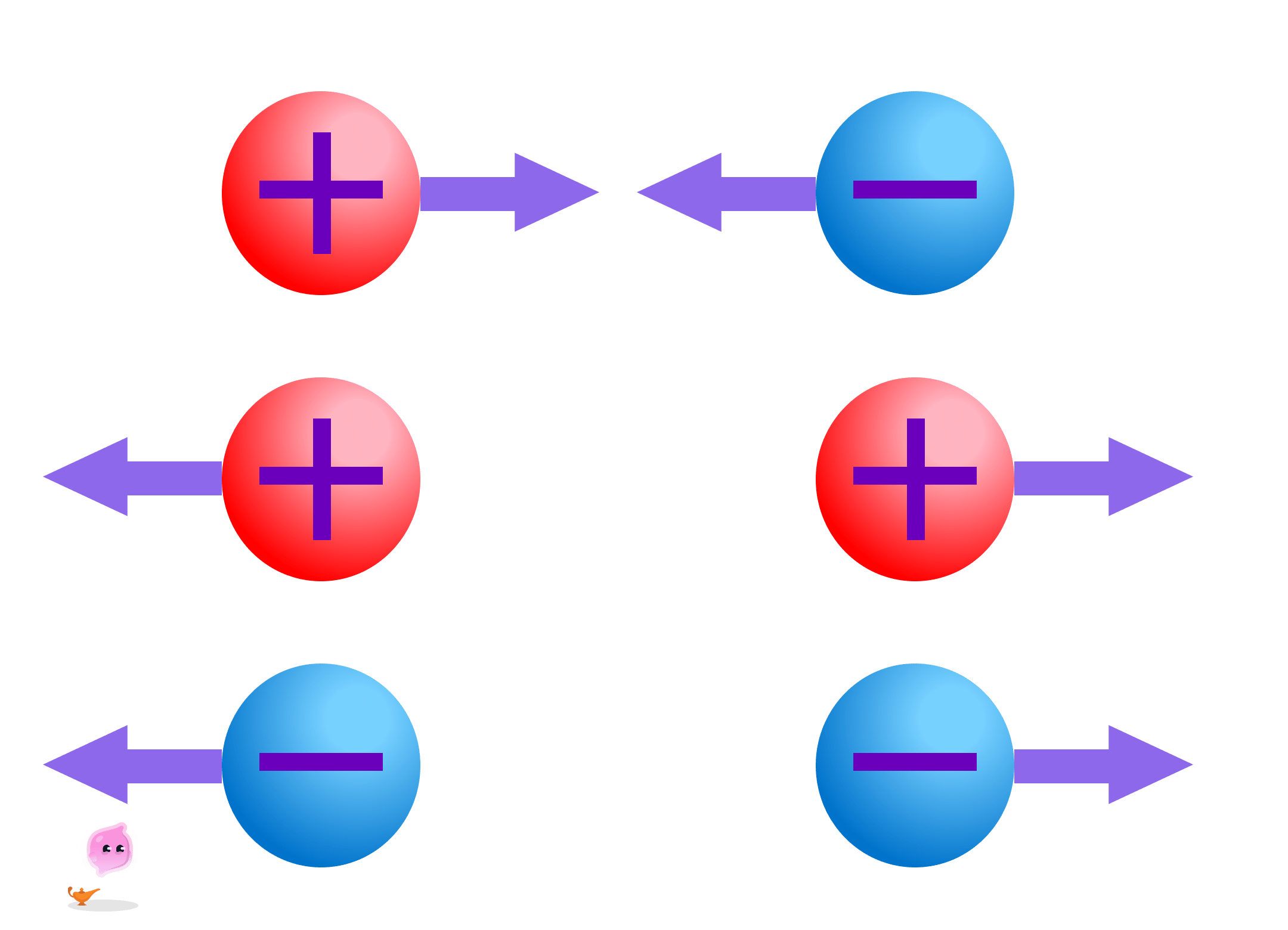
- Like charges repel, so a positive charge repels another positive charge, and a negative charge repels another negative charge.
- Opposite charges attract, so a positive charge attracts a negative charge.
- The force gets stronger as the objects move closer, because the second object is then in a stronger part of the field.
Practical
Demonstration: showing the field acts at a distance and strengthens with closeness
You charge a rod or balloon and bring it near light objects, watching them respond across a gap and respond more strongly as the gap shrinks.
- Tear up a few small pieces of tissue paper and spread them on a dry bench, then charge a plastic rod or an inflated balloon by rubbing it with a dry cloth or your hair.
- Hold the charged rod high above the paper and lower it slowly; the pieces stay still while the rod is far away, because the field there is too weak to lift them.
- As the rod comes closer, the paper suddenly jumps up and clings to it, showing the force acts across a gap and grows stronger as the distance shrinks.
- For a clearer version, charge the rod and hold it near a thin, steady stream of water from a tap; the stream bends towards the rod without being touched, and bends more sharply as you move the rod nearer.
- Each case is a non-contact force: the field around the charged object exerts a force on charges in the paper or water before anything touches.
Drawing the field around an isolated charged sphere
- For an isolated charged sphere, the electric field pattern is drawn with field lines.
- For a positively charged sphere, the field lines point away from the sphere.
- They are drawn radially outwards, evenly spaced all around the sphere.
- They are closer together near the sphere, which shows the field is stronger there.
- For a negatively charged sphere, the field lines point towards the sphere.
- They are drawn radially inwards, and are again closer together near the sphere.
- Field lines never cross, and the direction of the field is the direction of the force on a small positive charge placed in it.

Exam technique
- For a positive sphere, draw straight lines coming out evenly in all directions with the arrows pointing away.
- For a negative sphere, draw straight lines going in evenly from all directions with the arrows pointing in.
- Show the lines closer together near the sphere to represent the stronger field.
The field model explains forces and sparking
- Without the field idea it seems strange that charged objects attract or repel without touching, and the model explains it in steps.
- A charged object creates an electric field around itself.
- A second charged object placed in that field experiences a force.
- The force is attractive or repulsive depending on the signs of the two charges.
- The force is stronger when the objects are closer, because the field is stronger nearer the charged object.
- The same idea explains sparking: a large charge creates a strong field, and when another object is close the field in the small gap can become very strong.
- If the field is strong enough, charge is pushed through the air for a very short time, transferring charge and producing a spark before the objects even touch.
- A familiar example is the small shock after walking across a carpet and reaching for a metal door handle: charge builds up on you, and as your hand nears the handle the field grows strong enough for charge to cross the air as a tiny spark.
Common Mistake
- Do not say charged objects must touch to exert a force; electrostatic forces are non-contact forces caused by electric fields.
- Do not draw field lines randomly: for an isolated sphere they are radial, pointing away from a positive sphere and towards a negative sphere.
Self review
- What is an electric field?
- Where is the field around a charged object strongest?
- What happens to the force between two charges as they move closer?
- How do the field lines differ for a positive and a negative isolated sphere?
- How does the field model explain a spark?
