4.2.1a Radioactive decay, activity and count-rate
Unstable nuclei give out radiation to become more stable
Radioactive decay
The random process in which an unstable nucleus gives out nuclear radiation as it becomes more stable.
- Some atomic nuclei are unstable.
- An unstable nucleus releases energy by giving out nuclear radiation, which makes it more stable.
- You cannot predict when any single nucleus will decay, so it is a completely random process.
- This giving out of radiation from unstable nuclei is called radioactive decay.
Radioactive decay is random: you cannot say which nucleus will decay next, or exactly when.
Activity measures how quickly a source decays
Activity
The rate at which the nuclei of a source decay, measured in becquerel (Bq), where 1 Bq1\ \text{Bq}1 Bq is one decay per second.
- Activity is the number of nuclei that decay each second in a source.
- It is measured in becquerel (Bq).
- A source with an activity of 50 Bq50\ \text{Bq}50 Bq has 505050 nuclei decaying every second.
- A source produces 600600600 decays in 20 s20\ \text{s}20 s. Find its activity.
Count-rate is what the detector actually records
Count-rate
The number of decays per second recorded by a detector such as a Geiger–Müller tube.
- Activity describes the source, while count-rate describes what a detector picks up.
- A Geiger–Müller (GM) tube records a count each time it detects radiation from the source.
- The count-rate is the number of counts divided by the time in seconds.
- The count-rate is lower than the activity, because a detector only catches the radiation that reaches it, not every decay.
- A detector records 180180180 counts in 30 s30\ \text{s}30 s. Find the count-rate.
- Activity is a property of the source and is measured in becquerel.
- Count-rate is what the detector records, and it is usually smaller than the activity, so do not treat it as the true activity.
- Why does an unstable nucleus give out radiation?
- What does it mean to say that radioactive decay is random?
- What is activity, and what unit is it measured in?
- A source gives 600600600 decays in 20 s20\ \text{s}20 s; what is its activity?
- How is count-rate different from activity?
4.2.1b Types of nuclear radiation
Unstable nuclei can emit four types of nuclear radiation
Nuclear radiation
Particles or electromagnetic waves given out by an unstable nucleus during radioactive decay.
- When an unstable nucleus decays it can give out one of four types of nuclear radiation.
- These are alpha particles, beta particles, gamma rays and neutrons.
Alpha: two protons and two neutrons, the most ionising
Alpha particle
A particle made of two protons and two neutrons (the same as a helium nucleus), emitted from an unstable nucleus.
- An alpha particle (α\alphaα) is two protons and two neutrons joined together, which is the same as a helium nucleus.
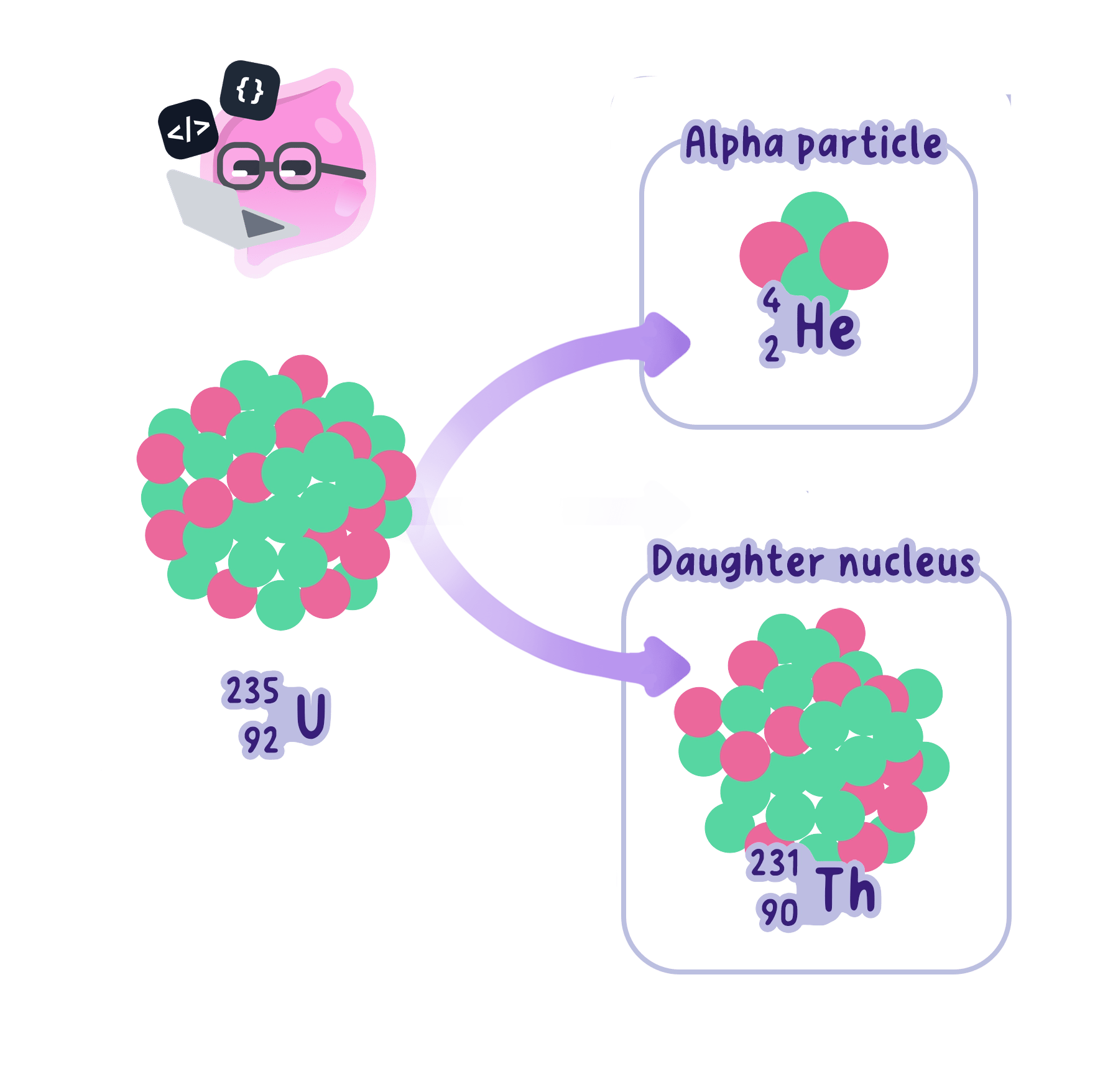
- It is relatively large and heavy and carries a 2+2+2+ charge, so it is the most strongly ionising.
- Because it interacts so strongly it has the shortest range: only a few centimetres in air, and it is stopped by a sheet of paper or by skin.
Beta: a fast electron made as a neutron becomes a proton
Beta particle
A high-speed electron emitted from the nucleus when a neutron changes into a proton.
- A beta particle (β\betaβ) is a high-speed electron thrown out of the nucleus.
- It is produced when a neutron in the nucleus turns into a proton.
- It is much lighter and less ionising than an alpha particle, so it travels further: about a few metres in air, and it is stopped by a few millimetres of aluminium.
Gamma: high-energy EM radiation, the most penetrating
Gamma ray
Electromagnetic radiation emitted from the nucleus of an atom.
- A gamma ray (γ\gammaγ) is electromagnetic radiation released from the nucleus.
- It has no mass and no charge, so it is the least ionising.
- It is the most penetrating: it has a long range in air and needs thick lead or several metres of concrete to reduce it.
Neutrons can also be emitted from the nucleus
- Some unstable nuclei give out a neutron (n\text{n}n).
- A neutron has no charge, which lets it travel a long way and pass into other nuclei.
Ionising power and penetration run in opposite orders
- Ionising power: alpha is strongest, then beta, then gamma is weakest.
- Penetration: gamma travels furthest, then beta, then alpha is stopped most easily.
- Stopped by: alpha by paper, beta by a few millimetres of aluminium, gamma only greatly reduced by thick lead or concrete.
- Alpha is the most ionising but the least penetrating, and gamma is the least ionising but the most penetrating, so do not mix the two orders up.
- A beta particle is a fast electron from the nucleus, not one of the electrons orbiting the atom.
- What is an alpha particle made of?
- How is a beta particle produced in the nucleus?
- What type of radiation is a gamma ray?
- Put alpha, beta and gamma in order of ionising power.
- Which materials are used to stop alpha, beta and gamma radiation?
