4.1.3a The development of the model of the atom: early models
Models of the atom change when new evidence appears
Scientific model
A way of describing something we cannot see directly, used to explain observations and predict how it will behave.
- A scientific model is only kept while it fits the evidence.
- When an experiment gives results the old model cannot explain, the model is changed or replaced.
- The accepted picture of the atom has changed several times as new experiments were carried out.
The first model: tiny, solid, indivisible spheres
- Before the electron was discovered, atoms were thought to be tiny solid spheres that could not be divided into anything smaller.
- This model had no internal parts and no charged particles inside it.
The plum pudding model: electrons dotted through positive charge
Plum pudding model
An early model of the atom as a ball of positive charge with negative electrons embedded in it.
- The discovery of the electron showed that atoms do contain smaller, charged particles, so the solid-sphere idea could not be right.
- The plum pudding model pictured the atom as a ball of positive charge with tiny negative electrons dotted through it.
- In this model the positive charge was spread out evenly across the whole atom.
Picture a fruit scone: the dough is the spread-out positive charge and the raisins are the electrons set into it.
New evidence forces a new model: the nuclear atom
- To test the plum pudding model, a beam of positively charged alpha particles was fired at a very thin sheet of gold foil.
- Most of the alpha particles passed straight through the foil with little or no change in direction.
- A small number were deflected through large angles.
- A very few, about 111 in every 10 00010\,00010000, bounced almost straight back towards the source.
- Passing straight through shows that the atom is mostly empty space.
- The large deflections show there is a concentrated region of positive charge that repels the positively charged alpha particles.
- The few that bounce back show that this central charge is very dense and holds most of the atom's mass: this is the nucleus.
The scattering results showed that mass and positive charge are concentrated in a tiny central nucleus, so the nuclear model replaced the plum pudding model.
- In the plum pudding model the positive charge is spread out with electrons embedded in it.
- In the nuclear model the positive charge and mass are packed into a tiny central nucleus, with electrons around the outside.
- The spread-out charge of the plum pudding model could not explain why some alpha particles bounced back, which is why the model was replaced.
- Why do scientific models of the atom get changed or replaced?
- What did the plum pudding model say the atom was made of?
- In the scattering experiment, what happened to most of the alpha particles?
- What did the small number of large deflections tell scientists about the atom?
- What did a few alpha particles bouncing back show about the nucleus?
4.1.3b The development of the model of the atom: the nuclear model develops
Bohr fixed the electrons into definite orbits
Bohr model
A refinement of the nuclear model in which electrons orbit the nucleus at specific, fixed distances.
- The nuclear model said electrons surround the nucleus, but it did not say where they were.
- Niels Bohr suggested that electrons orbit the nucleus at specific fixed distances, which are the energy levels.
- Bohr's theoretical calculations agreed with the results measured in experiments, which is why his idea was accepted.
These fixed distances are the same energy levels an electron moves between when it absorbs or emits electromagnetic radiation.
The positive charge of the nucleus splits into protons
Proton
A positively charged particle found in the nucleus; every proton carries the same size of positive charge.
- Later experiments showed the positive charge of a nucleus is not a single lump.
- It is made of a whole number of smaller particles, each carrying the same amount of positive charge.
- These particles were named protons.
Chadwick's work showed the nucleus also contains neutrons
Neutron
An uncharged particle found in the nucleus, with a mass close to that of a proton.
- Scientists still needed to account for the rest of the nucleus's mass.
- About 202020 years after the nucleus became an accepted idea, James Chadwick found evidence for a neutral particle in the nucleus.
- This particle is the neutron, which adds mass to the nucleus but carries no charge.
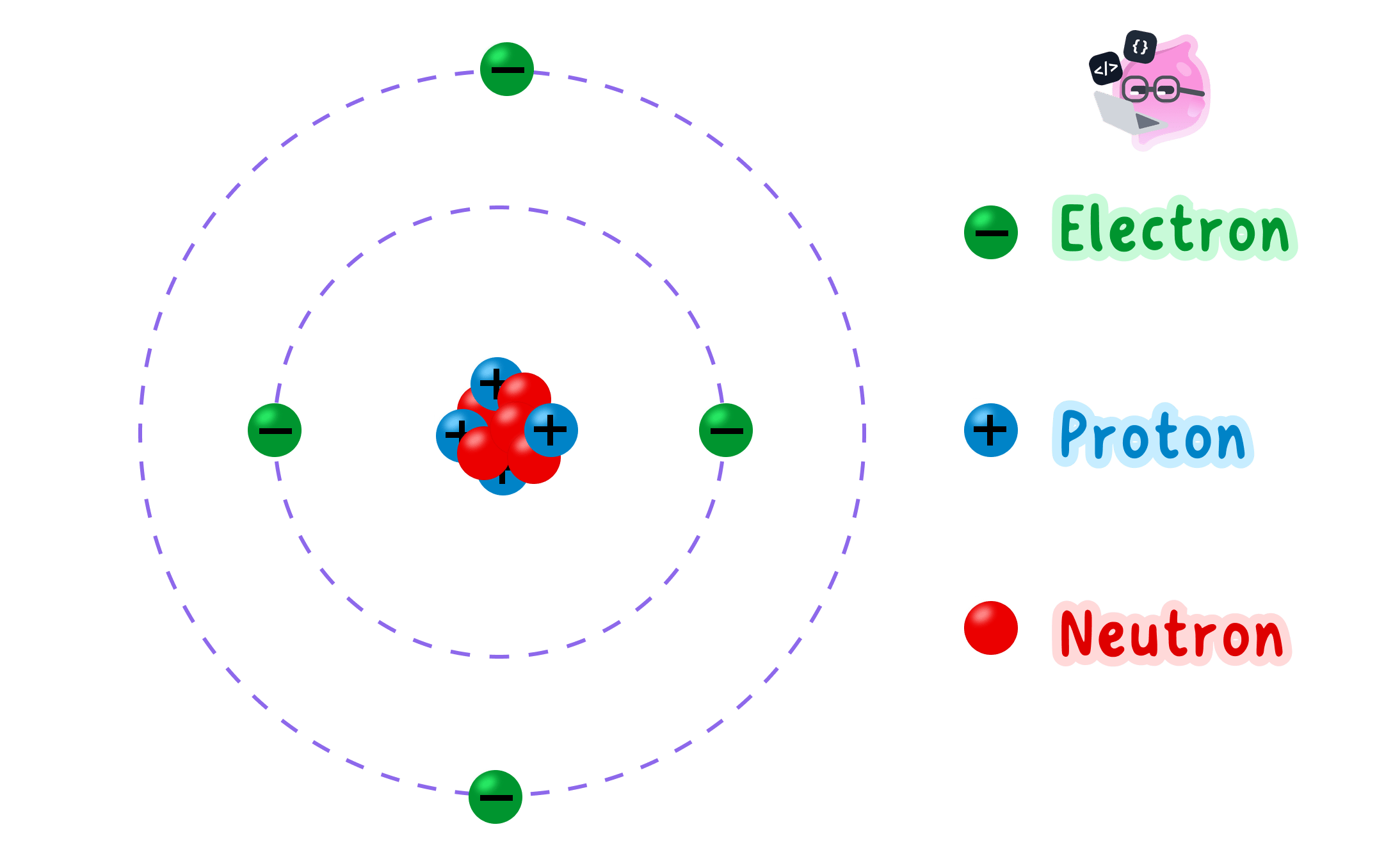
The model of the atom developed in stages:
- solid indivisible sphere,
- plum pudding model,
- nuclear model from the scattering experiment,
- Bohr's electron orbits,
- the positive charge split into protons,
- Chadwick's evidence for the neutron.
You are not expected to recall the experimental details of Bohr's calculations or Chadwick's work; focus on what each one concluded.
- How did Bohr change the nuclear model of the atom?
- Why was Bohr's model accepted by other scientists?
- What are the small particles of positive charge in the nucleus called?
- Whose work provided evidence for the neutron, and roughly how long after the nucleus was accepted?
- What does a neutron add to the nucleus, and what is its charge?
