Nuclear equations keep track of mass number and charge in decay
Definition
Nuclear equation
A balanced equation representing radioactive decay, in which the mass numbers and the atomic numbers add up to the same total on both sides.
- Radioactive decay can be written as a nuclear equation, with the original nucleus on the left and what it becomes on the right.
- In a nuclear equation an alpha particle is written as 24He^{4}_{2}\text{He}24He and a beta particle as −10e^{0}_{-1}\text{e}−10e.
- The total mass number (top) and the total atomic number (bottom) must be the same on both sides of the equation.
Alpha decay lowers both the mass number and the charge
- In alpha decay the nucleus emits an alpha particle, losing 2 protons and 2 neutrons.
- The mass number falls by 4 and the atomic number falls by 2.
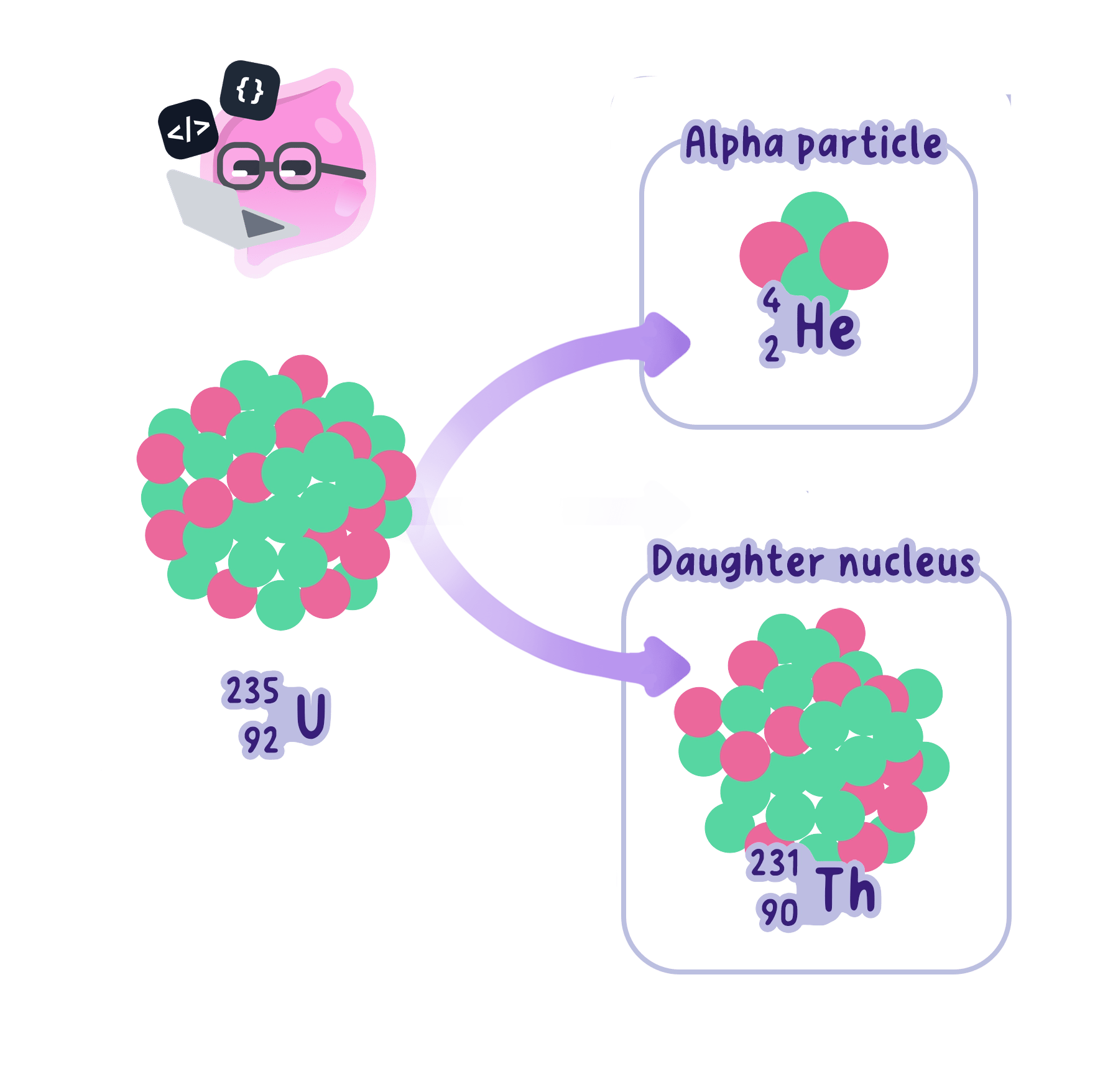
Example
- A radon nucleus decays by emitting an alpha particle.
- Check it balances: the mass numbers give 218+4=222218 + 4 = 222218+4=222, and the atomic numbers give 84+2=8684 + 2 = 8684+2=86.
Beta decay raises the charge but leaves the mass number unchanged
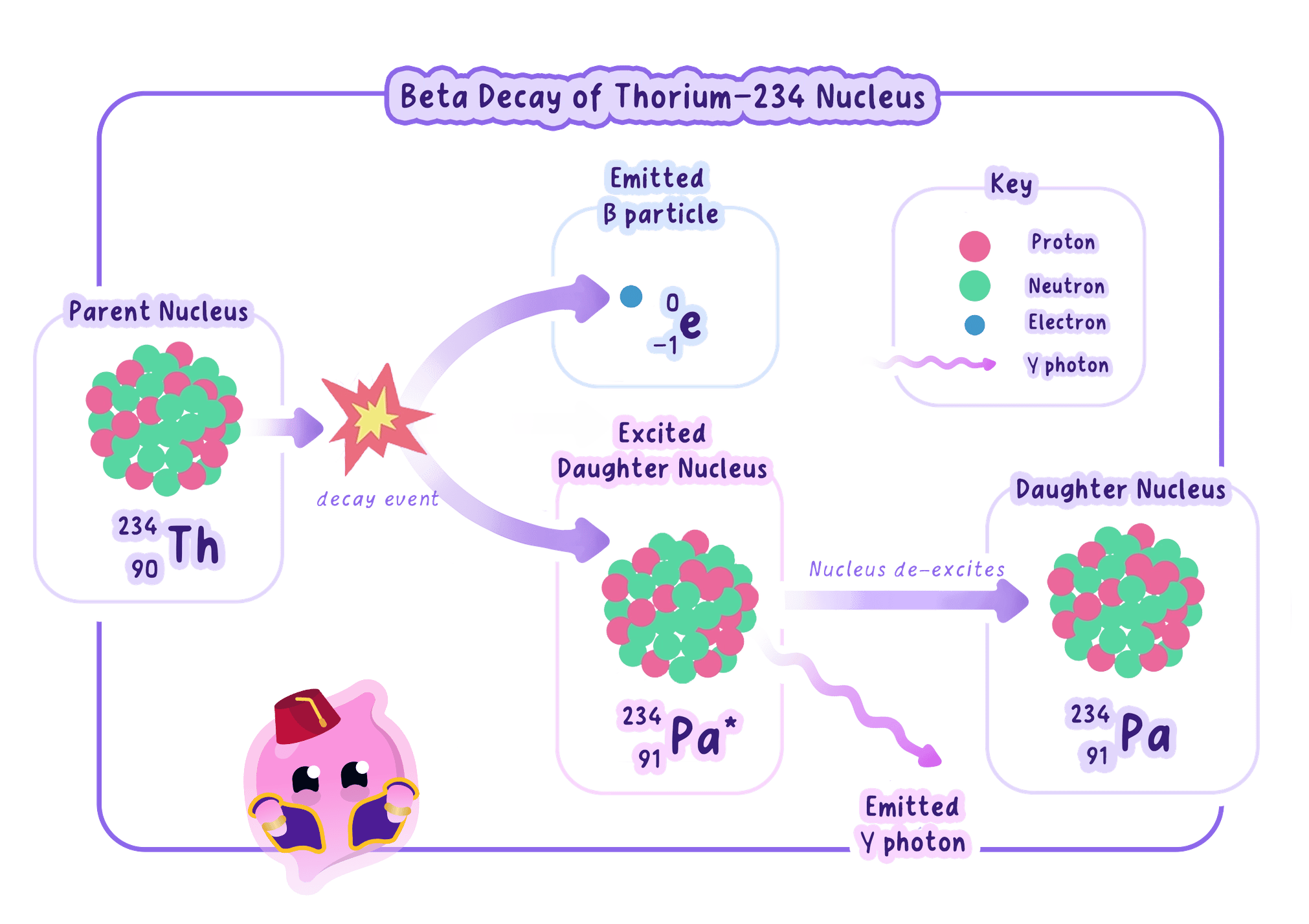
- In beta decay a neutron in the nucleus turns into a proton and throws out a fast electron, the beta particle.
- The mass number stays the same, but the atomic number goes up by 1.
Example
- A carbon-14 nucleus decays by emitting a beta particle.
- Check it balances: the mass numbers give 14=14+014 = 14 + 014=14+0, and the atomic numbers give 7+(−1)=67 + (-1) = 67+(−1)=6.
Gamma emission changes neither the mass number nor the charge
- A gamma ray carries away energy but has no mass and no charge.
- So emitting a gamma ray leaves both the mass number and the atomic number of the nucleus unchanged.
Common Mistake
- Alpha decay changes both the mass number and the charge, beta decay changes only the charge, and gamma emission changes neither.
- When you balance an equation, remember the beta particle counts as atomic number −1-1−1, so the atomic number on the right still adds up correctly.
Self review
- What symbols are used for an alpha particle and a beta particle in a nuclear equation?
- What must be equal on both sides of a balanced nuclear equation?
- How do the mass number and atomic number change in alpha decay?
- How do the mass number and atomic number change in beta decay?
- Why does gamma emission leave the mass number and atomic number unchanged?
