Question 3
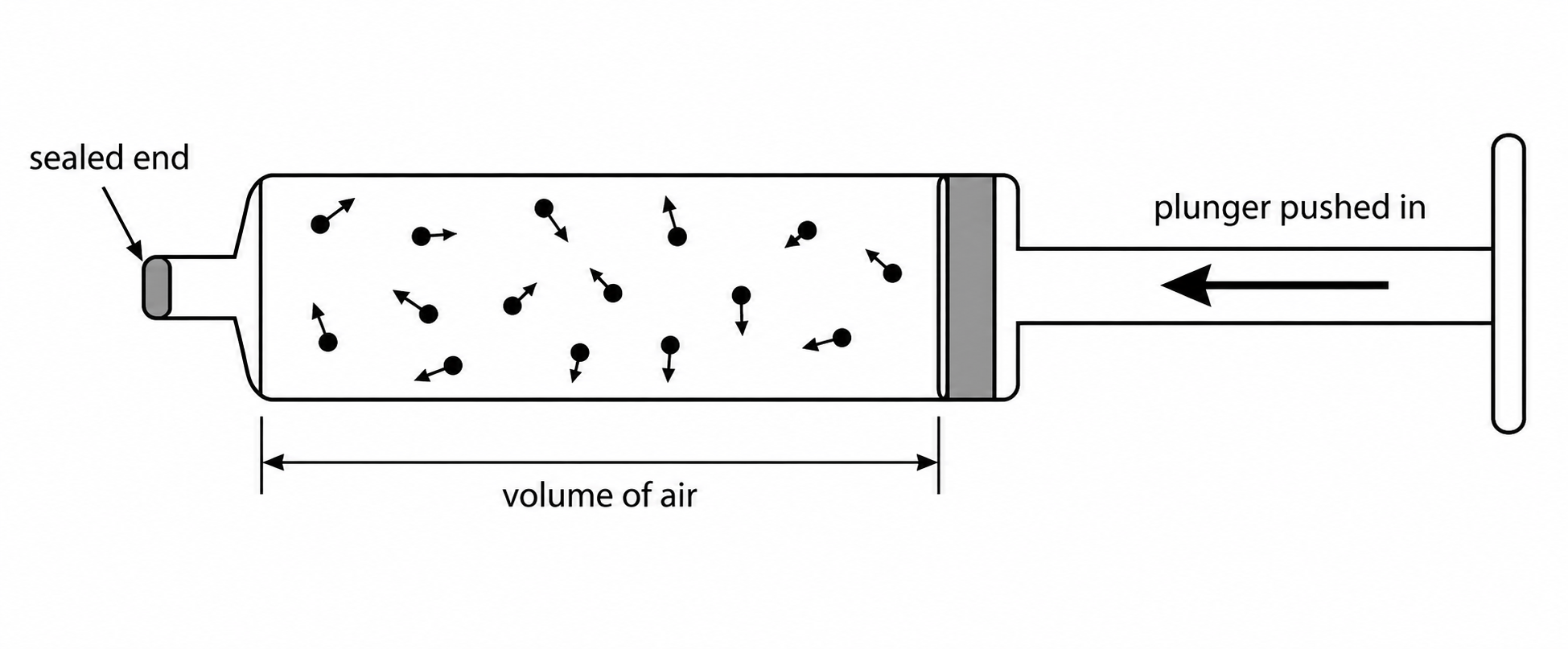
FFigure shows a sealed syringe containing air. A student pushes the plunger in slowly until the volume of the air is halved. The temperature of the air does not change.
Figure: a sealed syringe containing air, with the plunger being pushed in
a.[3]
Explain why the pressure of the air increases as the plunger is pushed in.
b.[1]
The plunger is then held still and the air inside the syringe is warmed. Write down what happens to the pressure of the air.
c.[2]
The student says that the molecules of air become smaller when the plunger is pushed in. Explain why the student is wrong.
3.3 Particle model and pressure Questions
40 exam-style questions on AQA GCSE Physics 3.3 Particle model and pressure, covering 3.3.1 Particle motion in gases, 3.3.2 Pressure in gases, and 3.3.3 Increasing the pressure of a gas (HT only). Each one has a worked solution and a mark scheme showing where the marks go.