4.2.3a Half-lives and the random nature of radioactive decay
Decay is random for one nucleus but predictable for a whole sample
Definition
Half-life
The time taken for the number of unstable nuclei in a sample to halve, or for the count-rate (or activity) to fall to half its starting value.
- You cannot predict when any single nucleus will decay, because decay is random.
- A real sample contains a huge number of nuclei, so on average its activity falls in a predictable way.
- This predictable pattern is described by the half-life.
Half-life: the time for the count-rate to halve
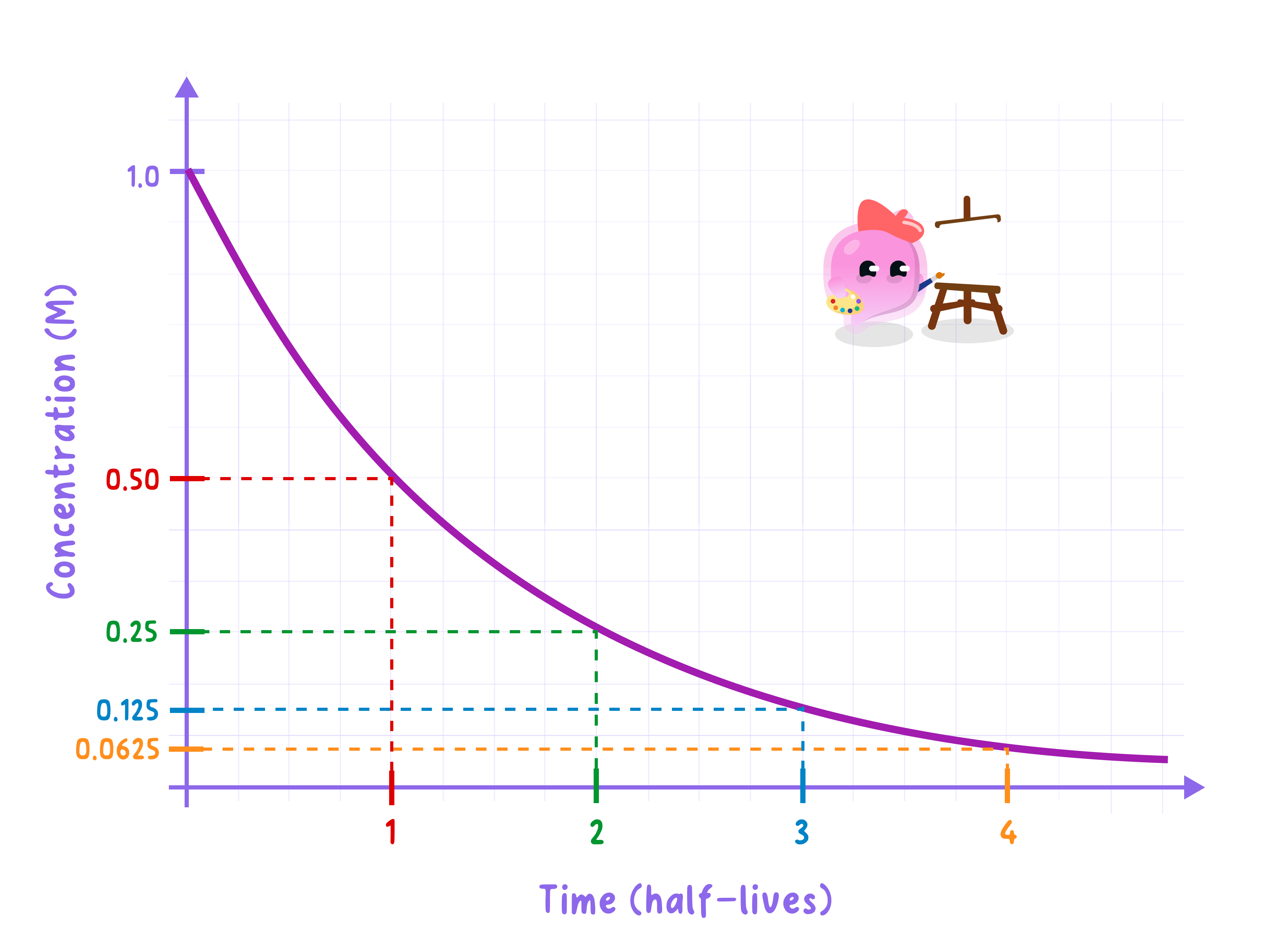
- The half-life is the time it takes for the number of unstable nuclei, or the count-rate, to fall to a half.
- After each half-life the count-rate halves again, so after nnn half-lives the fraction remaining is (12)n\left(\tfrac{1}{2}\right)^{n}(21)n.
- This gives: remaining count-rate === initial count-rate ×(12)n\times \left(\tfrac{1}{2}\right)^{n}×(21)n.
Example
- A source has a count-rate of 640640640 counts/s and a half-life of 666 days. Find the count-rate after 181818 days.
- 18 days18\ \text{days}18 days is 18÷6=318 \div 6 = 318÷6=3 half-lives, so halve the count-rate three times:
- After 181818 days the count-rate is 808080 counts/s.
Common Mistake
- Half-life is not the time for the sample to decay completely, nor half of that time.
- It is the time for the count-rate to fall by half, and the same length of time halves it again.
Self review
- What is meant by the half-life of a radioactive isotope?
- Why can the decay of a whole sample be predicted even though single nuclei are random?
- What fraction of the original nuclei remains after 3 half-lives?
- A source has a count-rate of 800800800 counts/s and a half-life of 222 hours; what is the count-rate after 666 hours?
4.2.3b Net decline after a number of half-lives
Net decline compares the radiation left with what you started with
Definition
Net decline
The overall fall in a radioactive emission after a number of half-lives, usually written as a ratio comparing the final amount with the initial amount.
- After each half-life the count-rate falls to a half, so after nnn half-lives the fraction remaining is (12)n=12n\left(\tfrac{1}{2}\right)^{n} = \dfrac{1}{2^{n}}(21)n=2n1.
- The net decline is written as a ratio comparing the initial and final count-rates.
- After 111, 222, 333 and 444 half-lives the fraction left is 12\tfrac{1}{2}21, 14\tfrac{1}{4}41, 18\tfrac{1}{8}81 and 116\tfrac{1}{16}161.
Example
- A source falls through 444 half-lives. Give the net decline as a ratio.
- After 444 half-lives the fraction remaining is 124=116\dfrac{1}{2^{4}} = \dfrac{1}{16}241=161.
- So final : initial =1:16= 1 : 16=1:16, which is the same as an initial : final ratio of 16:116 : 116:1.
Note
This ratio calculation is only needed at Higher tier.
Common Mistake
- Read whether the question wants the amount remaining compared with the start (1:161 : 161:16) or the decline written as start compared with end (16:116 : 116:1).
- State which way round your ratio goes so its meaning is clear.
Self review
- What fraction of a source remains after 5 half-lives?
- Write the net decline after 5 half-lives as an initial : final ratio.
- What fraction remains after 3 half-lives?
- How do you work out the fraction remaining after nnn half-lives?
