5.7.1 Momentum
Momentum
Definition
Momentum
Momentum is the product of an object's mass and its velocity.
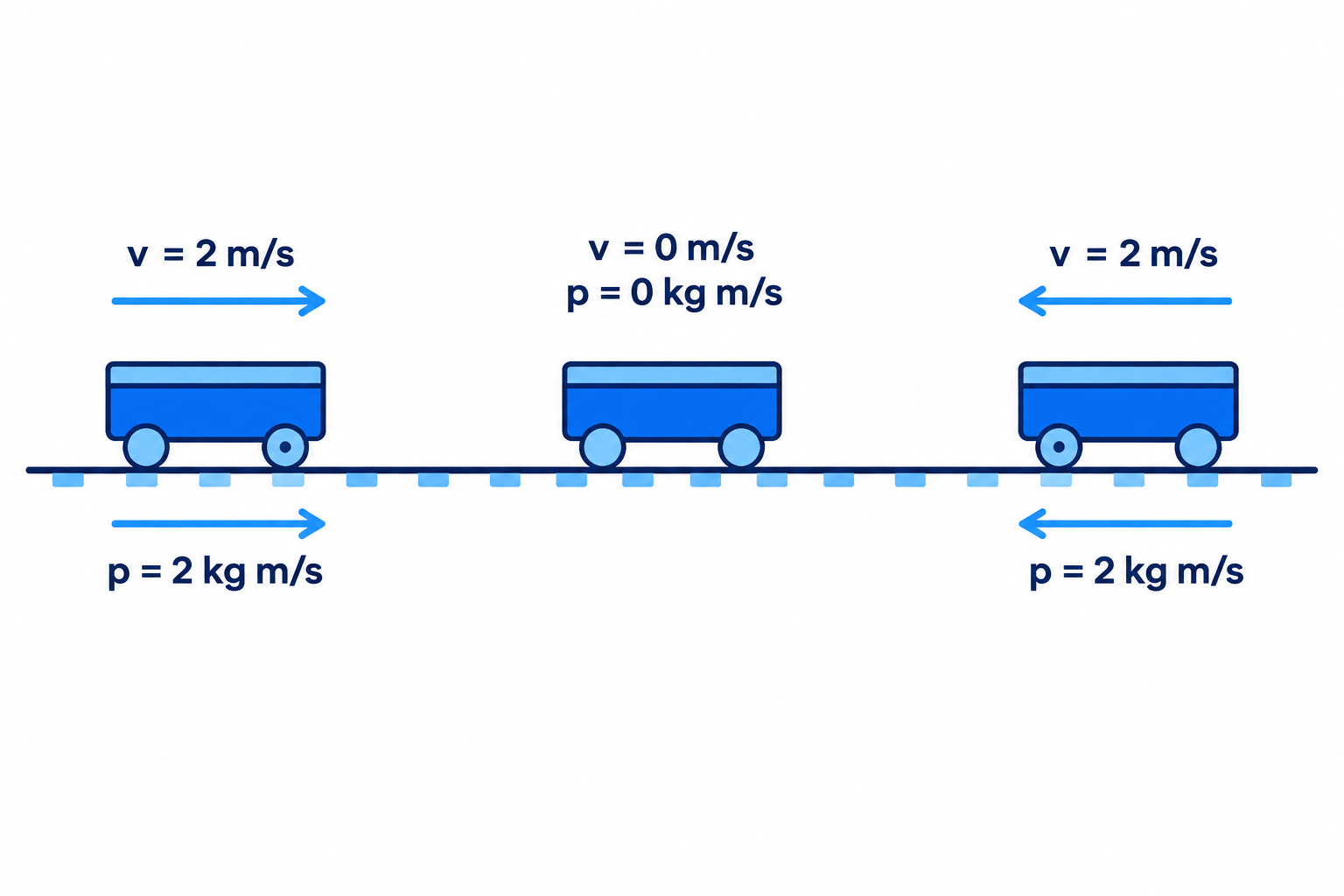
- Every moving object has momentum because it has both mass and a velocity.
- A stationary object has a velocity of 0 m/s0\ \text{m/s}0 m/s, so its momentum is 0 kg m/s0\ \text{kg m/s}0 kg m/s.
- Momentum is a vector, so it has a size and a direction, pointing the same way as the velocity.
- Momentum is calculated from p=mvp = mvp=mv, where ppp is momentum in kg m/s\text{kg m/s}kg m/s, mmm is mass in kg\text{kg}kg and vvv is velocity in m/s\text{m/s}m/s.
- For the same velocity, a greater mass gives greater momentum.
- For the same mass, a greater velocity gives greater momentum.
- If either the mass or the velocity doubles while the other stays the same, the momentum doubles.
Calculating momentum
- To find momentum, put the mass in kg\text{kg}kg and the velocity in m/s\text{m/s}m/s into p=mvp = mvp=mv.
- Convert grams to kg\text{kg}kg and km/h\text{km/h}km/h to m/s\text{m/s}m/s before substituting.
- You can rearrange p=mvp = mvp=mv when the momentum is known: use m=pvm = \dfrac{p}{v}m=vp to find mass, or v=pmv = \dfrac{p}{m}v=mp to find velocity.
Example
A car of mass 1200 kg1200\ \text{kg}1200 kg travels at 15 m/s15\ \text{m/s}15 m/s. Calculate its momentum.
- State the equation: p=mvp = mvp=mv.
- Substitute the values: p=1200×15p = 1200 \times 15p=1200×15.
- Calculate the answer: p=18 000 kg m/sp = 18\,000\ \text{kg m/s}p=18000 kg m/s.
Example
An object has momentum 54 kg m/s54\ \text{kg m/s}54 kg m/s and mass 6.0 kg6.0\ \text{kg}6.0 kg. Calculate its velocity.
- State the equation: p=mvp = mvp=mv.
- Rearrange for velocity: v=pmv = \dfrac{p}{m}v=mp.
- Substitute the values: v=546.0v = \dfrac{54}{6.0}v=6.054.
- Calculate the answer: v=9.0 m/sv = 9.0\ \text{m/s}v=9.0 m/s.
Common Mistake
- Do not confuse momentum with force: momentum is measured in kg m/s\text{kg m/s}kg m/s, never in newtons.
- Always use mass in kg\text{kg}kg; if it is given in grams, divide by 100010001000 first.
- Always use velocity in m/s\text{m/s}m/s, not km/h\text{km/h}km/h.
Exam technique
- Write p=mvp = mvp=mv before substituting, so you can still earn the equation mark if the arithmetic slips.
- Show any rearrangement, substitute with units, and give the answer in kg m/s\text{kg m/s}kg m/s.
Self review
- What is momentum?
- What is the equation for momentum, and the unit of each quantity?
- What is the momentum of a stationary object?
- What happens to momentum if the velocity doubles and the mass stays the same?
- How do you rearrange p=mvp = mvp=mv to find velocity?