5.7.2a Conservation of momentum
Conservation of momentum
Conservation of momentum
In a closed system, the total momentum before an event equals the total momentum after the event.
- A closed system is one in which no external force changes the total momentum.
- Objects inside the system can push on each other, but these internal forces do not change the system's total momentum.
- Momentum is a vector, so direction matters when the momenta are added; one direction is taken as positive and the opposite as negative.
- The rule is written as total momentum before === total momentum after, with each object's momentum found from p=mvp = mvp=mv.
During a collision the momentum of each object can change as momentum is transferred between them, but the total momentum of a closed system stays the same.
Describing collisions using momentum
- Picture a moving trolley colliding with a stationary one.
- Before the collision the moving trolley has momentum and the stationary trolley has zero momentum.
- During the collision momentum is transferred from the moving trolley to the stationary one.
- Afterwards the trolleys may move separately or join together, but their combined momentum is unchanged if the system is closed.
- For two objects this is written m1u1+m2u2=m1v1+m2v2m_1u_1 + m_2u_2 = m_1v_1 + m_2v_2m1u1+m2u2=m1v1+m2v2, where uuu is velocity before and vvv is velocity after.
- If the objects stick together they share one final velocity, so m1u1+m2u2=(m1+m2)vm_1u_1 + m_2u_2 = (m_1 + m_2)vm1u1+m2u2=(m1+m2)v.
A 2.0 kg2.0\ \text{kg}2.0 kg trolley at 4.0 m/s4.0\ \text{m/s}4.0 m/s hits a stationary 3.0 kg3.0\ \text{kg}3.0 kg trolley and they join together. Find their velocity afterwards.
- Find the total momentum before: p=(2.0×4.0)+(3.0×0)=8.0 kg m/sp = (2.0 \times 4.0) + (3.0 \times 0) = 8.0\ \text{kg m/s}p=(2.0×4.0)+(3.0×0)=8.0 kg m/s.
- Find the combined mass: m=2.0+3.0=5.0 kgm = 2.0 + 3.0 = 5.0\ \text{kg}m=2.0+3.0=5.0 kg.
- Apply conservation of momentum: 8.0=5.0×v8.0 = 5.0 \times v8.0=5.0×v.
- Rearrange and calculate: v=8.05.0=1.6 m/sv = \dfrac{8.0}{5.0} = 1.6\ \text{m/s}v=5.08.0=1.6 m/s in the original direction.
Explaining a collision
- Identify the closed system, then compare the total momentum before and after.
- Before the collision the moving object has momentum and the stationary object has zero momentum.
- During the collision momentum is transferred between the objects.
- Because the system is closed, the total momentum stays constant, so total momentum after equals total momentum before.
Elastic and inelastic collisions
Elastic collision
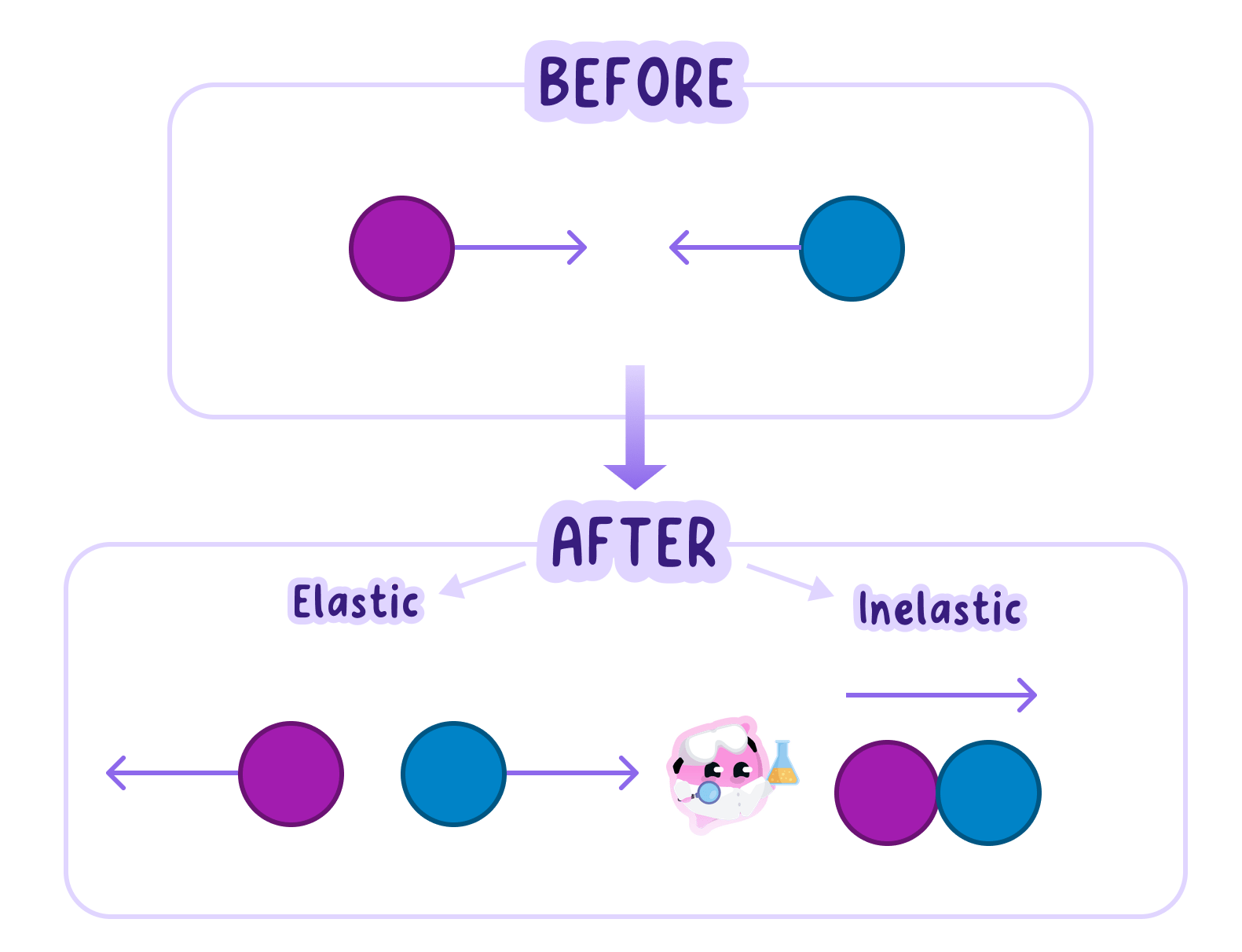
An elastic collision is one in which the total kinetic energy is conserved, as well as momentum.
Inelastic collision
An inelastic collision is one in which momentum is conserved but the total kinetic energy is not, because some is transferred to other energy stores.
- In both elastic and inelastic collisions, the total momentum of a closed system is conserved.
- In an elastic collision the objects bounce apart and the total kinetic energy after the collision equals the total kinetic energy before it.
- In an inelastic collision some kinetic energy is transferred to other stores, such as thermal and sound, so there is less kinetic energy after the collision than before.
- When two objects stick together in a collision, the collision is inelastic, because kinetic energy is transferred to other stores even though momentum is still conserved.
- It is the total momentum of the whole closed system that is conserved, not each object's momentum.
- Do not confuse conservation of momentum with conservation of kinetic energy: momentum is still conserved even when kinetic energy is transferred to other stores.
- Include direction: if two objects move in opposite directions, one velocity must be negative.
- Choose a positive direction, calculate total momentum before, set it equal to total momentum after, then rearrange for the unknown.
- Use the phrases closed system, total momentum before, total momentum after and momentum is conserved.
- What is conservation of momentum?
- What is a closed system?
- What equation gives an object's momentum?
- Why must direction be considered?
- In a collision, can a single object's momentum change?
- What do two objects share if they join after colliding?
5.7.2b Calculating momentum in collisions
Momentum in collisions
Momentum
Momentum is the product of an object's mass and velocity, p=mvp = mvp=mv, measured in kg m/s\text{kg m/s}kg m/s.
Closed system
A closed system is one in which no external resultant force acts on the objects involved.
- Momentum is used as a model for an event such as a collision.
- Because momentum is conserved in a closed system, total momentum before === total momentum after.
- This works because momentum is transferred between the objects while the total stays the same when there is no external resultant force.
Setting up a collision calculation
- A question may ask for an unknown velocity, mass or momentum after two objects collide.
- Write the momentum equation p=mvp = mvp=mv.
- Choose a positive direction, for example motion to the right, so motion to the left is negative.
- Calculate the total momentum before by adding each object's mvmvmv.
- Write an expression for the total momentum after.
- Set total momentum before equal to total momentum after and rearrange for the unknown.
- Because momentum uses velocity, give a negative sign to any object moving in the negative direction.
A 1.2 kg1.2\ \text{kg}1.2 kg trolley moves right at 3.0 m/s3.0\ \text{m/s}3.0 m/s into a stationary 0.8 kg0.8\ \text{kg}0.8 kg trolley; they stick together. Find their velocity.
- Take right as positive.
- Total momentum before: p=(1.2×3.0)+(0.8×0)=3.6 kg m/sp = (1.2 \times 3.0) + (0.8 \times 0) = 3.6\ \text{kg m/s}p=(1.2×3.0)+(0.8×0)=3.6 kg m/s.
- Combined mass after: m=1.2+0.8=2.0 kgm = 1.2 + 0.8 = 2.0\ \text{kg}m=1.2+0.8=2.0 kg.
- Apply conservation of momentum: 3.6=2.0×v3.6 = 2.0 \times v3.6=2.0×v.
- Rearrange and calculate: v=3.62.0=1.8 m/sv = \dfrac{3.6}{2.0} = 1.8\ \text{m/s}v=2.03.6=1.8 m/s to the right.
A 0.50 kg0.50\ \text{kg}0.50 kg ball moves right at 6.0 m/s6.0\ \text{m/s}6.0 m/s and meets a 0.30 kg0.30\ \text{kg}0.30 kg ball moving left at 4.0 m/s4.0\ \text{m/s}4.0 m/s. Afterwards the 0.50 kg0.50\ \text{kg}0.50 kg ball moves right at 2.0 m/s2.0\ \text{m/s}2.0 m/s. Find the velocity of the 0.30 kg0.30\ \text{kg}0.30 kg ball.
- Take right as positive, so left is negative.
- Total momentum before: p=(0.50×6.0)+(0.30×−4.0)=1.8 kg m/sp = (0.50 \times 6.0) + (0.30 \times -4.0) = 1.8\ \text{kg m/s}p=(0.50×6.0)+(0.30×−4.0)=1.8 kg m/s.
- Total momentum after: p=(0.50×2.0)+(0.30×v)=1.0+0.30vp = (0.50 \times 2.0) + (0.30 \times v) = 1.0 + 0.30vp=(0.50×2.0)+(0.30×v)=1.0+0.30v.
- Apply conservation of momentum: 1.8=1.0+0.30v1.8 = 1.0 + 0.30v1.8=1.0+0.30v.
- Rearrange and calculate: 0.8=0.30v0.8 = 0.30v0.8=0.30v, so v=0.80.30=2.7 m/sv = \dfrac{0.8}{0.30} = 2.7\ \text{m/s}v=0.300.8=2.7 m/s to the right.
- Momentum uses velocity, not just speed, so include direction when objects move different ways.
- A stationary object has momentum 0 kg m/s0\ \text{kg m/s}0 kg m/s.
- Use the total momentum of the whole system, not one object's momentum.
- Never miss the negative sign for an object moving the opposite way.
- Use conservation of momentum, not conservation of energy, because kinetic energy is not always conserved in a collision.
- Show the equation, the chosen positive direction, total momentum before and after, and a final answer with unit.
- If a final velocity comes out negative, it means the object moves in the direction you chose as negative.
- Which equation gives momentum, and its unit?
- What is conserved in a closed system during a collision?
- Why does direction matter?
- How do you show an object moving the opposite way?
- What must a final velocity answer include?
