- Why gas pressure is caused by particles colliding with surfaces.
- What it means to do work on a gas.
- How compressing an enclosed gas can increase its internal energy and temperature.
- How to explain examples such as a bicycle pump in clear GCSE exam language.
A gas is made of tiny particles moving quickly in random directions. The particles are far apart compared with particles in solids and liquids, so gases can be squashed into a smaller volume.
A collision happens when a gas particle hits another particle or the wall of its container and bounces off. Every time a particle hits a surface, it exerts a tiny force on that surface.
Gas pressure
Pressure is force per unit area. In a gas, pressure is caused by gas particles colliding with the walls of their container.
p=FAp = \frac{F}{A}p=AF
Pressure is measured in pascals (Pa).
If there are more collisions each second, the pressure increases. If the particles are moving faster, each collision is “harder”, so the pressure also increases.
How gas pressure increases
Gas pressure increases when particles collide with the container walls more often, with greater force, or both.
Compressing a sealed syringe
A syringe contains trapped air and the end is sealed. The plunger is pushed in slowly. Explain why the pressure of the air increases.
- The air is enclosed, so the same number of gas particles is trapped inside the syringe.
- Pushing the plunger in reduces the volume, so each particle has less distance to travel before hitting a wall.
- The particles collide with the syringe walls more often, so the force per unit area increases.
- Therefore, the pressure of the trapped air increases.
The particles in a gas are moving, so they have kinetic energy. Kinetic energy is the energy an object has because it is moving.
Internal energy
The internal energy of a substance is the total energy stored by its particles. At GCSE, this includes the particles’ kinetic energy and potential energy.
For a gas, the particles are spread out, so the temperature is mainly linked to the particles’ kinetic energy.
Temperature
Temperature is a measure of the average kinetic energy of the particles in a substance. A higher temperature means the particles are moving faster on average.
The word average matters: not every particle has exactly the same speed. Some are faster and some are slower, but increasing the temperature increases the average kinetic energy.
Internal energy is not the same as temperature
A larger amount of gas can have more internal energy than a smaller amount at the same temperature, because it contains more particles. Temperature is about the average kinetic energy per particle.
In physics, work has a very specific meaning. It is not just “effort”; it means energy has been transferred by a force.
Work done
Work done is the transfer of energy by a force when an object moves in the direction of the force. If the force and movement are in the same direction:
W=FsW = F sW=Fs
where WWW is work done in joules (J), FFF is force in newtons (N), and sss is distance moved in metres (m).
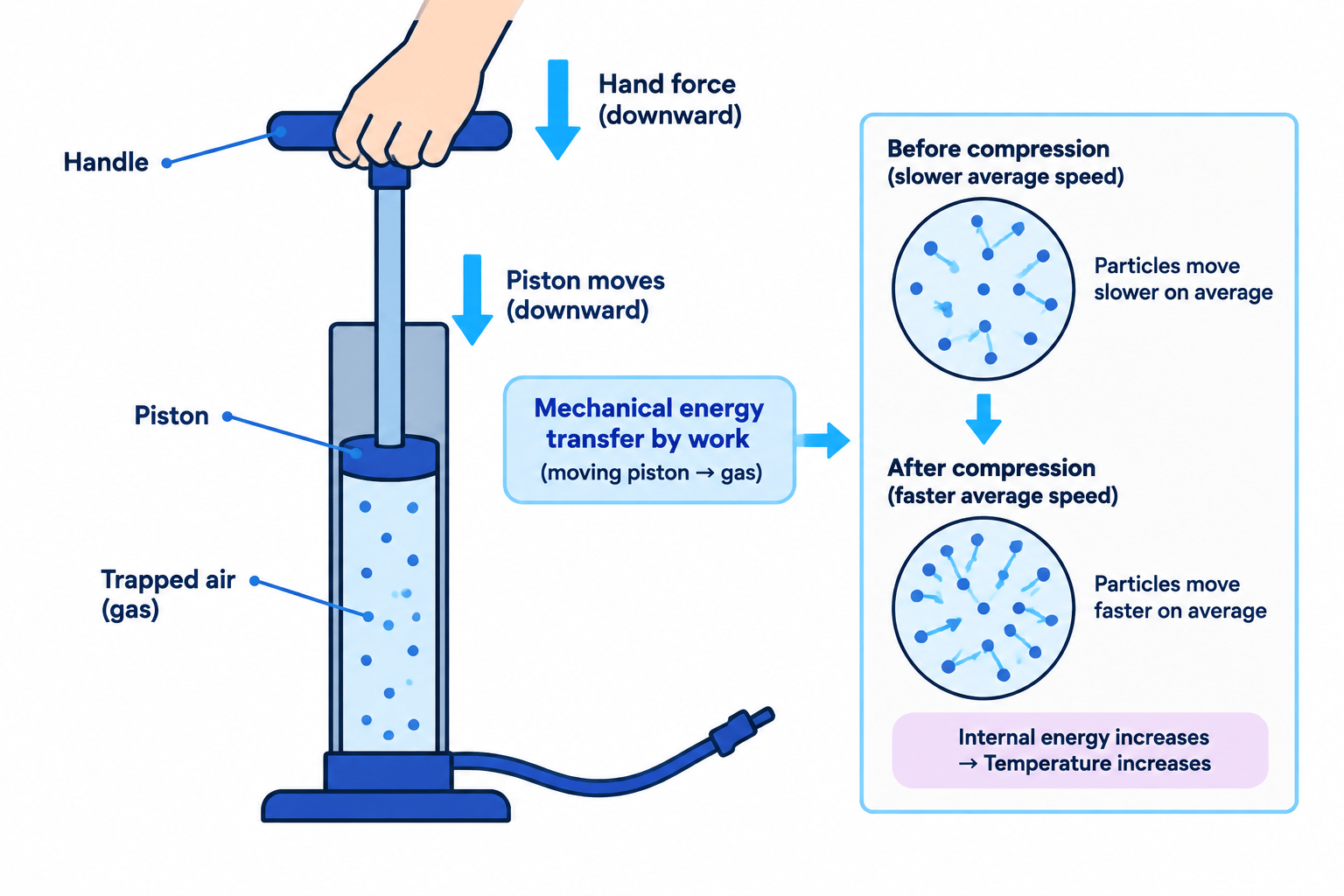
When you push a piston into a gas, your hand exerts a force and the piston moves. That means work is done on the gas.
A piston is a sliding part that can move inside a cylinder, like the plunger in a syringe or the moving part inside a bicycle pump. To compress a gas means to reduce its volume by squashing it.
Calculating work done on a gas
A piston is pushed with an average force of 40 N through a distance of 0.15 m. Calculate the work done on the gas.
-
Use the work done equation because a force moves the piston through a distance:
W=FsW = F sW=Fs
-
Substitute the values, keeping the units with the calculation:
W=40 N×0.15 mW=6.0 J\begin{aligned}
W &= 40\,\text{N} \times 0.15\,\text{m} \\
W &= 6.0\,\text{J}
\end{aligned}WW=40N×0.15m=6.0J
-
The work done is 6.0 J, so 6.0 J of energy is transferred to the gas, assuming energy losses are ignored.
When you compress an enclosed gas, you push a piston into it. The piston is moving inwards, and gas particles collide with it.
Because the piston is moving towards the particles, the particles can rebound with greater speed after collisions. This means energy is transferred from the moving piston to the particles. Their kinetic energy increases, so the internal energy of the gas increases. This can cause the temperature of the gas to increase.

Doing work on a gas
Doing work on an enclosed gas transfers energy to its particles. This increases the internal energy of the gas and can increase its temperature.
There are two linked reasons why the pressure can increase when you squash a gas.
If the same number of particles is trapped in a smaller space, the particles hit the container walls more often. More collisions each second means a larger force on the walls.
So, reducing the volume tends to increase the pressure.
If work is done on the gas, the particles gain kinetic energy. They move faster on average.
Faster particles collide with the walls more often and with greater force, so this can also increase the pressure.
Put together:
- smaller volume → more frequent collisions
- higher temperature → faster particles and harder collisions
- both effects → increased pressure
Explaining a bicycle pump getting warm and hard to push
When you use a bicycle pump, the pump can become warm and harder to push. Explain why.
- Your hand exerts a force on the pump handle, and the piston moves, so work is done on the air inside the pump.
- The work done transfers energy from your hand to the air particles, increasing the internal energy of the air.
- The air particles move faster on average, so the temperature of the air can increase; some energy is then transferred to the pump walls, making the pump feel warm.
- The piston also reduces the volume of the trapped air, so the particles collide with the walls and piston more often.
- Faster and more frequent collisions increase the pressure, so the air pushes back harder on the piston and the pump becomes harder to push.
The spec says doing work on a gas can cause an increase in temperature. It usually does during quick compression, such as using a bicycle pump, but the size of the temperature rise depends on energy transfer to the surroundings.
If the gas is compressed slowly, energy may be transferred from the gas to the surroundings as it is being compressed. Then the temperature rise may be smaller.
Fast and slow compression
Fast compression gives less time for energy to be transferred away to the surroundings, so the gas is more likely to heat up noticeably. Slow compression gives more time for energy transfer to the surroundings.
Using Boyle’s law at the wrong time
The relationship pV=constantpV = \text{constant}pV=constant only applies to a fixed mass of gas at constant temperature. In this topic, doing work on a gas can increase its temperature, so do not automatically assume pVpVpV stays constant unless the question says the temperature is constant.
A strong explanation usually follows a chain of cause and effect. You want to connect the force on the gas to the particle behaviour and then to the pressure or temperature change.
A strong explanation chain
Use this order: force moves piston → work done on gas → energy transferred to particles → internal energy increases → temperature can increase → particles move faster → pressure increases because collisions are more frequent and harder.
You do not need A-level ideas or complicated equations here. The GCSE explanation is about energy transfer and particle collisions.
In this topic, the important case is work done on a gas. That happens when an external force compresses the gas.
If a gas expands and pushes a piston out, then the gas is doing work on the piston. That would transfer energy away from the gas instead. For this section, keep your focus on compression: energy is transferred into the gas.
In the exam
- Start with the force: say that a force moves the piston, so work is done on the gas.
- Link work done to energy transfer: energy is transferred to the gas particles, increasing the internal energy.
- Link internal energy to temperature: the particles have greater average kinetic energy, so the temperature can increase.
- Finish with pressure: particles collide with the walls more often and/or more forcefully, so the pressure increases.
Check yourself
- Why does reducing the volume of an enclosed gas increase its pressure?
- What does it mean to say that work is done on a gas?
- In a bicycle pump, why can the air and pump barrel become warm?