4.1.1a The structure of an atom
The atom: a tiny, dense nucleus surrounded by mostly empty space
Atom
The smallest particle of an element, with a radius of about 1×10⁻¹⁰ m1 \times 10^{-10}\ \text{m}1×10⁻¹⁰ m.
- Everything around you is built from atoms, and a typical atom has a radius of about 1×10⁻¹⁰ m1 \times 10^{-10}\ \text{m}1×10⁻¹⁰ m.
- Written out in full that is 0.0000000001 m0.0000000001\ \text{m}0.0000000001 m, so you could line up roughly ten billion atoms across a single metre.
- The value is given in standard form because the size is far smaller than one metre.
- An atom has no hard outer shell, so its radius is really the distance from the centre out to the outermost electrons.
A typical atomic radius is about 1×10⁻¹⁰ m1 \times 10^{-10}\ \text{m}1×10⁻¹⁰ m, and you should be able to recall this value.
Inside the atom: a positive nucleus with negative electrons around it
Nucleus
The tiny, positively charged centre of an atom; it contains protons and neutrons and holds almost all of the atom's mass.
- At the centre of every atom is a very small, positively charged nucleus.
- The nucleus contains two kinds of particle: positively charged protons and uncharged neutrons.
- Negatively charged electrons move around the nucleus in the space that surrounds it.
- An atom has no overall charge because it holds equal numbers of protons and electrons.
- In diagrams the nucleus is drawn far larger than it really is so the protons and neutrons can be seen, so those pictures are not drawn to scale.
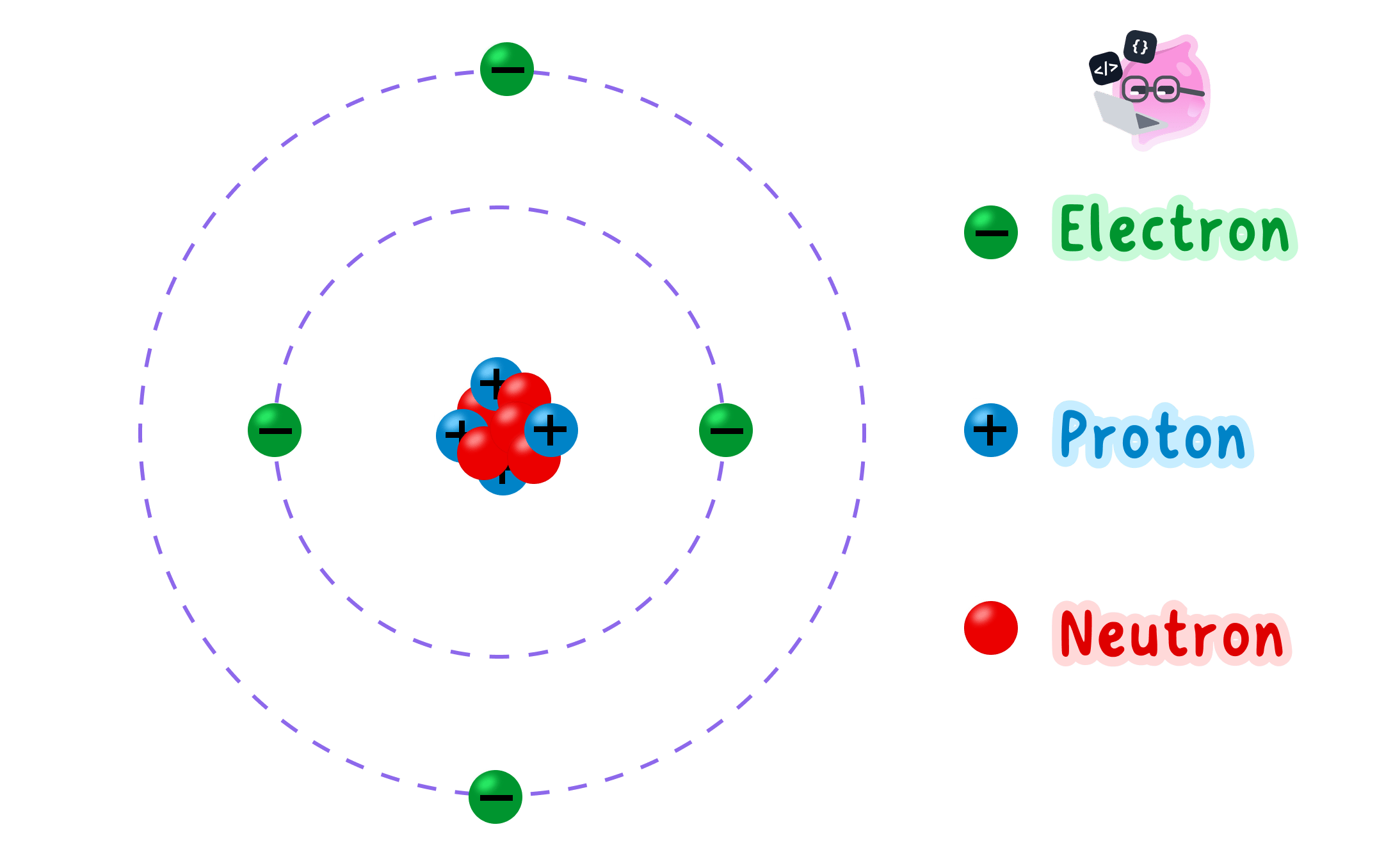
- Do not call the whole atom positive just because its nucleus is positive: overall the atom is neutral.
- Do not place electrons inside the nucleus: protons and neutrons sit in the nucleus, electrons surround it.
- Do not confuse size with mass: the nucleus is minute, yet it holds almost all the atom's mass.
The nucleus is minute but holds nearly all the mass
- The radius of the nucleus is less than 110 000\frac{1}{10\,000}100001 of the radius of the whole atom.
- So an atom is more than 10 00010\,00010000 times wider than its nucleus, which means the atom is mostly empty space.
- Even so, almost all of the atom's mass sits in the nucleus, because protons and neutrons are far heavier than electrons.
- Estimating the largest possible size of a nucleus. An atom has a radius of 1×10⁻¹⁰ m1 \times 10^{-10}\ \text{m}1×10⁻¹⁰ m, and the nuclear radius is less than 110 000\frac{1}{10\,000}100001 of this.
- Dividing by 10410^{4}104 lowers the power of ten by 444:
- So for this atom the nucleus has a radius of less than 1×10⁻¹⁴ m1 \times 10^{-14}\ \text{m}1×10⁻¹⁴ m.
To describe atomic structure, make three points and add the sizes if the question asks:
- the nucleus is positive and contains protons and neutrons,
- negative electrons surround the nucleus,
- nearly all the mass is in the nucleus.
For size, quote an atomic radius of about 1×10⁻¹⁰ m1 \times 10^{-10}\ \text{m}1×10⁻¹⁰ m and a nuclear radius of less than 110 000\frac{1}{10\,000}100001 of that.
- What is the approximate radius of an atom?
- Which particles are found in the nucleus, and which surround it?
- Why is an atom neutral overall?
- How does the radius of the nucleus compare with the radius of the atom?
- Where is almost all of an atom's mass found?
4.1.1b Electron energy levels
Electrons sit in energy levels at set distances from the nucleus
Energy level
One of the fixed distances from the nucleus at which electrons are arranged; electrons further from the nucleus have more energy.
- Electrons are not scattered at random: they are arranged at particular distances from the nucleus called energy levels (or shells).
- An electron close to the nucleus is in a low energy level, and one further out is in a higher energy level.
- An electron can only move between energy levels by gaining or losing energy as electromagnetic radiation.
- Absorbing electromagnetic radiation moves an electron to a higher level, further from the nucleus.
- Emitting electromagnetic radiation moves an electron to a lower level, closer to the nucleus.
Absorbing radiation lifts an electron to a higher level
- When an electron absorbs electromagnetic radiation, it gains energy.
- That extra energy moves the electron to a higher energy level, further from the nucleus.
- The electron only moves up if the radiation delivers the right amount of energy for that jump.
Emitting radiation drops an electron to a lower level
- An electron in a higher energy level can move back down towards the nucleus.
- As it drops to a lower energy level, it releases energy by emitting electromagnetic radiation.
- The radiation it gives out carries away exactly the energy the electron loses.
- Absorption moves an electron up and away; emission moves it down and closer, so do not swap them.
- The radiation here is electromagnetic radiation, which is different from the nuclear radiation given out in radioactive decay.
- What is meant by an electron energy level?
- What happens to an electron when it absorbs electromagnetic radiation?
- What must an electron do to emit electromagnetic radiation?
- How does the energy of an electron change as it moves closer to the nucleus?
