x

Revision notes for AQA GCSE Physics Pressure in gases (physics only). Open the guide for explanations and worked examples. Written against the AQA GCSE Physics (8463) specification, so the content matches what's examinable rather than general Physics background.

Pressure in gases (physics only)

What you'll learn

  • How moving gas particles create pressure on the walls of a container.
  • Why changing the volume of a gas changes its pressure if temperature stays constant.
  • How to use pV=constantpV = \text{constant}pV=constant to calculate pressure or volume changes.
  • The exam conditions you must check before using the gas pressure equation.

The particle model: gases are moving particles

A gas is made of particles that are far apart and moving randomly in all directions. They travel in straight lines until they collide with another particle or with the wall of a container.

When a gas particle hits a wall, it changes direction. That means its motion has changed, so the wall must have exerted a force on the particle. By Newton’s third law, the particle also exerts a force on the wall.

Lots of tiny collisions happen every second. Together, these collisions create gas pressure.

Definition

Gas pressure

Gas pressure is caused by gas particles colliding with the walls of their container. Pressure is force per unit area, measured in pascals, Pa.

The force from gas pressure acts at right angles to the wall or surface. “At right angles” means perpendicular to the surface.

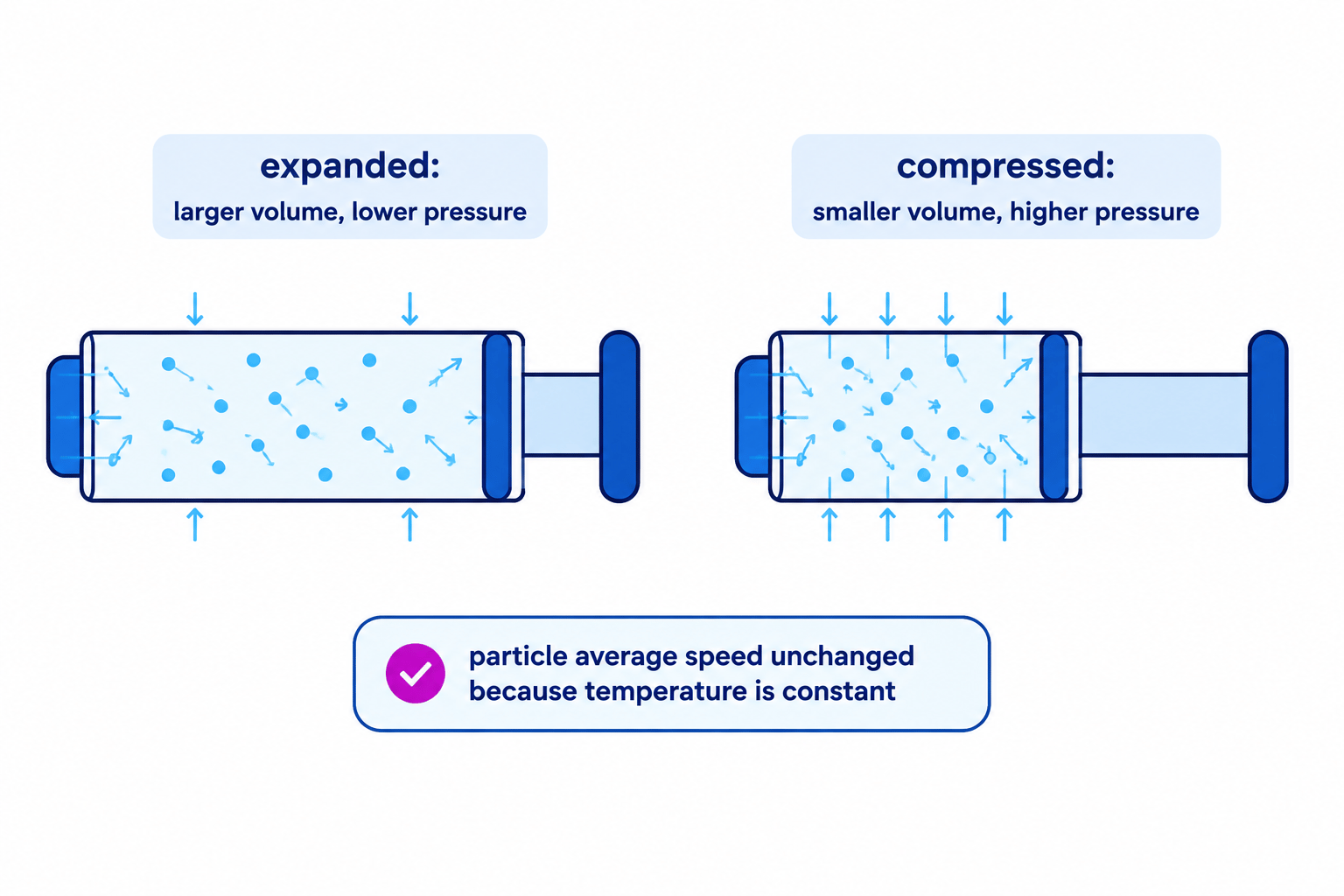
Gas particles colliding with the walls of a container and a piston, showing how smaller volume gives higher pressure

Pressure produces a net force

A net force means the overall force after combining all the forces acting on an object or surface.

Inside a container, gas particles hit all walls. If the pressure is the same everywhere and the container is fixed, the forces on opposite sides can balance. But if one side can move, such as a piston in a syringe, gas pressure can produce a net force on that moving surface.

Key Idea

Pressure acts normal to a surface

Gas pressure produces a force at right angles to the wall of the container or any surface the gas touches.

For example, in a syringe, the gas particles inside collide with the plunger. These collisions push the plunger outwards. If you push the plunger in, you are applying an external force that compresses the gas.

Compression and expansion

To compress a gas means to reduce the volume it occupies. To expand a gas means to increase the volume it occupies.

Definition

Volume

Volume is the amount of space occupied by a substance. For gas calculations in this topic, volume VVV is measured in cubic metres, m³.

A gas can be compressed or expanded because its particles are far apart. There is empty space between them, so the particles can be forced closer together or allowed to spread further apart.

Liquids and solids are much harder to compress because their particles are already close together.

Why increasing volume decreases pressure

For this section, imagine a fixed mass of gas. That means the amount of gas does not change: no gas particles enter or leave.

Also imagine the gas is at constant temperature. Temperature is linked to the average kinetic energy of the particles, so if temperature stays constant, the average speed of the particles stays the same.

Definition

Fixed mass of gas

A fixed mass of gas means the number of gas particles stays the same. No particles are added or removed.

If the volume increases:

  • the same number of particles are spread out in a larger space
  • each particle has further to travel before hitting a wall
  • collisions with the walls happen less frequently
  • the force per unit area on the walls decreases
  • so the pressure decreases
Key Idea

Volume up, pressure down

For a fixed mass of gas at constant temperature, increasing the volume decreases the pressure because particles collide with the walls less often.

Example

Explaining pressure decrease when volume increases

A sealed syringe contains air. The plunger is pulled out slowly, increasing the volume of the trapped air. Explain why the pressure decreases.

  1. The gas is sealed, so the number of particles stays the same: it is a fixed mass of gas.

  2. Pulling the plunger out increases the volume, so the particles are more spread out and have further to travel between wall collisions.

  3. If the temperature is constant, the particles’ average speed does not increase, so they collide with the walls less frequently.

  4. Fewer collisions per second with the walls means a smaller force per unit area, so the gas pressure decreases.

Common Mistake

Forgetting the constant temperature condition

Do not just say “bigger volume means lower pressure” in every situation. The GCSE equation only applies when the temperature stays constant and the mass of gas is fixed.

The pressure-volume relationship

For a fixed mass of gas at constant temperature:

pV=constantpV = \text{constant}pV=constant

where:

  • ppp is pressure, measured in pascals, Pa
  • VVV is volume, measured in cubic metres, m³

This means that the product of pressure and volume stays the same.

So if the gas changes from one state to another:

p1V1=p2V2p_1V_1 = p_2V_2p1​V1​=p2​V2​

Here:

  • p1p_1p1​ and V1V_1V1​ are the initial pressure and volume
  • p2p_2p2​ and V2V_2V2​ are the final pressure and volume

This is an inverse relationship: when one quantity increases, the other decreases by the same factor.

For example:

  • if volume doubles, pressure halves
  • if volume halves, pressure doubles
  • if volume becomes three times bigger, pressure becomes one third as big

Pressure-volume graph for a fixed mass of gas at constant temperature, showing an inverse curve labelled pV = constant

Tip

Quick proportionality check

Before calculating, estimate the direction of the answer. If the volume gets smaller, the pressure should get bigger. If your answer goes the other way, check your rearranging.

Using p1V1=p2V2p_1V_1 = p_2V_2p1​V1​=p2​V2​

The equation is given on the Physics equation sheet, but you need to know when and how to apply it.

The most useful form is:

p1V1=p2V2p_1V_1 = p_2V_2p1​V1​=p2​V2​

You then rearrange depending on what the question asks for.

To find final pressure:

p2=p1V1V2p_2 = \frac{p_1V_1}{V_2}p2​=V2​p1​V1​​

To find final volume:

V2=p1V1p2V_2 = \frac{p_1V_1}{p_2}V2​=p2​p1​V1​​
Example

Calculating a new pressure

A fixed mass of gas has a volume of 0.060 m³ and a pressure of 100000 Pa. The gas is compressed at constant temperature until its volume is 0.020 m³. Calculate the new pressure.

  1. The gas is compressed, so the volume decreases. The pressure should increase, so the final answer should be bigger than 100000 Pa.

  2. Use the relationship for a fixed mass of gas at constant temperature:

    p1V1=p2V2p_1V_1 = p_2V_2p1​V1​=p2​V2​
  3. Rearrange to make the final pressure the subject:

    p2=p1V1V2p_2 = \frac{p_1V_1}{V_2}p2​=V2​p1​V1​​
  4. Substitute the values:

    p2=100000×0.0600.020p_2 = \frac{100000 \times 0.060}{0.020}p2​=0.020100000×0.060​
  5. Calculate:

    p2=300000 Pap_2 = 300000\ \text{Pa}p2​=300000 Pa

So the new pressure is 300000 Pa.

Example

Calculating a new volume

A gas in a sealed container has a pressure of 150000 Pa and a volume of 0.040 m³. The pressure is reduced to 60000 Pa while the temperature stays constant. Calculate the new volume.

  1. The pressure decreases, so the gas should expand. The final volume should be bigger than 0.040 m³.

  2. Start with:

    p1V1=p2V2p_1V_1 = p_2V_2p1​V1​=p2​V2​
  3. Rearrange for final volume:

    V2=p1V1p2V_2 = \frac{p_1V_1}{p_2}V2​=p2​p1​V1​​
  4. Substitute:

    V2=150000×0.04060000V_2 = \frac{150000 \times 0.040}{60000}V2​=60000150000×0.040​
  5. Calculate:

    V2=0.10 m3V_2 = 0.10\ \text{m}^3V2​=0.10 m3

So the new volume is 0.10 m³.

Units and conversions

In the equation, pressure should be in pascals, Pa, and volume should be in cubic metres, m³.

Sometimes questions give volume in cm³. To convert from cm³ to m³:

1 m3=1000000 cm31\ \text{m}^3 = 1000000\ \text{cm}^31 m3=1000000 cm3

So:

volume in m3=volume in cm31000000\text{volume in m}^3 = \frac{\text{volume in cm}^3}{1000000}volume in m3=1000000volume in cm3​

For example, 500 cm³ is 0.000500 m³.

Tip

When matching units is enough

If you use p1V1=p2V2p_1V_1 = p_2V_2p1​V1​=p2​V2​ and both volumes are in the same unit, the calculation can still give the correct pressure ratio because the volume units cancel. But if the question asks for the constant pVpVpV in SI units, convert volume to m³.

What the graph means

A graph of pressure against volume for a fixed mass of gas at constant temperature is a curve, not a straight line.

As volume increases, pressure decreases. But it does not decrease in equal steps. Doubling the volume halves the pressure; tripling the volume makes the pressure one third of its original value.

Common Mistake

Drawing a straight-line graph

For pV=constantpV = \text{constant}pV=constant, a graph of pressure against volume is a decreasing curve. A straight line would suggest pressure decreases at a constant rate, which is not the relationship here.

Why the equation has limits

The equation pV=constantpV = \text{constant}pV=constant is for:

  • a fixed mass of gas
  • constant temperature
  • pressure and volume changes only

If the temperature changes, the average kinetic energy of the particles changes. That changes the collision force and frequency, so pVpVpV may not stay constant.

Common Mistake

Temperature changes break the rule

Do not use pV=constantpV = \text{constant}pV=constant if the gas is heated or cooled during the change, unless the question says the temperature is constant.

Exam technique

In the exam

  1. Check the conditions first: fixed mass of gas and constant temperature.

  2. Decide whether pressure should increase or decrease before calculating, using the idea that volume up means pressure down.

  3. Use p1V1=p2V2p_1V_1 = p_2V_2p1​V1​=p2​V2​, rearrange carefully, and include the final unit: Pa for pressure or m³ for volume.

Self review

Check yourself

  • Why does increasing the volume of a gas reduce its pressure at constant temperature?
  • A gas is compressed to half its original volume. What happens to its pressure if temperature stays constant?
  • What two conditions must be true before you use pV=constantpV = \text{constant}pV=constant?
You've reached the end

Test yourself on this topic, or move on to the next guide.

FlashcardsSelf-test with active recall
Increasing the pressure of a gas (physics only) (HT only)Up next

How was this guide?

Pressure in gases (physics only) Revision Guide

  1. GCSE
  2. /Physics
  3. /Pressure in gases (physics only)