Question 2
FThe radiation dose a person receives each year depends on their occupation and on where they live.
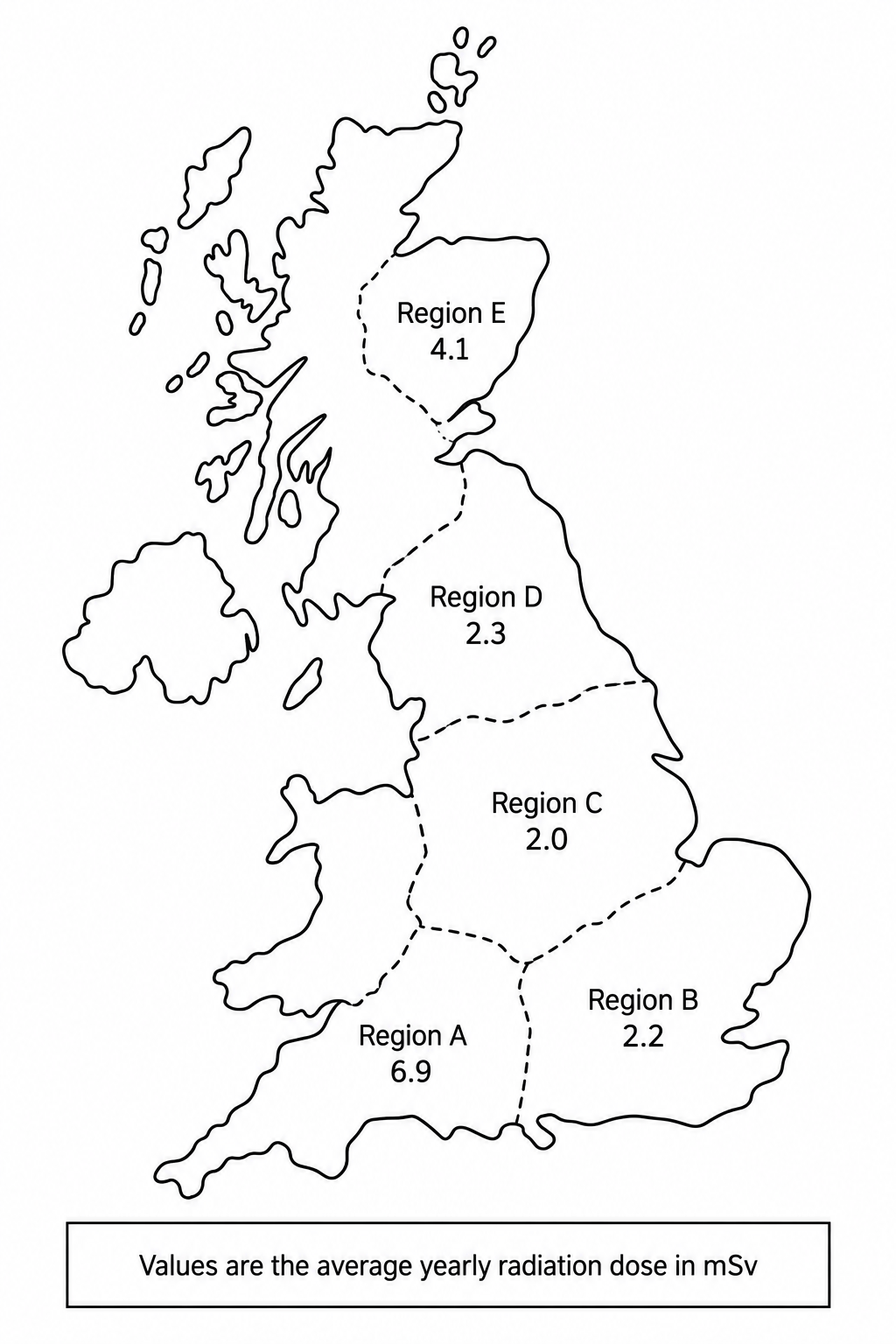
Figure shows the average yearly radiation dose received by people living in five regions of the UK.
Figure: The average yearly radiation dose received by people living in five regions of the UK
a.[1]
A pilot who flies long-distance aircraft receives a higher radiation dose than a person who works in an office. Give one reason why.
b.[1]
Use Figure. Give the region in which people receive the largest average yearly dose.
c.[2]
Granite is the main rock in regions A and E. Granite contains more uranium than most other rocks. Explain why people who live in regions A and E receive a higher radiation dose than people in region C.
d.[1]
A student says, "Background radiation is exactly the same everywhere in the UK." Use Figure 1 to give one piece of evidence that the student is wrong.
4.3 Hazards and uses of radioactive emissions and of background radiation Questions
40 exam-style questions on AQA GCSE Physics 4.3 Hazards and uses of radioactive emissions and of background radiation, covering 4.3.1 Background radiation, 4.3.2 Different half-lives of radioactive isotopes, and 4.3.3 Uses of nuclear radiation. Each one has a worked solution and a mark scheme showing where the marks go.