3.1.1a Density of materials
Density: how much mass is packed into a volume
Density
Density is the mass per unit volume of a material.
- Density tells you how much mass is contained in a given volume of a material.
- A material has a high density if a given volume of it has a large mass.
- A material has a low density if the same volume has a smaller mass.
- For two objects of the same volume, the one with the greater mass has the greater density.
- For two objects of the same mass, the one with the smaller volume has the greater density.
- Density is given the symbol ρ\rhoρ, the Greek letter “rho”.
Density is a property of the material, not of the size of the object. A large, heavy object can still have a low density if its volume is large, because density compares mass with volume rather than looking at either on its own.
The density equation
- Density is calculated from mass and volume using the equation ρ=mV\rho = \dfrac{m}{V}ρ=Vm, which in words is density=massvolume\text{density} = \dfrac{\text{mass}}{\text{volume}}density=volumemass.
- Density, ρ\rhoρ, is measured in kilograms per metre cubed, kg/m3\text{kg/m}^3kg/m3.
- Mass, mmm, is measured in kilograms, kg\text{kg}kg.
- Volume, VVV, is measured in metres cubed, m3\text{m}^3m3.
- The unit follows straight from the equation: dividing kilograms by metres cubed gives kg/m3\text{kg/m}^3kg/m3.
- In the lab you will often measure grams and centimetres cubed, giving g/cm3\text{g/cm}^3g/cm3; to convert, multiply by 1000, so 1 g/cm3=1000 kg/m31\ \text{g/cm}^3 = 1000\ \text{kg/m}^31 g/cm3=1000 kg/m3.
- A solid block has a mass of 12 kg12\ \text{kg}12 kg and a volume of 0.004 m30.004\ \text{m}^30.004 m3. Calculate its density.
- State the equation:
- Substitute the values:
- The density of the material is 3000 kg/m33000\ \text{kg/m}^33000 kg/m3.
- Do not confuse density with mass: mass tells you how much matter there is, while density compares that mass with the volume.
- Do not assume a large or heavy object must be dense, as its mass may just be spread over a large volume.
- Do not turn the equation upside down: it is always mass divided by volume, never volume divided by mass.
- Show the equation, the substitution, the answer and the unit, as each can earn a mark.
- Before you calculate, check the mass is in kg\text{kg}kg and the volume in m3\text{m}^3m3, so the density comes out in kg/m3\text{kg/m}^3kg/m3.
- What does density mean?
- Write the density equation in words and in symbols.
- What does the symbol ρ\rhoρ represent?
- State the standard units of mass, volume and density.
- Two objects have the same volume; which one has the greater density?
- Why is the unit of density kg/m3\text{kg/m}^3kg/m3?
3.1.1b The particle model, states of matter and measuring density (required practical)
The particle model: how solids, liquids and gases differ
Particle model
The particle model represents a material as tiny particles, such as atoms or molecules, and is used to explain the three states of matter and the differences in their densities.
- In a solid, the particles are packed closely together, usually in a regular pattern.
- These particles vibrate about fixed positions but cannot move past one another, so a solid keeps a fixed shape and volume.
- In a liquid, the particles are still close together but arranged randomly.
- These particles can move past one another, so a liquid flows and takes the shape of its container while keeping the same volume.
- In a gas, the particles are far apart and arranged randomly.
- These particles move quickly in all directions and spread out to fill their container, so a gas has no fixed shape or volume.
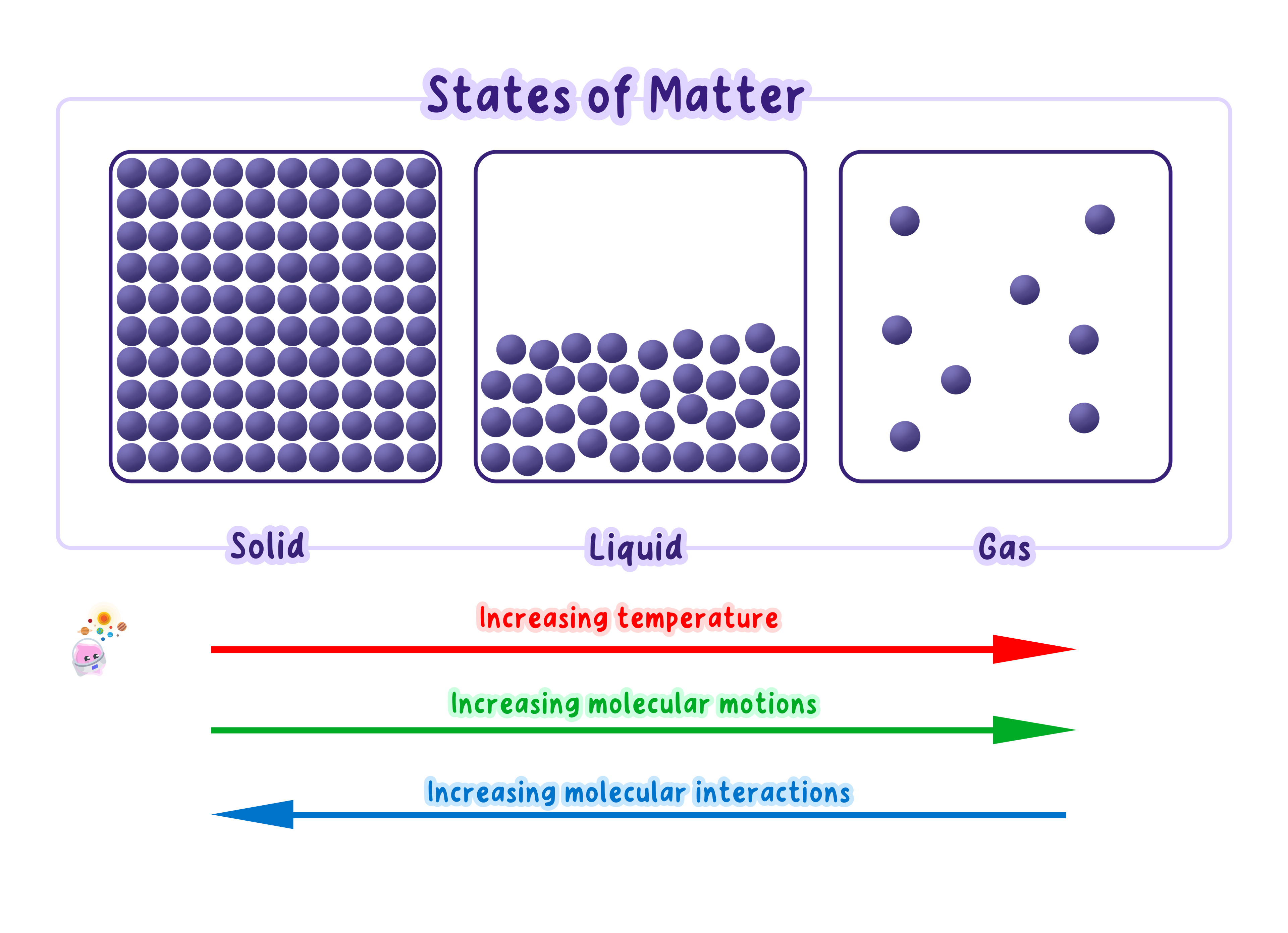
To draw simple particle diagrams:
- solid: circles touching in a regular, ordered pattern;
- liquid: circles touching but in a random arrangement;
- gas: a few circles spread far apart and randomly placed.
The circles model the particles; they do not show their real size, shape or spacing.
Explaining density with the particle model
Density
Density is the mass per unit volume of a material, ρ=mV\rho = \dfrac{m}{V}ρ=Vm.
- In solids and liquids the particles are close together, so a large number of particles, and therefore a large mass, is packed into each cubic metre, giving a high density.
- In a gas the particles are far apart, so far fewer particles, and much less mass, occupy each cubic metre, giving a much lower density.
- When a substance melts or boils, the number of particles does not change, but they spread further apart, so the density usually falls.
Do not say that the particles in a gas have “no mass” or that they disappear. The particles still have the same mass; a gas has a lower density only because the same particles are spread out over a much larger volume.
Investigation: measuring the density of solids and liquids
- Aim: to measure the density of a regularly shaped solid, an irregularly shaped solid and a liquid.
- Apparatus: a 30 cm30\ \text{cm}30 cm ruler marked in millimetres, a digital balance, a displacement (eureka) can, a selection of measuring cylinders, a beaker of water, a regular solid such as a metal cuboid, an irregular solid such as a small stone or metal object, a liquid such as a sugar solution, and paper towels.
Part 1: a regularly shaped solid
- Measure the mass of the object with the balance and record it.
- Use the ruler to measure the length, width and height, reading each scale at eye level.
- Calculate the volume from the dimensions using V=length×width×heightV = \text{length} \times \text{width} \times \text{height}V=length×width×height.
- Calculate the density using ρ=mV\rho = \dfrac{m}{V}ρ=Vm.
Part 2: an irregularly shaped solid (displacement)
- Measure the mass of the object with the balance.
- Fill the displacement can until water just runs from the spout, then wait until the dripping stops.
- Place an empty measuring cylinder under the spout.
- Lower the object gently into the can, on a thread, until it is fully submerged.
- Collect all the water pushed out of the spout in the measuring cylinder.
- Read the volume of displaced water at eye level; this volume equals the volume of the object.
- Calculate the density using ρ=mV\rho = \dfrac{m}{V}ρ=Vm, then refill the can before repeating for another object.
Part 3: a liquid
- Measure the mass of an empty measuring cylinder.
- Pour in a known volume of the liquid, reading the volume at the bottom of the meniscus at eye level.
- Measure the mass of the measuring cylinder and liquid together.
- Subtract the empty-cylinder mass to find the mass of the liquid alone.
- Calculate the density using ρ=mV\rho = \dfrac{m}{V}ρ=Vm.
Worked result
- A metal cuboid has a mass of 216 g216\ \text{g}216 g and measures 6.0 cm×3.0 cm×2.0 cm6.0\ \text{cm} \times 3.0\ \text{cm} \times 2.0\ \text{cm}6.0 cm×3.0 cm×2.0 cm.
- Volume: V=6.0×3.0×2.0=36 cm3V = 6.0 \times 3.0 \times 2.0 = 36\ \text{cm}^3V=6.0×3.0×2.0=36 cm3.
- Density: ρ=21636=6.0 g/cm3\rho = \dfrac{216}{36} = 6.0\ \text{g/cm}^3ρ=36216=6.0 g/cm3.
Accuracy and safety
- Make sure the object is fully submerged, and dry it before weighing, or the readings will be wrong.
- Wait until the can has stopped dripping before you start, or the measured volume will be too large.
- Masses in grams with volumes in cm3\text{cm}^3cm3 give a density in g/cm3\text{g/cm}^3g/cm3; multiply by 1000 to convert to kg/m3\text{kg/m}^3kg/m3.
- Wipe up any spilt water straight away so that no one slips.
- For an irregular object, never try to work out the volume from measured dimensions; use displacement.
- Describe the arrangement and movement of the particles in a solid, a liquid and a gas.
- Why do gases have much lower densities than solids and liquids?
- What does the density equation tell you to measure?
- How do you find the volume of a regularly shaped solid, and of an irregularly shaped one?
- Why must you wait for the displacement can to stop dripping before lowering in the object?
