A student sets up the circuit shown below to investigate how the resistance R R\,R of a length of thin nichrome wire varies with its length L L\,L in order to determine its resistivity ρ\rhoρ.
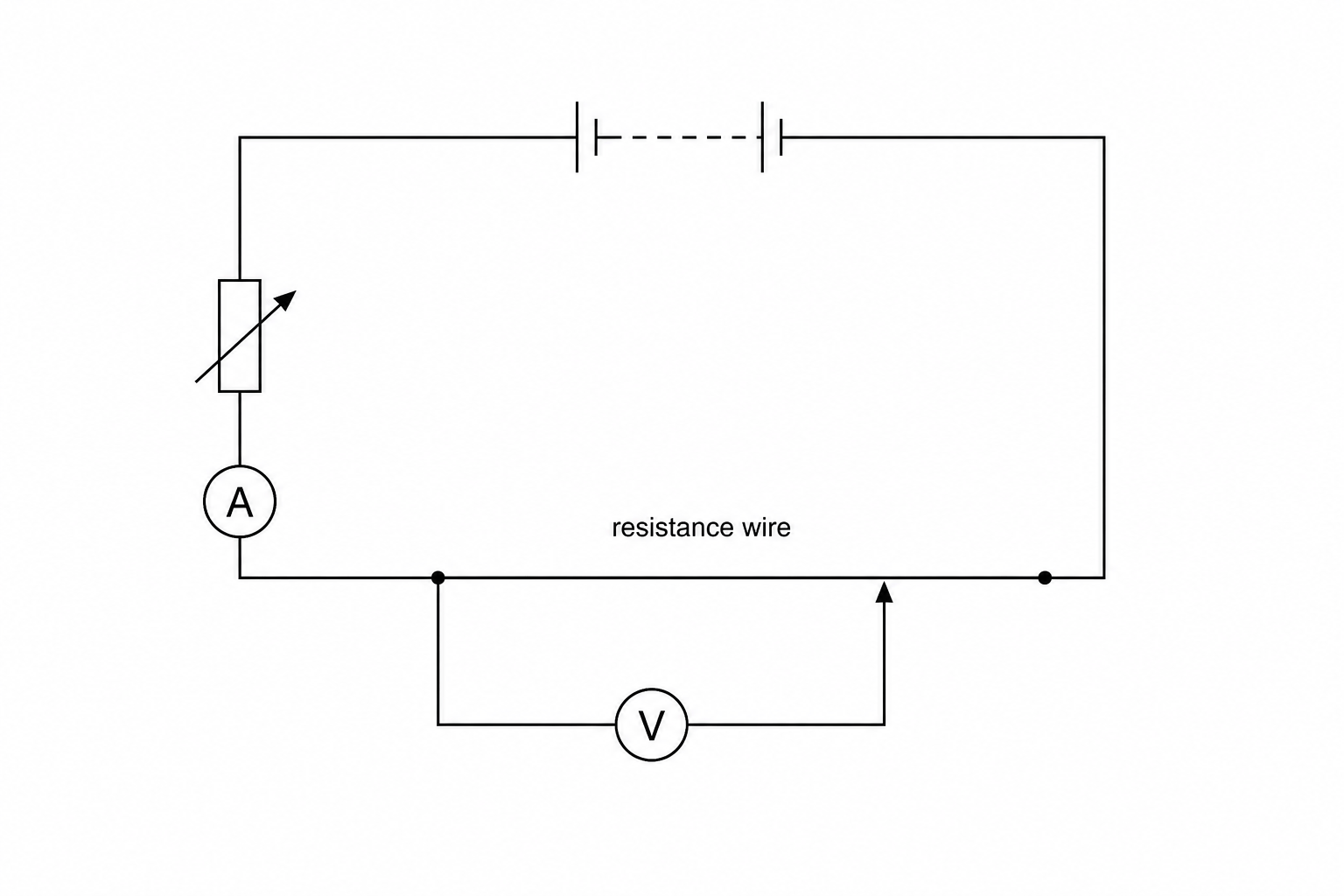
Which row in the table correctly identifies:
- the ideal electrical resistance of the voltmeter (RVR_{\text{V}}RV) and ammeter (RAR_{\text{A}}RA),
- the primary reason for opening the switch (not shown) between taking readings, and
- the effect on the percentage uncertainty in the calculated resistivity if the student repeats the experiment using a wire of the same material and length but with half the diameter, measured with the same micrometer?
Ideal resistance: RVR_{\text{V}}RV is infinite, RAR_{\text{A}}RA is zero \ Primary reason: Maintain constant wire temperature to keep resistivity constant \ Uncertainty impact: Increases
Ideal resistance: RVR_{\text{V}}RV is infinite, RAR_{\text{A}}RA is zero \ Primary reason: Prevent cell EMF and terminal potential difference from decreasing \ Uncertainty impact: Decreases
Ideal resistance: RVR_{\text{V}}RV is zero, RAR_{\text{A}}RA is infinite \ Primary reason: Maintain constant wire temperature to keep resistivity constant \ Uncertainty impact: Increases
Ideal resistance: RVR_{\text{V}}RV is infinite, RAR_{\text{A}}RA is zero \ Primary reason: Maintain constant wire temperature to keep resistivity constant \ Uncertainty impact: Decreases