An engineer designed a test circuit for an electrochemical gas sensor, containing a DC power supply, an ammeter, and a sensor element connected in a single loop as shown below.
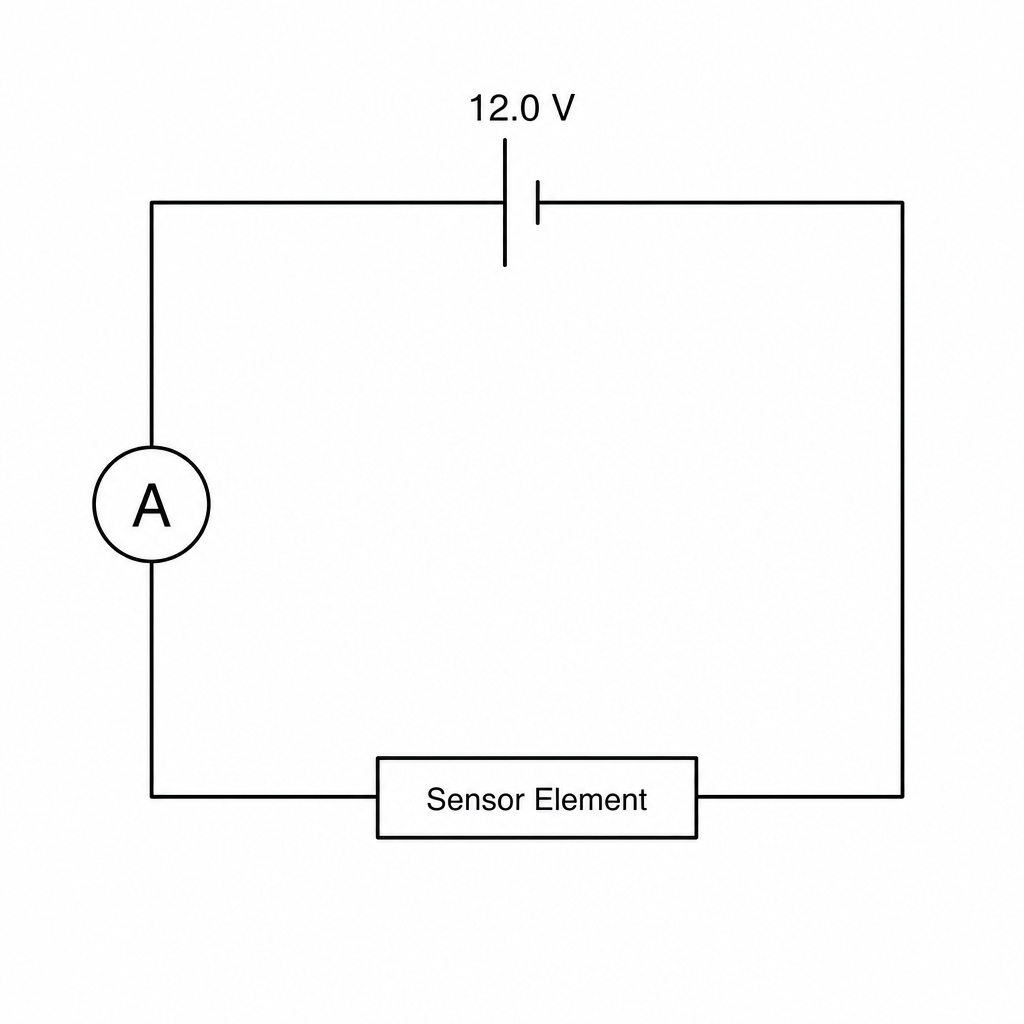
During an experiment, a total of 54 coulombs54\text{ coulombs}54 coulombs of charge flows through the DC power supply in 36 seconds36\text{ seconds}36 seconds.
Calculate the current through the power supply.
Use the equation: current=charge flowtime\text{current} = \frac{\text{charge flow}}{\text{time}}current=timecharge flow
There is a potential difference of 12.0 V12.0\text{ V}12.0 V across the DC power supply.
Calculate the energy transferred by the power supply when 125 coulombs125\text{ coulombs}125 coulombs of charge flows through it.
Use the equation: energy transferred=charge flow×potential difference\text{energy transferred} = \text{charge flow} \times \text{potential difference}energy transferred=charge flow×potential difference
Write down the equation that links current (III), potential difference (VVV), and resistance (RRR).
The potential difference across the sensor element is 12.0 V12.0\text{ V}12.0 V and the current through it is 1.5 A1.5\text{ A}1.5 A.
Calculate the resistance of the sensor element.