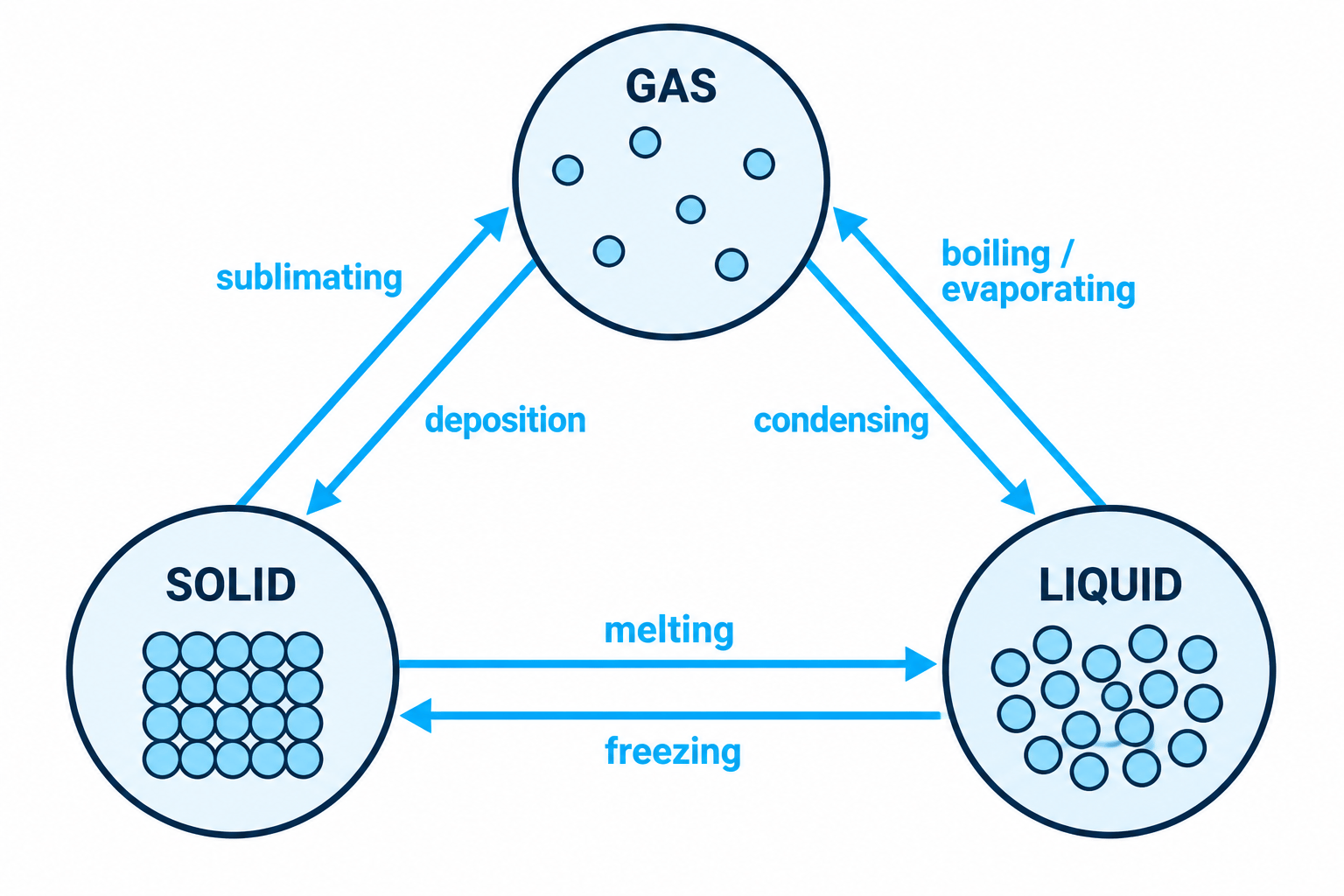
Changes of state: the same substance in a new state
Definition
Change of state
A change of state is a physical change in which a substance changes between the solid, liquid and gas states.
- Melting: a solid changes into a liquid.
- Freezing: a liquid changes into a solid.
- Boiling: a liquid changes into a gas throughout the liquid.
- Evaporating: a liquid changes into a gas at its surface.
- Condensing: a gas changes into a liquid.
- Sublimating: a solid changes directly into a gas without becoming a liquid first.
- During any change of state the substance stays the same material: ice, liquid water and water vapour are all made of water particles, and only the state has changed.
Conservation of mass
Definition
Conservation of mass
When a substance changes state, its total mass stays the same, because particles are not created or destroyed.
- If 50 g50\ \text{g}50 g of ice melts completely, it forms 50 g50\ \text{g}50 g of liquid water; if 50 g50\ \text{g}50 g of water freezes, it forms 50 g50\ \text{g}50 g of ice.
- In a closed container, the total mass of liquid and gas stays the same when a liquid boils or evaporates, because the particles have only spread out.
- In an open container, the measured mass may seem to fall during boiling, evaporation or sublimation, because gas particles escape into the surroundings.
- That mass has not been destroyed; it has simply left the container.
Common Mistake
- Do not say that particles disappear when a liquid evaporates or boils, as they still exist as a gas and may have escaped into the surroundings.
- Do not say that melting or boiling makes a new substance, as a change of state is not a chemical reaction.
Why a change of state is a physical change
Definition
Physical change
A physical change produces no new substance; if the change is reversed, the material recovers its original properties.
- Changes of state are physical changes because the chemical identity of the substance does not change.
- Liquid water can freeze to ice, and melting the ice returns it to liquid water with its original properties.
- A chemical change is different: it produces one or more new substances, and simply reversing a change of state cannot undo it.
Exam technique
- For “why is mass conserved during a change of state?”, make both points: no particles are created or destroyed, and the substance has only changed state.
- If the measured mass falls in an open container, explain that gas particles have escaped into the surroundings, rather than saying mass has been lost.
Self review
- What is meant by a change of state?
- Name the changes from solid to liquid, liquid to gas, and gas to liquid.
- Why is mass conserved during a change of state?
- Why might the measured mass fall when a liquid evaporates from an open container?
- Why is a change of state a physical change rather than a chemical one?