Revision notes for AQA GCSE Physics Internal energy. Open the guide for explanations and worked examples. Written against the AQA GCSE Physics (8463) specification, so the content matches what's examinable rather than general Physics background.
In this topic, you are zooming in on matter and thinking about what its particles are doing.
A system just means the object or substance you choose to study. It could be a metal block, a beaker of water, or gas in a sealed container.
System
A system is the object or group of objects you are focusing on when describing energy transfers.
All substances are made of tiny particles. These may be atoms or molecules. Even in a solid, the particles are not perfectly still — they vibrate about fixed positions.
The particles in a system can store energy in two main ways:
Particle kinetic energy
Particle kinetic energy is the energy particles have because they are moving or vibrating.
Particle potential energy
Particle potential energy is energy stored because of the positions of particles and the forces between them.
This diagram pulls together the two parts of internal energy and what can happen when a system is heated.

The internal energy of a system is the total energy stored by all the particles inside it.
That means you must include:
Internal energy
Internal energy is the total kinetic energy and potential energy of all the particles that make up a system.
This is a total quantity. That word matters. A large object usually has more particles than a small object, so it can have a larger internal energy even if it is not very hot.
Temperature tells you how hot something is. In the particle model, it is linked to the average kinetic energy of the particles.
Internal energy is different because it is about the total energy of all the particles.
Average vs total
Temperature is linked to the average kinetic energy of particles. Internal energy is the total kinetic and potential energy of all the particles in the system.
Comparing temperature and internal energy
A mug contains 0.20 kg of hot water at 70 °C. A bath contains 80 kg of warm water at 35 °C. Compare their temperature and internal energy.
Compare temperature first: 70 °C is higher than 35 °C, so the water in the mug has the higher temperature.
Link temperature to particles: the particles in the mug have a higher average kinetic energy because the mug water is hotter.
Compare the amount of water: the bath contains much more water, so it contains many more particles.
Use the definition of internal energy: because internal energy is the total energy of all the particles, the bath can have a much larger internal energy overall, even though its temperature is lower.
Temperature and internal energy
Do not write that temperature and internal energy mean the same thing. Temperature is about the average kinetic energy of particles; internal energy is the total kinetic and potential energy of all the particles.
Heating is an energy transfer into a system, usually because there is a temperature difference. For example, energy is transferred by heating from a hot hob to a pan, then into the water in the pan.
When a system is heated, energy is transferred to its particles. This increases the energy stored inside the system, so the internal energy increases.
But the result is not always the same. Heating can:
Two outcomes of heating
Heating increases the internal energy of a system. It either raises the temperature or causes a change of state.
If you heat a substance and it is not changing state, the particles gain kinetic energy.
For a liquid or gas, the particles move around faster. For a solid, the particles vibrate more strongly about their fixed positions.
As the average kinetic energy of the particles increases, the temperature rises.
Heating water without changing state
A beaker of liquid water is heated from 20 °C to 60 °C. Explain what happens to the internal energy.
Identify whether there is a change of state: the water is liquid at both 20 °C and 60 °C, so it is not changing state.
Apply the particle model: heating transfers energy to the water particles, so their average kinetic energy increases.
Link this to temperature: a higher average kinetic energy means a higher temperature.
State the internal energy change: the internal energy increases because the total kinetic energy of the particles has increased.
Temperature rise clue
If the temperature is rising and the substance stays in the same state, focus on kinetic energy increasing.
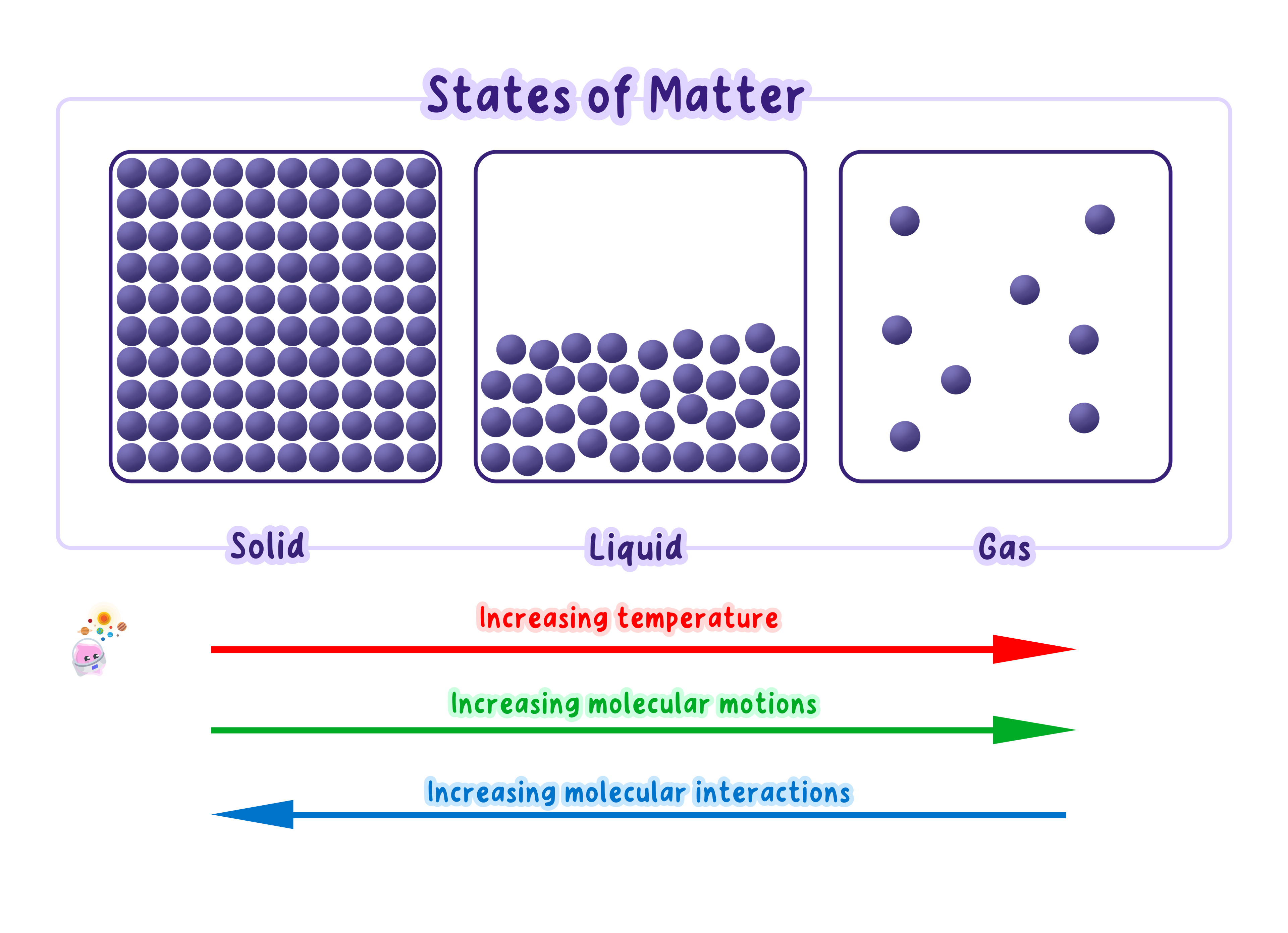
A change of state is when a substance changes between solid, liquid and gas. Examples include:
When a substance is changing state, the energy transferred by heating is used to change the particle arrangement and spacing. This changes the potential energy of the particles.
For example, when a solid melts, particles move from fixed positions in a regular pattern to a less ordered liquid arrangement. Energy is needed to overcome some of the attractive forces between particles.
Change of state
A change of state is a physical change between solid, liquid and gas, caused by changes in the arrangement and energy of particles.
During melting or boiling, the temperature stays constant until the change of state is complete.
This can feel strange because energy is still being transferred by heating. The key idea is that the energy is increasing the particles’ potential energy, not their average kinetic energy.
If the average kinetic energy does not increase, the temperature does not rise.
Melting at a constant temperature
Ice at 0 °C is heated and begins to melt. The mixture remains at 0 °C until all the ice has melted. Explain what is happening to the internal energy.
Recognise that energy is being transferred by heating, so the internal energy of the ice-water system increases.
Identify the process: melting is a change of state from solid to liquid.
Apply the particle model: the transferred energy changes the arrangement of the particles and helps overcome attractions between them.
Decide which part of internal energy increases: the particle potential energy increases, while the average kinetic energy stays the same during the melting.
Link to temperature: because average kinetic energy stays the same, the temperature remains at 0 °C until melting is complete.
Heating always raises temperature
Heating does not always raise temperature. During a change of state, energy is still transferred to the system, but it changes particle potential energy instead.
You do not need complicated detail here, but you should be able to describe the particle arrangements clearly.
In a solid, particles are close together in a fixed arrangement. They vibrate about fixed positions. When a solid is heated but stays solid, the particles vibrate more strongly.
In a liquid, particles are still close together, but they can move past each other. This is why liquids can flow. Heating a liquid usually makes the particles move faster, unless it is boiling.
In a gas, particles are far apart and move randomly at high speeds. Heating a gas usually increases the average speed of the particles, unless a change of state is happening.
Best exam wording
For changes of state, say the arrangement or separation of particles changes. Avoid saying particles “melt”, “boil”, “expand” or “get bigger” — the substance changes state, not the individual particles.
Internal energy is always about the particles inside the system.
When energy is transferred by heating:
One sentence summary
Heating increases the energy stored inside a system by increasing the energy of its particles; this either raises the temperature or changes the state.
In the exam
If asked to define internal energy, include both parts: total kinetic energy and total potential energy of all the particles.
If temperature changes, explain it using average kinetic energy of particles.
If a change of state happens at constant temperature, explain that internal energy still increases because particle potential energy changes.
Check yourself
Test yourself on this topic, or move on to the next guide.
How was this guide?