Question 1
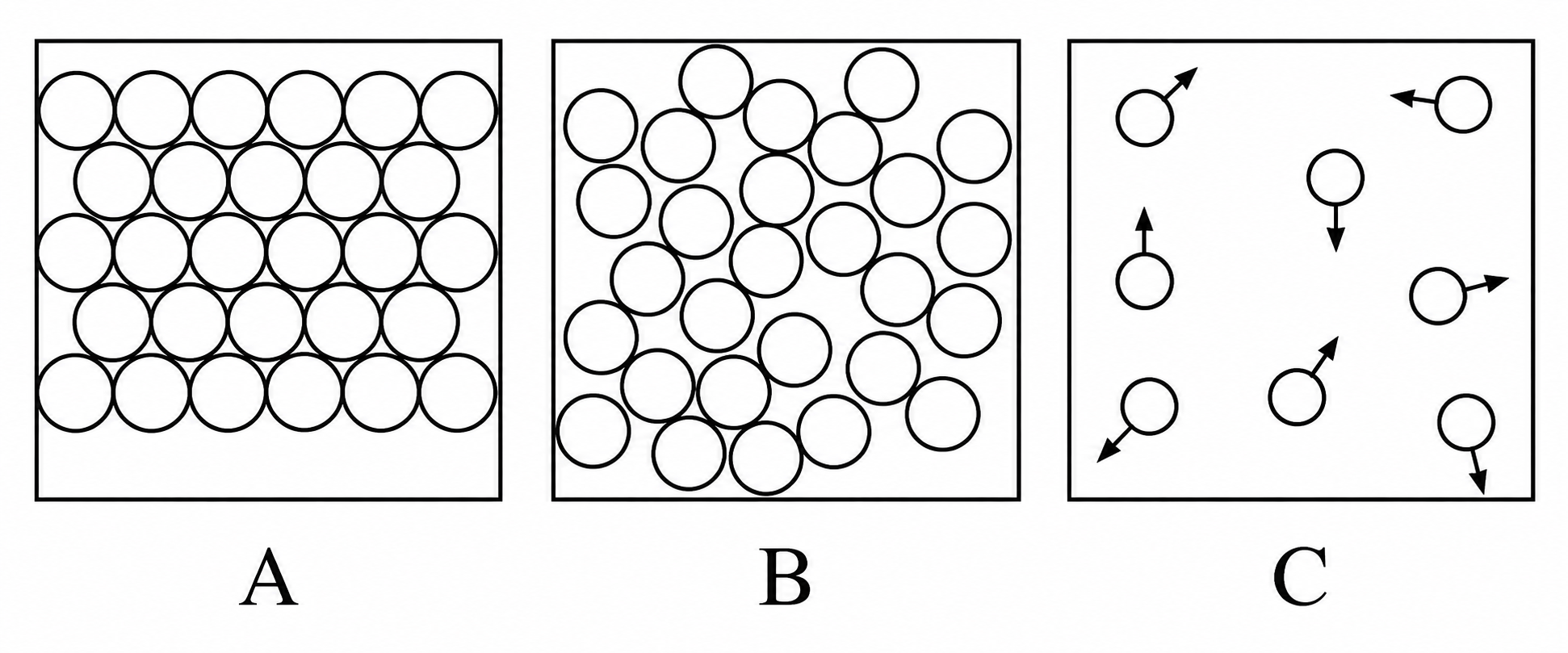
FFigure shows the arrangement of the particles in three samples of the same substance.
Figure: The arrangement of the particles in three samples of the same substance, labelled A, B and C
a.[3]
Name the state of matter shown in each box.
b.[1]
Give one way in which the arrangement of the particles in box A is different from the arrangement of the particles in box B.
c.[2]
Explain why the substance in box C has a much lower density than the substance in box A.
3.1 Changes of state and the particle model Questions
40 exam-style questions on AQA GCSE Physics 3.1 Changes of state and the particle model, covering 3.1.1 Density of materials and 3.1.2 Changes of state. Each one has a worked solution and a mark scheme showing where the marks go.