Question 1
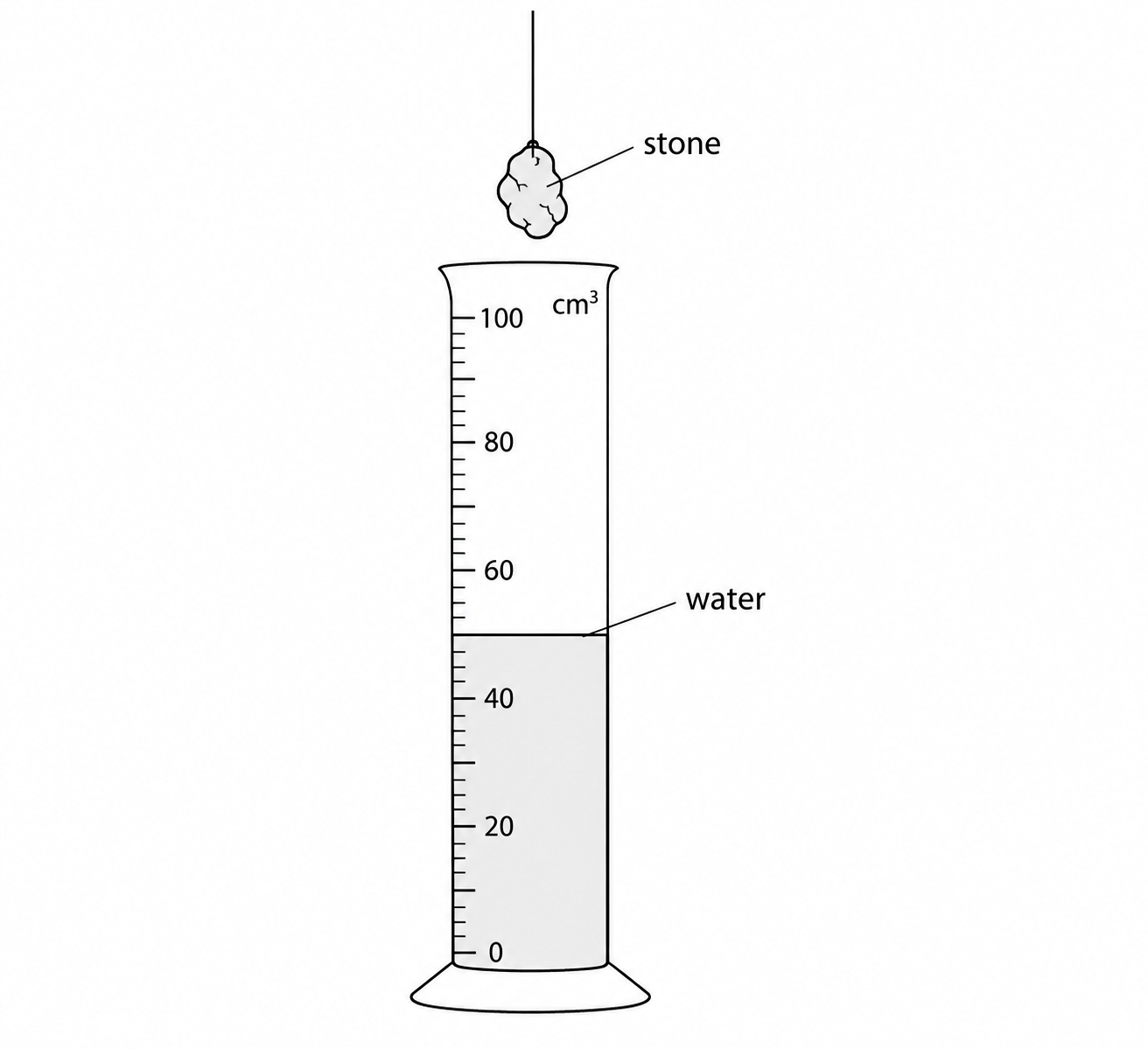
FA student determines the density of a small stone.
Figure: A measuring cylinder of water and the stone hanging on a thread above it
a.[1]
Name the piece of apparatus the student uses to measure the mass of the stone.
b.[3]
Describe how the student uses the measuring cylinder and water shown in Figure to determine the volume of the stone.
c.[2]
The mass of the stone is 88 g and the volume of the stone is 32 cm3.
Calculate the density of the stone.
d.[2]
The student did not dry the stone before measuring its mass. Explain the effect this has on the value the student calculates for the density.
3.1 Changes of state and the particle model Questions
40 exam-style questions on AQA GCSE Physics 3.1 Changes of state and the particle model, covering 3.1.1 Density of materials and 3.1.2 Changes of state. Each one has a worked solution and a mark scheme showing where the marks go.