Question 1
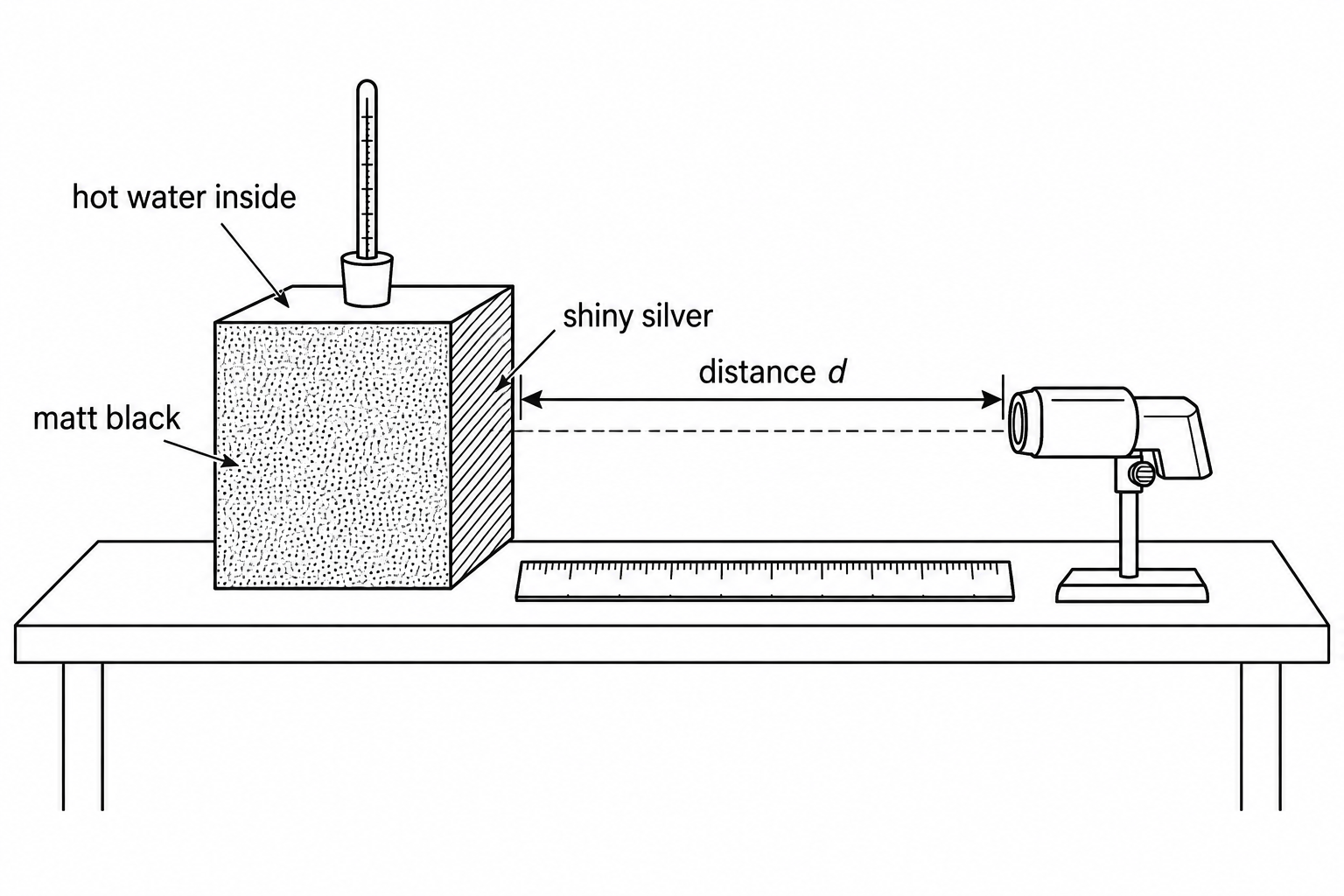
FA student investigated how the surface of an object affects the amount of infrared radiation the object emits. The student used a hollow metal cube filled with hot water. Each of the four vertical faces of the cube had a different surface. The student pointed an infrared detector at each face in turn.
Figure: The apparatus used to compare the infrared radiation emitted by the four faces of a hollow metal cube filled with hot water
a.[2]
The student kept the distance d d\,d the same for every face. Explain why this was important.
b.
[2]
The table shows the student's results.
Table: Infrared detector reading for each of the four vertical faces of the cube
| Face | Surface of the face | Detector reading in arbitrary units |
|---|---|---|
| W | matt black | 92 |
| X | matt white | 71 |
| Y | shiny black | 60 |
| Z | shiny silver | 18 |
Give two conclusions that can be made from the results in the table.
c.[1]
The student took all four readings within two minutes of filling the cube. Explain why the readings must be taken quickly.
d.[1]
The student repeated the investigation with water at a lower temperature. Describe how all four readings would change.
6.3 Black body radiation Questions
40 exam-style questions on AQA GCSE Physics 6.3 Black body radiation, covering 6.3.1 Emission and absorption of infrared radiation and 6.3.2 Perfect black bodies and radiation. Each one has a worked solution and a mark scheme showing where the marks go.