Question 1
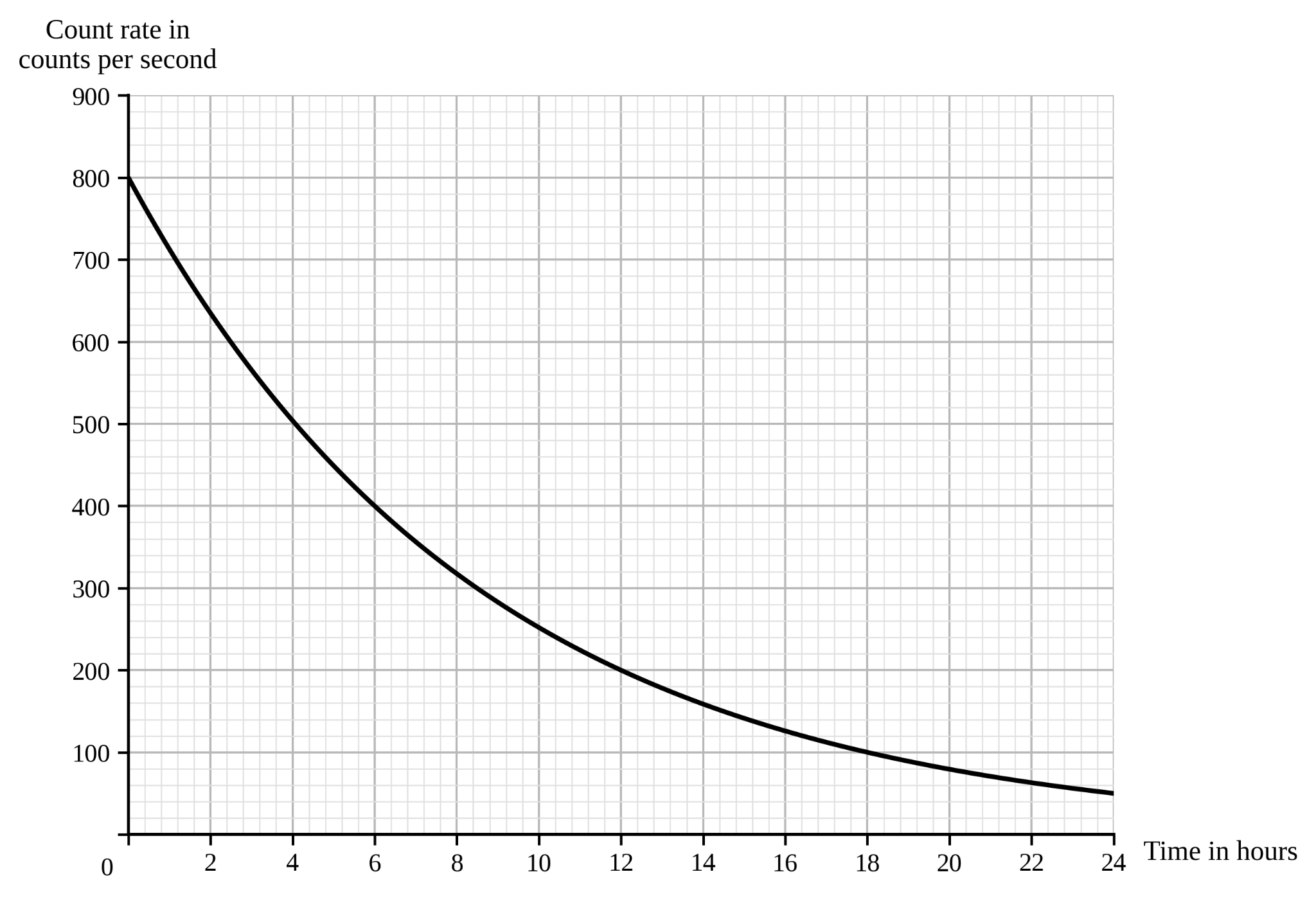
FA student measured the count rate from a sample of a radioactive isotope over 24 hours. Figure shows the results.
Figure: How the count rate from the sample changed over 24 hours
a.[2]
Use Figure to determine the half-life of the isotope.
b.[1]
Use Figure to determine the count rate 24 hours after the start.
c.[2]
The student measured the count rate at 6 hours a second time and obtained a slightly different value. Explain why.
d.[1]
Describe what is meant by the half-life of a radioactive isotope.
4.2 Atoms and nuclear radiation Questions
40 exam-style questions on AQA GCSE Physics 4.2 Atoms and nuclear radiation, covering 4.2.1 Radioactive decay and nuclear radiation, 4.2.2 Nuclear equations, 4.2.3 Half-lives and the random nature of radioactive decay, and 4.2.4 Radioactive contamination. Each one has a worked solution and a mark scheme showing where the marks go.