Stage 11 Test D
Question 1
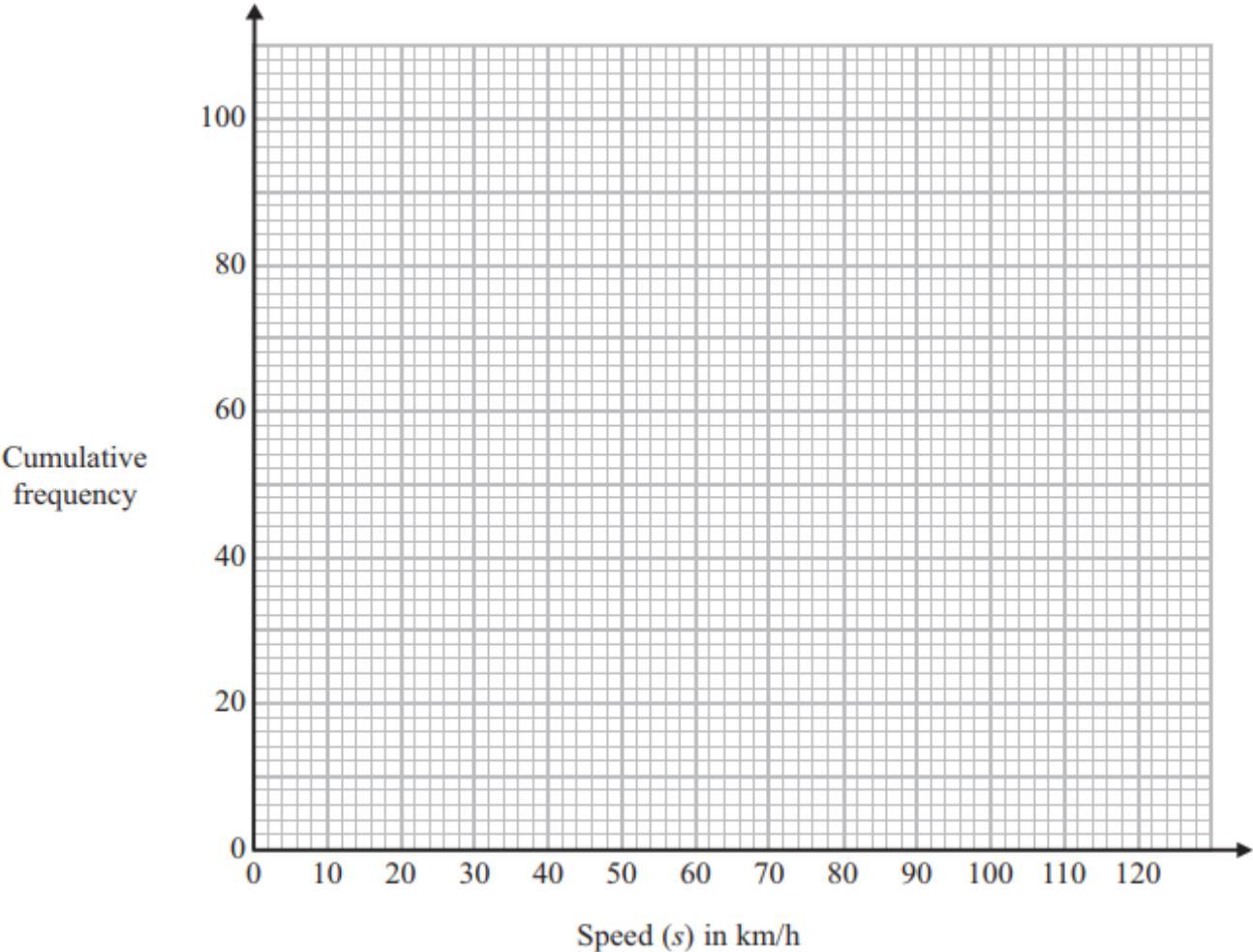
The frequency table shows the speeds of 100 cars.
| Speed (km/h) | Frequency |
|---|---|
| 0<s≤200 < s \leq 200<s≤20 | 10 |
| 20<s≤4020 < s \leq 4020<s≤40 | 17 |
| 40<s≤6040 < s \leq 6040<s≤60 | 23 |
| 60<s≤8060 < s \leq 8060<s≤80 | 27 |
| 80<s≤10080 < s \leq 10080<s≤100 | 18 |
| 100<s≤120100 < s \leq 120100<s≤120 | 5 |
a.[2]
On the grid, plot a cumulative frequency graph for this information.
b.[1]
Find an estimate for the number of cars travelling over 90 km/h.
Question 2
Expand and Simplify (x+2)(2x+3)(3x+1)(x + 2)(2x + 3)(3x + 1)(x+2)(2x+3)(3x+1)
Question 3
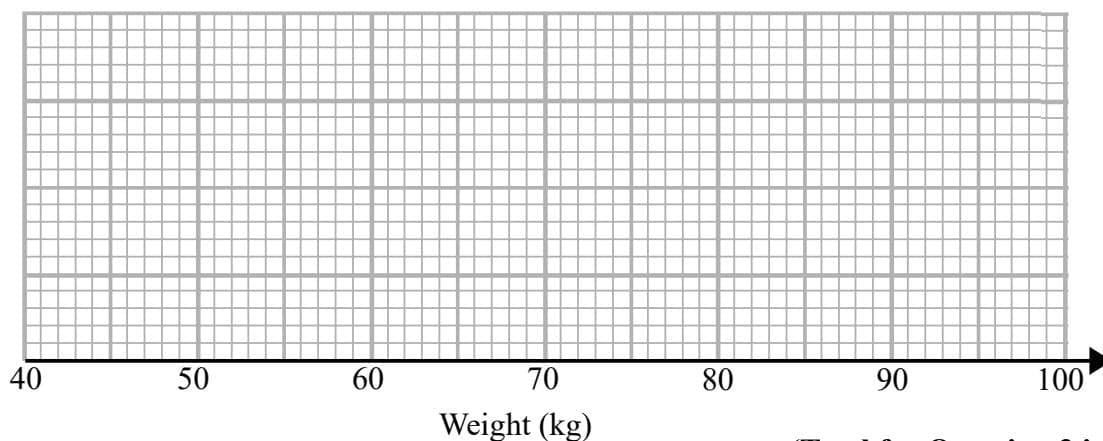
The weights of 11 pigs, in kg, are recorded below.
49 52 56 62 66 66 69 71 77 78 91
Draw a box plot for this information.
Question 4
Write 575 5\sqrt{75}\,575 in the form k3k\sqrt{3}k3, where k k\,k is an integer.
Question 5
Find the value of (27125)−23\displaystyle \left(\frac{27}{125}\right)^{-\frac{2}{3}}(12527)−32
Question 6
Make x x\,x the subject of the formula ax+y=4x−2bax + y = 4x - 2bax+y=4x−2b
Question 7
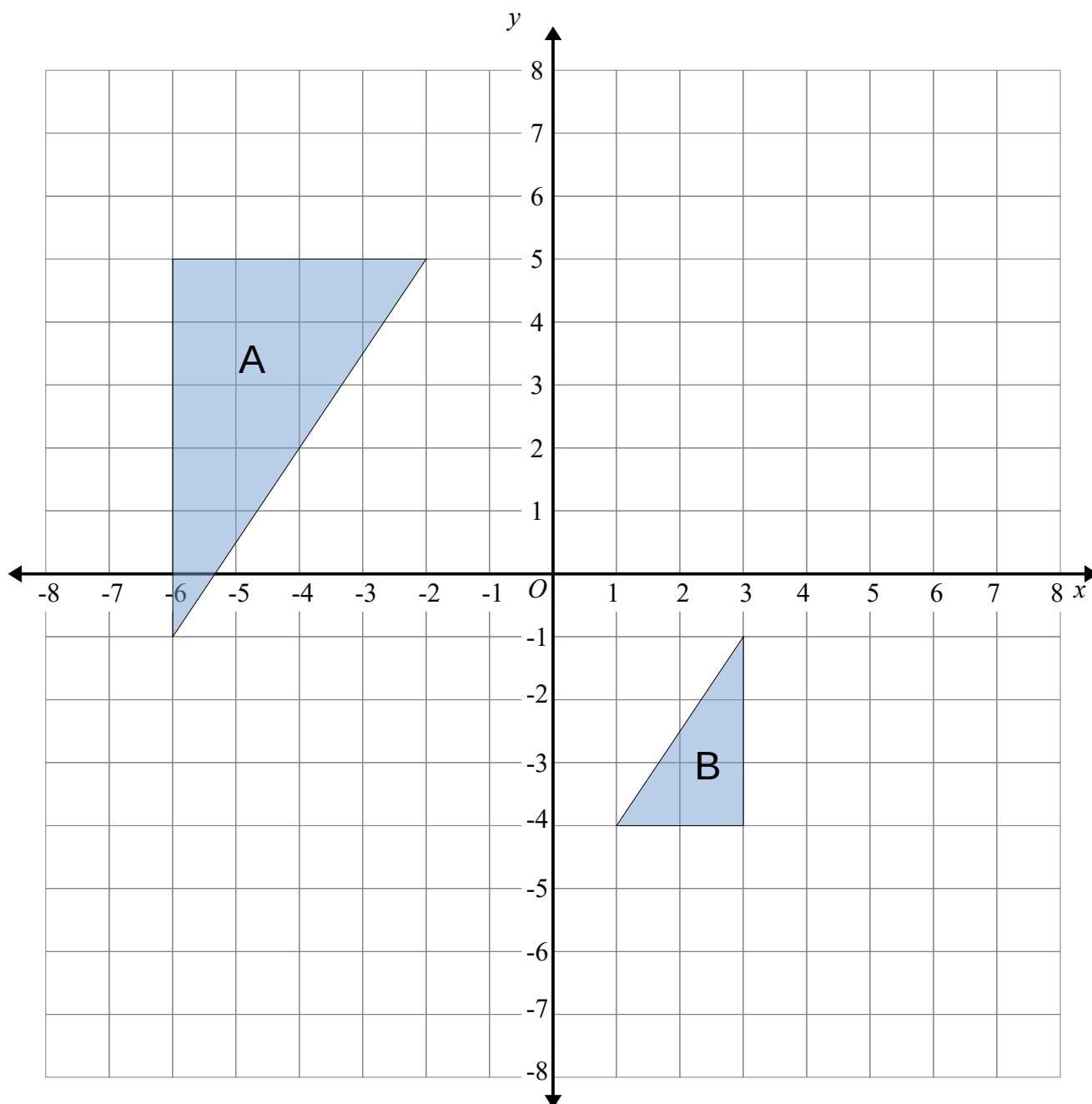
Describe fully the single transformation which maps triangle A onto triangle B.
Question 8
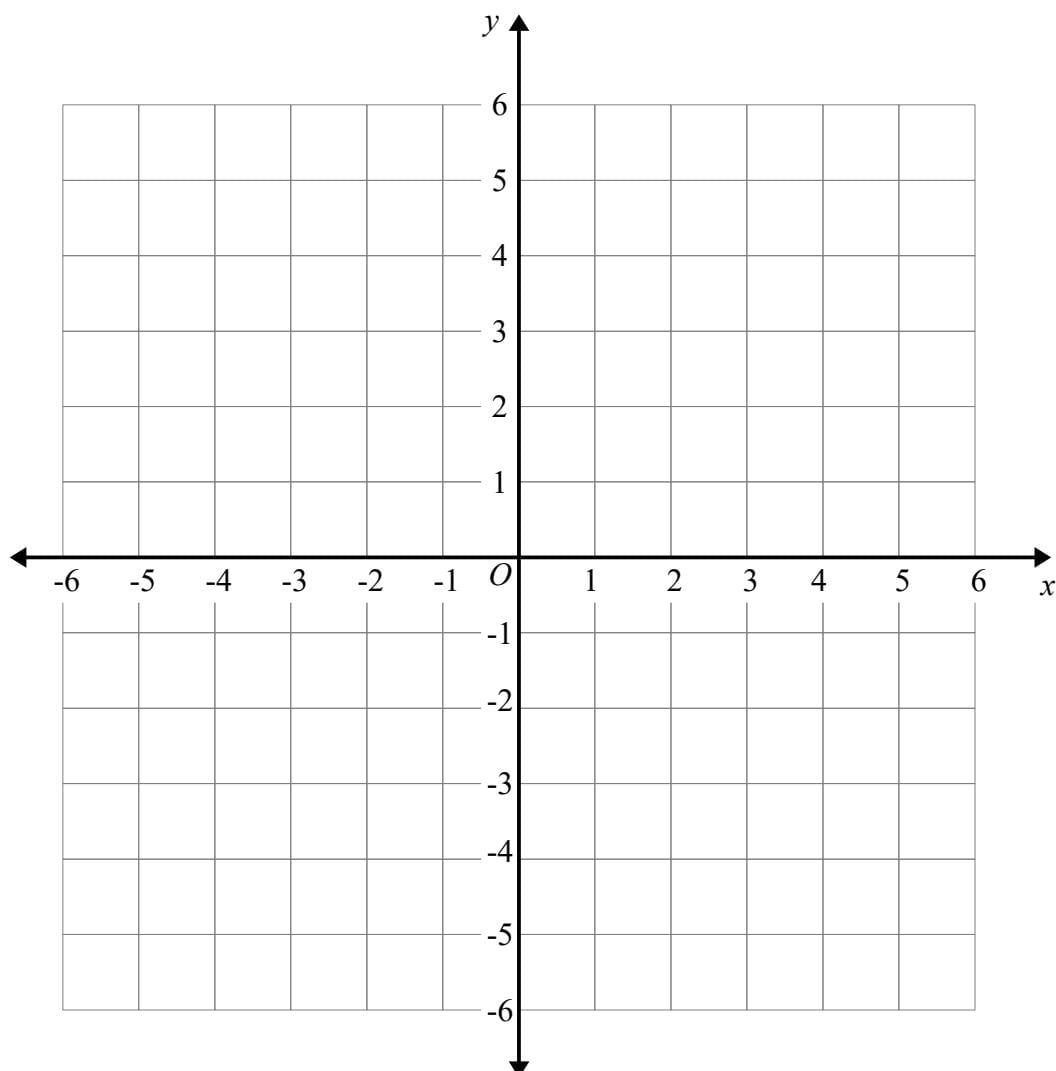
On the grid shade the region that satisfies all these inequalities
x+y<5 x + y < 5 x+y<5 y>x+1 y > x + 1 y>x+1 y>1 y > 1 y>1Label the region R.
Question 9
Write 0.4˙5˙0.\dot{4}\dot{5}0.4˙5˙ as a fraction in its simplest form.
Question 10
Line A A\,A passes through the points (2,1)(2, 1)(2,1) and (8,10)(8, 10)(8,10)
Line B B\,B passes through the points (1,7)(1, 7)(1,7) and (−3,1)(-3, 1)(−3,1)
Show that Line A A\,A and Line B B\,B are parallel.