What you'll learn
- How UK environments are used and changed to provide food, energy and water.
- Why activities such as mechanised farming, commercial fishing, wind farms, fracking, reservoirs and water transfers create both benefits and environmental costs.
- How to explain these changes at a national scale, using named UK examples.
- How to write balanced GCSE answers about environmental trade-offs.
The big idea: resources come from environments
The UK is a high-income country with a large population, high living standards and high demand for food, energy and clean water. Meeting that demand means humans use and modify landscapes, rivers, seas and ecosystems.
Environment and ecosystem
An environment is the surroundings in which people, plants and animals live, including physical features such as rivers, soils and rocks, plus human features such as farms and towns. An ecosystem is a community of living organisms interacting with each other and with non-living parts such as water, soil, air and climate.
Resource
A resource is something from the environment that people use because it has value. In this topic, the key resources are food, energy and water.
Humans do not just “take” resources. They often modify environments to make resource supply more reliable, cheaper or larger. This can increase production, but it can also damage habitats, reduce biodiversity, pollute water or create conflict between groups.
The trade-off
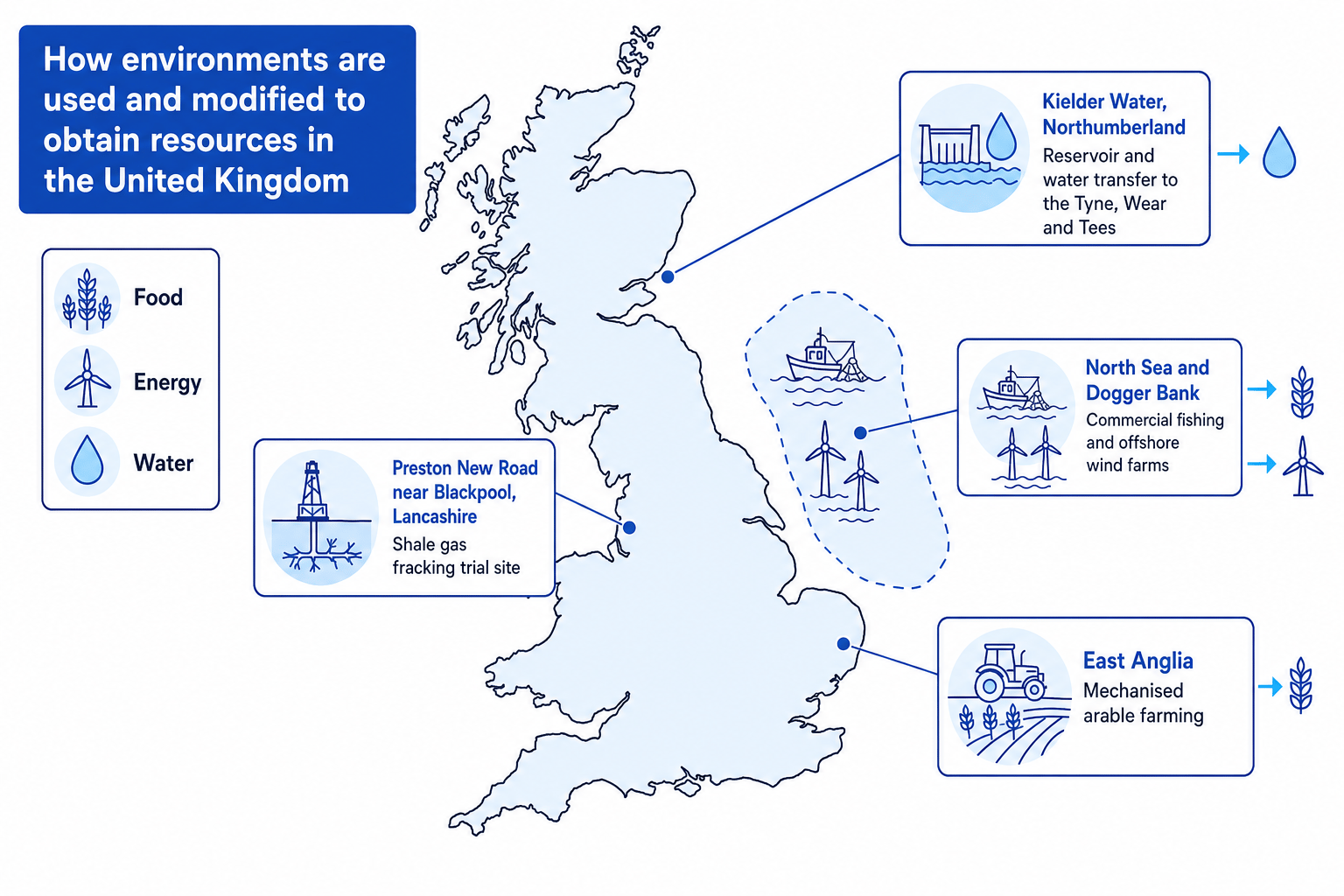
Most UK resource use involves a trade-off: people gain food, energy or water security, but ecosystems may be altered, simplified or damaged.
Food: mechanised farming in the UK
What is mechanised farming?
Mechanisation
Mechanisation means using machines to do work that was previously done by people or animals. In farming, this includes tractors, combine harvesters, milking machines, irrigation systems, GPS-guided equipment and chemical sprayers.
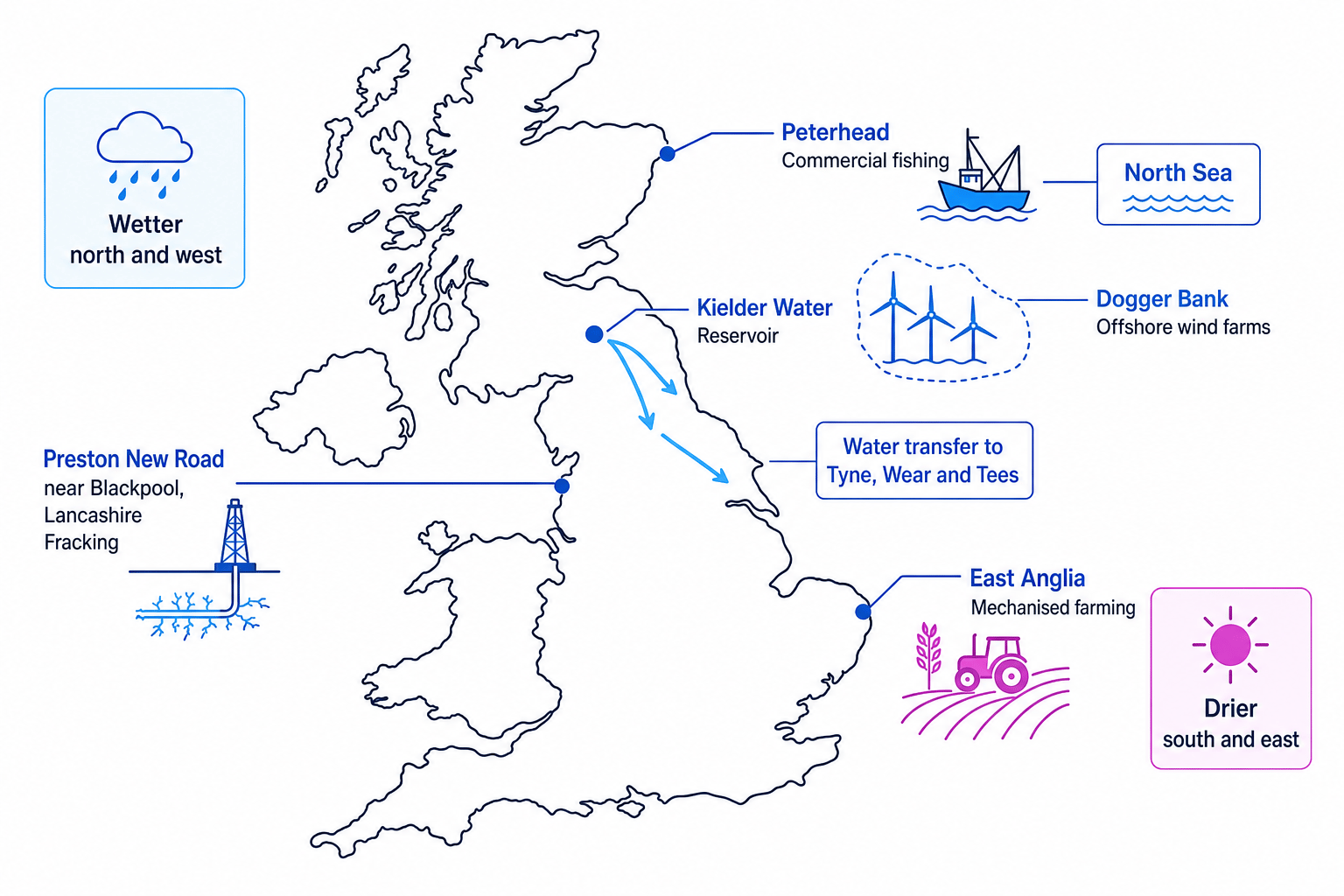
Mechanised farming is common in lowland parts of the UK, especially areas such as East Anglia, where the land is relatively flat, soils are fertile and large fields are suitable for machinery. Farmers grow crops such as wheat, barley, sugar beet and potatoes.
Mechanisation helps farmers produce more food from each hectare of land. A hectare is a unit of area equal to 10,000 square metres, often used when measuring farmland.
How mechanised farming modifies ecosystems
Mechanised farming changes the environment in several ways:
- Hedgerows may be removed to create larger fields for machinery.
- Fields may be drained to make wet land suitable for crops.
- Fertilisers add nutrients to increase crop growth.
- Pesticides kill pests, but may also harm other insects.
- Monoculture can develop, where one crop is grown over a large area.
Monoculture
Monoculture is the growing of a single crop species over a large area. It can be efficient, but it usually supports fewer species than a varied landscape with hedges, ponds and mixed crops.
Mechanised farming can increase yields and reduce food imports, but it may also reduce biodiversity. For example, removing hedgerows can reduce habitats for birds, insects and small mammals. Fertilisers can be washed into rivers, causing excess plant and algal growth.
Eutrophication
Eutrophication is when extra nutrients, often from fertilisers or sewage, enter water and cause rapid algal growth. When algae die and decompose, oxygen levels can fall, harming fish and other aquatic life.
Explaining how mechanisation affects biodiversity
- Identify the human change: a farmer removes hedgerows to combine several small fields into one larger field for tractors and combine harvesters.
- Link the change to the ecosystem: hedgerows provide nesting sites, food and corridors for species such as birds, insects and small mammals.
- Explain the outcome: with fewer habitats and less connectivity between habitats, species numbers may fall, so biodiversity decreases even if crop production increases.
Only writing the benefit
Do not just say “machines make farming faster”. For GCSE Geography, you usually need the benefit and the environmental consequence, such as higher yields but reduced habitats.
Food: commercial fishing around the UK
What is commercial fishing?
Commercial fishing
Commercial fishing is catching fish and shellfish to sell for profit, rather than for personal use. It can involve large boats, sonar, nets, trawlers and processing facilities.
The UK has important fishing areas around its coasts, including parts of the North Sea, the English Channel and waters west of Scotland. Ports such as Peterhead in north-east Scotland are major fishing centres.
Modern commercial fishing uses technology such as GPS, sonar fish-finding equipment, refrigerated storage and large nets. This makes fishing more efficient, but it can also put pressure on fish stocks.
Fish stock
A fish stock is the population of a fish species in a particular area that can potentially be harvested.
How commercial fishing modifies marine ecosystems
Fishing modifies marine ecosystems by removing organisms from food webs. Some methods, especially bottom trawling, can disturb the seabed.
Bottom trawling
Bottom trawling is a fishing method where heavy nets are dragged along the seabed to catch fish or shellfish. It can damage seabed habitats such as reefs, sediment communities and nursery areas.
Commercial fishing can also cause bycatch, where species not being targeted are accidentally caught. This may include young fish, seabirds or marine mammals.
To reduce damage, the UK and nearby countries use management methods such as quotas, minimum landing sizes, closed seasons and marine protected areas. A quota is a limit on how much of a species can be caught.
Assessing whether a fishing method is sustainable
- Consider the removal rate: if fish are caught faster than they reproduce, the stock will decline over time.
- Consider habitat damage: bottom trawling may reduce nursery habitats, so fewer young fish survive to adulthood.
- Consider management: quotas, protected areas and selective nets can reduce pressure, making the activity more sustainable if they are enforced.
Use food-web language
For fishing answers, strong explanations often mention food webs, fish stocks, bycatch and habitat damage, not just “there will be fewer fish”.
Energy: wind farms in the UK
What is a wind farm?
Wind farm
A wind farm is a group of wind turbines that use wind to generate electricity. Wind farms can be onshore on land or offshore at sea.
The UK is well suited to wind power because it has a long coastline, shallow continental shelf areas and frequent strong winds. Offshore wind farms are especially important in the North Sea, including the Dogger Bank area off north-east England, which is one of the world’s major offshore wind development zones.
Wind power is a renewable energy source, meaning it is naturally replaced and will not run out on human timescales. It also produces very low greenhouse gas emissions during operation.
How wind farms modify environments
Wind farms change environments by adding turbines, access tracks, cables, substations and maintenance infrastructure. Offshore wind farms may disturb seabed habitats during construction, while onshore wind farms can affect upland landscapes and peatland areas if poorly located.
However, wind farms can also reduce reliance on fossil fuels, helping the UK cut carbon dioxide emissions. Offshore turbine foundations may sometimes act as artificial reef structures, providing hard surfaces for marine organisms.
Intermittent energy
Intermittent energy is energy that is not produced continuously because it depends on changing conditions. Wind power is intermittent because turbines only generate electricity when wind speeds are suitable.
Balancing wind farm benefits and impacts
- Start with the resource benefit: offshore wind farms generate renewable electricity and reduce the need to burn fossil fuels.
- Add the environmental cost: construction can disturb seabed habitats, and turbines may affect some bird migration routes.
- Make a balanced judgement: wind farms can be a lower-carbon option overall, but they need careful site selection, environmental surveys and monitoring to reduce local ecosystem impacts.
Saying renewable means impact-free
Renewable energy is not the same as “no environmental impact”. Wind power has much lower operational emissions than fossil fuels, but turbines and cables still modify landscapes and ecosystems.
Energy: fracking in the UK
What is fracking?
Fracking
Fracking, short for hydraulic fracturing, is a method of extracting gas or oil from shale rock by injecting water, sand and chemicals at high pressure to create cracks in the rock.
In the UK, fracking has been associated with shale gas exploration in places such as Preston New Road near Blackpool, Lancashire. It is controversial and has faced strong public opposition. England has had a moratorium on shale gas fracking since 2019, briefly lifted in 2022 and then reinstated; Scotland and Wales also have policies against it.
Fracking is included in the specification because it shows how energy demand can lead to attempts to modify underground environments as well as surface landscapes.
How fracking modifies environments
Fracking requires drilling pads, access roads, water supply, wastewater storage and transport. Underground, it deliberately fractures shale rock to release gas.
Possible concerns include:
- small earth tremors linked to fracturing;
- risk of water contamination if wells are poorly sealed;
- high water use;
- lorry traffic and noise;
- continued reliance on fossil fuels.
Supporters argue that domestic shale gas could improve energy security and create jobs. Critics argue that it risks local environmental damage and delays the transition to low-carbon energy.
Energy security
Energy security means having a reliable and affordable supply of energy to meet people’s needs.
Evaluating fracking as an energy option
- Consider the national benefit: shale gas could increase domestic energy supply, reducing dependence on imported gas.
- Consider the local environmental risks: drilling and fracturing may create traffic, noise, wastewater issues and small tremors.
- Consider the long-term issue: because shale gas is a fossil fuel, burning it releases carbon dioxide, so it does not solve climate change in the way renewable energy can.
Use current wording carefully
Avoid writing “the UK uses fracking widely”. A safer GCSE phrasing is: fracking has been trialled and debated in the UK, but it is currently restricted by policy because of environmental and seismic concerns.
Water: reservoirs in the UK
Why the UK needs water management
The UK receives plenty of rainfall overall, but it is unevenly distributed. The north and west are generally wetter, while the south and east are drier and often have higher population density and water demand.
Water surplus and water deficit
A water surplus happens when water supply is greater than demand. A water deficit happens when demand is greater than the available supply, especially during dry periods.
This mismatch means water has to be stored and sometimes moved.
Reservoir
A reservoir is an artificial lake used to store water, often created by building a dam across a river valley.
Examples include Kielder Water in Northumberland, the Elan Valley reservoirs in Wales, and Lake Vyrnwy in Wales. Reservoirs store water for homes, industry and sometimes hydroelectric power.
How reservoirs modify ecosystems
Building a reservoir floods land behind a dam. This can submerge farmland, woodland, habitats, roads or even settlements. River flow downstream may also change, affecting sediment transport, water temperature and aquatic habitats.
Reservoirs can also create new wetland and recreational habitats, but they are not the same as the original ecosystem.
Explaining reservoir impacts
- Identify the physical modification: a dam blocks a valley, causing water to collect and flood land upstream.
- Link this to ecosystem change: existing terrestrial habitats such as woodland, grassland or farmland are replaced by open water.
- Explain the wider effect: species adapted to the old habitat may decline or move away, while water birds and aquatic species may increase.
Water: water transfer schemes
What is a water transfer scheme?
Water transfer scheme
A water transfer scheme moves water from an area of surplus to an area of deficit, usually using pipes, tunnels, canals or river channels.
A key UK example is the Kielder Water Transfer Scheme. Kielder Water stores water in Northumberland, and water can be released into rivers to support demand in parts of north-east England, including the Tyne, Wear and Tees areas.
Water transfer can improve supply reliability for homes, farms and industry. However, it can be expensive, use energy for pumping, and affect both the source and receiving environments.
How water transfers modify environments
At the source, taking water can reduce river flow if not managed carefully. At the receiving end, adding water can change river levels, flow speed and water chemistry. Construction of pipelines, pumping stations and channels can also disturb habitats.
Deciding whether a water transfer is justified
- Compare supply and demand: if a wetter region has surplus water and a drier, more populated region has shortages, transfer may improve water security.
- Consider environmental costs: removing or adding water can alter river ecosystems, especially during dry periods.
- Reach a balanced judgement: the scheme may be justified if shortages are serious, but it should include flow controls, habitat protection and demand reduction such as fixing leaks.
Water management is about space
The UK’s water challenge is not just “too little water”. It is that water supply and water demand are unevenly distributed across the country.
Bringing it together: food, energy and water are connected
Food, energy and water are often linked. Farming needs water and energy. Energy production may need water. Water transfer may need energy for pumping. This is sometimes called the food-energy-water nexus.
Food-energy-water nexus
The food-energy-water nexus is the idea that food, energy and water systems are connected, so a change in one can affect the others.
For example, irrigated farming in eastern England may increase food production but also increases water demand. Offshore wind farms provide energy, but construction can affect marine ecosystems that also support fishing. Reservoirs improve water supply but flood valleys and change river systems.
A strong explanation chain
Use this structure: human need → modification → benefit → environmental impact → management or judgement. This helps you move beyond simple description.
Quick comparison
| Resource need | UK activity | Named example | Main benefit | Possible environmental impact |
|---|---|---|---|---|
| Food | Mechanised farming | East Anglia | Higher crop yields and efficient production | Habitat loss, reduced biodiversity, fertiliser runoff |
| Food | Commercial fishing | North Sea / Peterhead | Fish supply and jobs | Overfishing, bycatch, seabed damage |
| Energy | Wind farms | Dogger Bank, North Sea | Renewable electricity | Visual impact, seabed disturbance, bird impacts |
| Energy | Fracking | Preston New Road, Lancashire | Potential domestic gas supply | Tremors, wastewater, fossil fuel emissions |
| Water | Reservoirs | Kielder Water, Northumberland | Stores water for dry periods | Flooded habitats and changed river flow |
| Water | Water transfers | Kielder to Tyne, Wear and Tees | Moves water to areas of demand | Alters river flow and requires infrastructure |
In the exam
- Use named UK examples where you can, such as East Anglia, Dogger Bank, Preston New Road or Kielder Water.
- Explain both sides: state the resource benefit, then link it to a specific environmental change.
- For longer answers, finish with a judgement about sustainability, using words like however, whereas, overall and depends on the management.
Check yourself
- How does mechanised farming increase food production but reduce biodiversity?
- Why is wind power renewable but not completely impact-free?
- How can reservoirs and water transfer schemes help solve the UK’s uneven water supply?