What you'll learn
- How to identify renewable and non-renewable energy sources.
- Where different energy sources are found or used in the UK at national, regional and local scales.
- How renewable and non-renewable sources contribute to the UK’s energy supply.
- How to interpret energy mix data without confusing electricity with total energy use.
The starting point: what is an energy source?
The UK needs energy for homes, schools, hospitals, transport, industry and services. Energy does not just mean electricity: it also includes petrol and diesel for transport, natural gas for heating, and fuels used by factories.
Energy source and energy mix
An energy source is something that provides usable energy, such as wind, oil or natural gas. An energy mix is the combination of different energy sources used by a country, region or local area.
The UK’s energy mix has changed a lot. Coal used to be extremely important, especially for electricity and heavy industry. Today, coal is almost absent from electricity generation, while wind, gas and nuclear power play much larger roles.
The big picture
The UK has many energy sources available, but non-renewable fossil fuels still dominate total energy use, while renewables now provide a large share of electricity generation.
Renewable and non-renewable sources
The first skill is classification: deciding whether a source is renewable or non-renewable.
Renewable and non-renewable energy
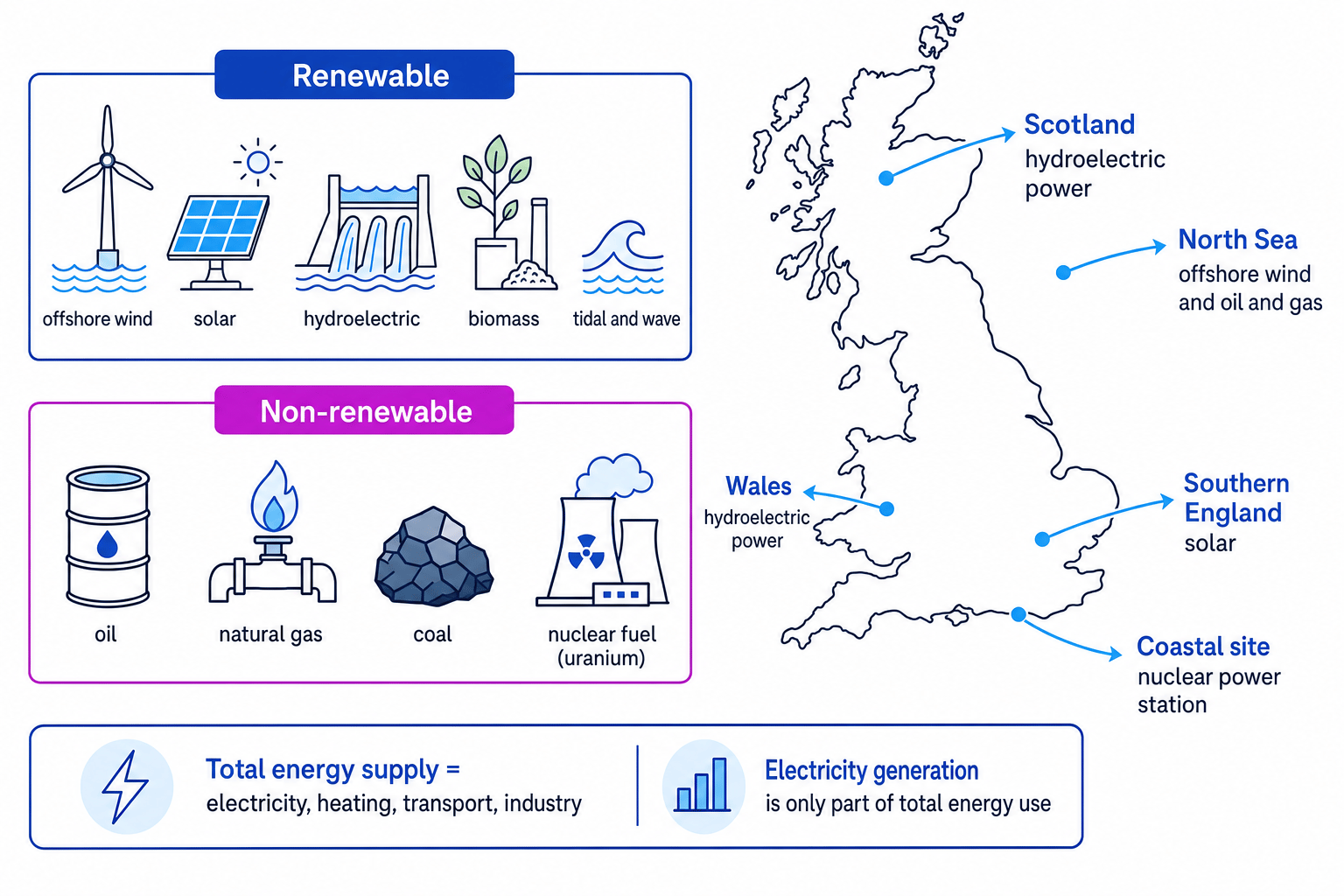
A renewable energy source is naturally replaced on a human timescale, such as wind, sunlight or flowing water. A non-renewable energy source is finite or forms so slowly that it cannot be replaced within a human lifetime, such as oil, natural gas, coal or uranium.
Non-renewable energy sources
The main non-renewable sources available to the UK are:
| Source | What it is | UK context |
|---|---|---|
| Coal | A fossil fuel formed from ancient plant material | Once very important; now almost gone from UK electricity generation |
| Oil | A fossil fuel used mainly for transport fuels and petrochemicals | Extracted from the North Sea, but the UK also imports oil |
| Natural gas | A fossil fuel used for heating, cooking, industry and electricity | Very important for home heating and flexible electricity generation |
| Nuclear fuel | Usually uranium, used in nuclear power stations | Low-carbon electricity, but uranium is finite |
A fossil fuel is a fuel formed from the remains of living organisms over millions of years. Coal, oil and natural gas are fossil fuels. When they are burnt, they release carbon dioxide, a greenhouse gas linked to climate change.
Nuclear is not renewable
Nuclear power is low-carbon during operation, but it is still non-renewable because it relies on finite uranium fuel.
Renewable energy sources
The main renewable sources used or available in the UK are:
| Source | How it works | UK context |
|---|---|---|
| Wind | Moving air turns turbines | Very important, especially offshore wind in the North Sea and Irish Sea |
| Solar | Sunlight is converted into electricity | More productive in sunnier parts of southern and eastern England |
| Hydroelectric power | Falling or flowing water turns turbines | Best in upland, wet areas such as Scotland and Wales |
| Biomass | Organic material is burnt or processed for energy | Can use wood, crops, food waste or waste materials |
| Tidal and wave | Movement of tides or waves generates electricity | The UK has strong potential around some coasts, but use is still limited |
Biomass depends on management
Biomass is only renewable if it is managed sustainably, for example by replanting trees or using waste materials rather than destroying forests faster than they regrow.
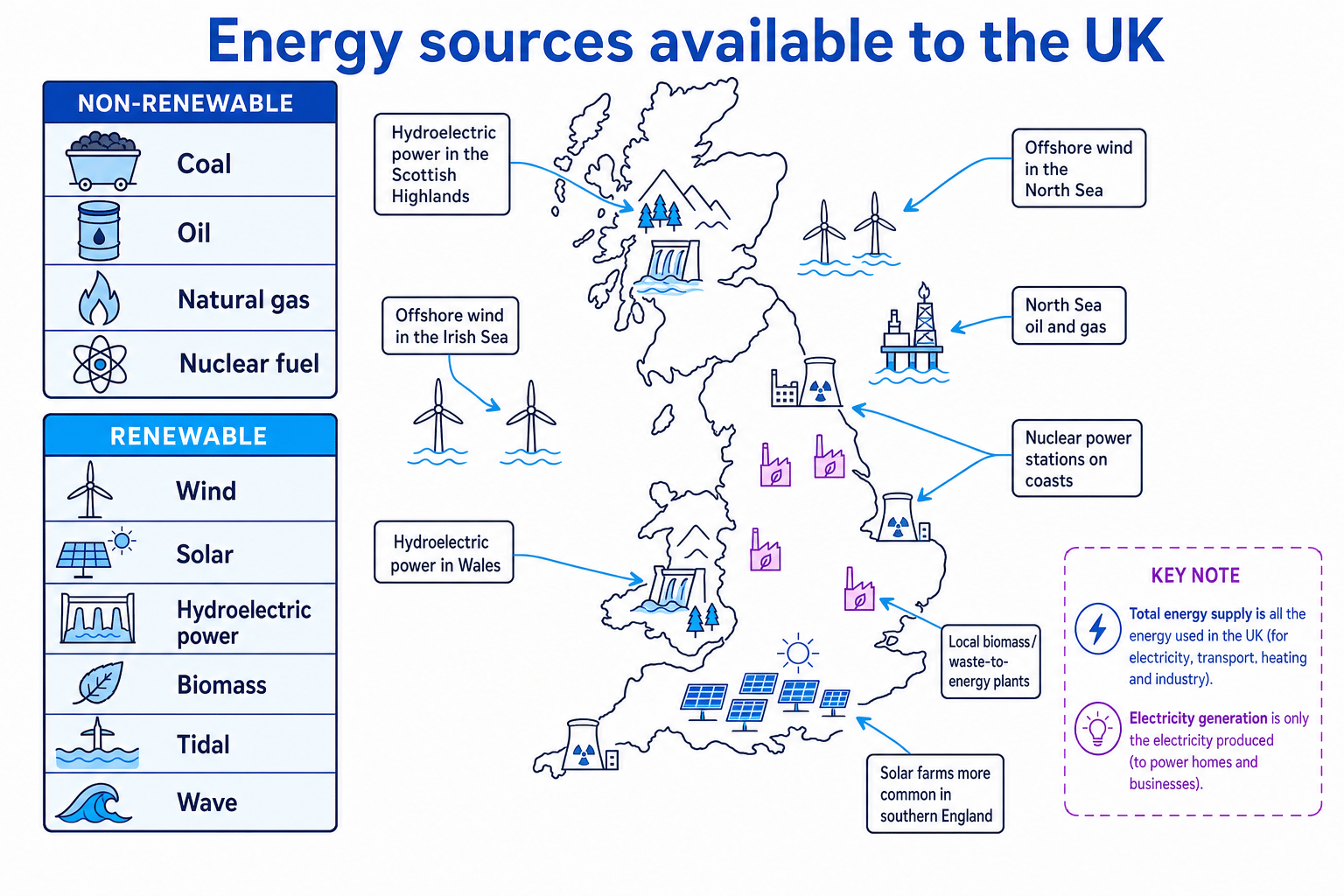
This diagram summarises the classification of energy sources and shows where some of them are found or used around the UK.
Where different sources are available in the UK
Energy availability depends on both physical factors and human factors.
Physical factors include wind speed, relief, rainfall, geology, sunlight and tidal range. Human factors include cost, planning permission, technology, grid connection, local opposition and government policy.
National scale
At the national scale, the UK has access to:
- North Sea oil and gas.
- Large offshore wind resources.
- Nuclear power stations, mostly on coastal sites.
- Imported energy through pipelines, ships and electricity interconnectors.
- Solar, biomass, hydroelectric and smaller-scale renewables.
Regional scale
Different regions suit different sources:
- The North Sea is important for oil, gas and offshore wind.
- The Scottish Highlands and parts of Wales suit hydroelectric power because they are wetter and more mountainous.
- Southern England has more favourable conditions for solar farms because it generally receives more sunshine.
- Coastal areas may suit nuclear power stations, tidal power or offshore wind.
Local scale
At a local scale, energy might come from:
- Rooftop solar panels on homes and schools.
- Small wind turbines.
- Community hydro schemes.
- Biomass boilers.
- Waste-to-energy plants.
Choosing a suitable renewable source for a region
A rural upland area in Scotland has high rainfall, steep valleys and several fast-flowing rivers. Which renewable source is most suitable?
- Match the physical conditions to the energy source: high rainfall and steep relief mean water can flow downhill with enough energy to turn turbines.
- Compare with alternatives: solar is less reliable in this area because sunshine is lower, and tidal power would only be suitable if the site were coastal.
- Add a human factor: a hydroelectric scheme would need investment, grid connection and careful planning to reduce impacts on habitats and river flow.
- Conclude that hydroelectric power is the best fit because the physical conditions directly support it.
Contribution to the UK’s energy supply
This is where you need to be careful. There is a difference between total energy supply and electricity generation.
Total energy supply and electricity generation
Total energy supply means all energy used for electricity, heating, transport and industry. Electricity generation only means the electricity produced to power homes, businesses and services.
In the UK, non-renewables still provide most total energy, mainly because:
- Oil is still heavily used for transport.
- Natural gas is widely used for home heating and electricity generation.
- Some industries still rely on fossil fuels.
However, for electricity generation, renewables are now very important. In recent years, renewables have provided roughly 40–45% of UK electricity, depending on the year and weather. Wind is the biggest renewable electricity source. Gas is still important because gas-fired power stations can increase or decrease output quickly when demand changes or wind speeds fall. Nuclear power provides a steady low-carbon supply, but it is expensive and slow to build.
Electricity is not the whole energy supply
Do not write “the UK mostly uses renewables” just because renewables generate a large share of electricity. Heating and transport still use large amounts of gas and oil.
Calculating contribution to an energy mix
To compare energy sources, you may be asked to calculate a percentage contribution.
Use:
Percentage contribution=energy from one sourcetotal energy supply×100\text{Percentage contribution} = \frac{\text{energy from one source}}{\text{total energy supply}} \times 100Percentage contribution=total energy supplyenergy from one source×100Calculating a contribution to an energy mix
A simplified UK electricity dataset shows total electricity generation of 300 TWh. Renewables generate 132 TWh and gas generates 96 TWh. Calculate the percentage contribution of renewables and compare it with gas.
-
Select the correct figures: renewables generate 132 TWh out of a total of 300 TWh.
-
Substitute into the formula:
132300×100=44\frac{132}{300} \times 100 = 44300132×100=44 -
Interpret the result: renewables contribute 44% of electricity generation in this simplified dataset.
-
Calculate the gas share for comparison:
96300×100=32\frac{96}{300} \times 100 = 3230096×100=32 -
Compare the two percentages: renewables contribute 12 percentage points more than gas, so renewables are the larger electricity source in this example.
Why the UK energy mix is changing
The UK’s energy mix is changing because of environmental, economic and political pressures.
Coal has declined sharply because it produces high carbon dioxide emissions and air pollution. The UK’s last coal-fired power station closed in 2024, which is a major shift from the past.
Wind power has grown because the UK has strong wind resources, especially offshore. Shallow seas around parts of the UK also make it easier to build offshore wind farms than in very deep water.
Natural gas remains important because it is flexible and the UK has existing gas infrastructure. However, relying on gas can reduce energy security, because prices can rise quickly and some gas is imported.
Energy security
Energy security means having a reliable, affordable and sufficient supply of energy for a country’s needs.
Nuclear power helps provide steady low-carbon electricity, but nuclear power stations are expensive, take a long time to build and create radioactive waste that must be managed safely.
A simple way to explain the UK mix
For strong GCSE answers, link source, reason and scale: “Offshore wind has grown nationally because the UK has strong coastal winds and shallow seas, especially in the North Sea.”
In the exam
- Separate classification from contribution: first say whether a source is renewable or non-renewable, then explain how important it is in the UK mix.
- Be precise about scale: use examples such as North Sea oil and gas, Scottish hydroelectric power, offshore wind, or local rooftop solar.
- Do not confuse electricity generation with total energy supply; oil and gas remain very important for transport and heating.
- Use comparative language: “larger share”, “declining contribution”, “increasing importance”, and “mainly used for”.
- If given data, calculate percentages carefully and quote the unit, such as TWh, if it is shown.
Check yourself
- Why is nuclear power classed as non-renewable even though it is low-carbon during operation?
- Why can renewables provide a large share of UK electricity but a smaller share of total UK energy use?
- Name one UK region associated with offshore wind, one with oil and gas, and one with hydroelectric power.