What you'll learn
- What geographers mean by development, including social, economic and environmental development.
- How sustainable development tries to balance present needs with the future.
- How indicators such as GNI per capita, HDI and Internet Users measure development.
- How indicators reveal global patterns of ACs, EDCs and LIDCs.
Starting point: what is development?
In Geography, development means improvement in people’s lives. It is not just about being “rich”. A country may have a growing economy but still have poor healthcare, inequality, pollution or limited access to education.
Development is usually studied at the global scale in this topic: you compare countries and world regions to see how opportunities and quality of life vary around the world.
Development
Development is the process of improving people’s quality of life, including their income, health, education, security, equality and environment.
Two useful everyday terms are:
- Standard of living — the material side of life, such as income, housing, goods and services.
- Quality of life — wider wellbeing, including health, education, safety, freedom, equality and environment.
Uneven development
Uneven development
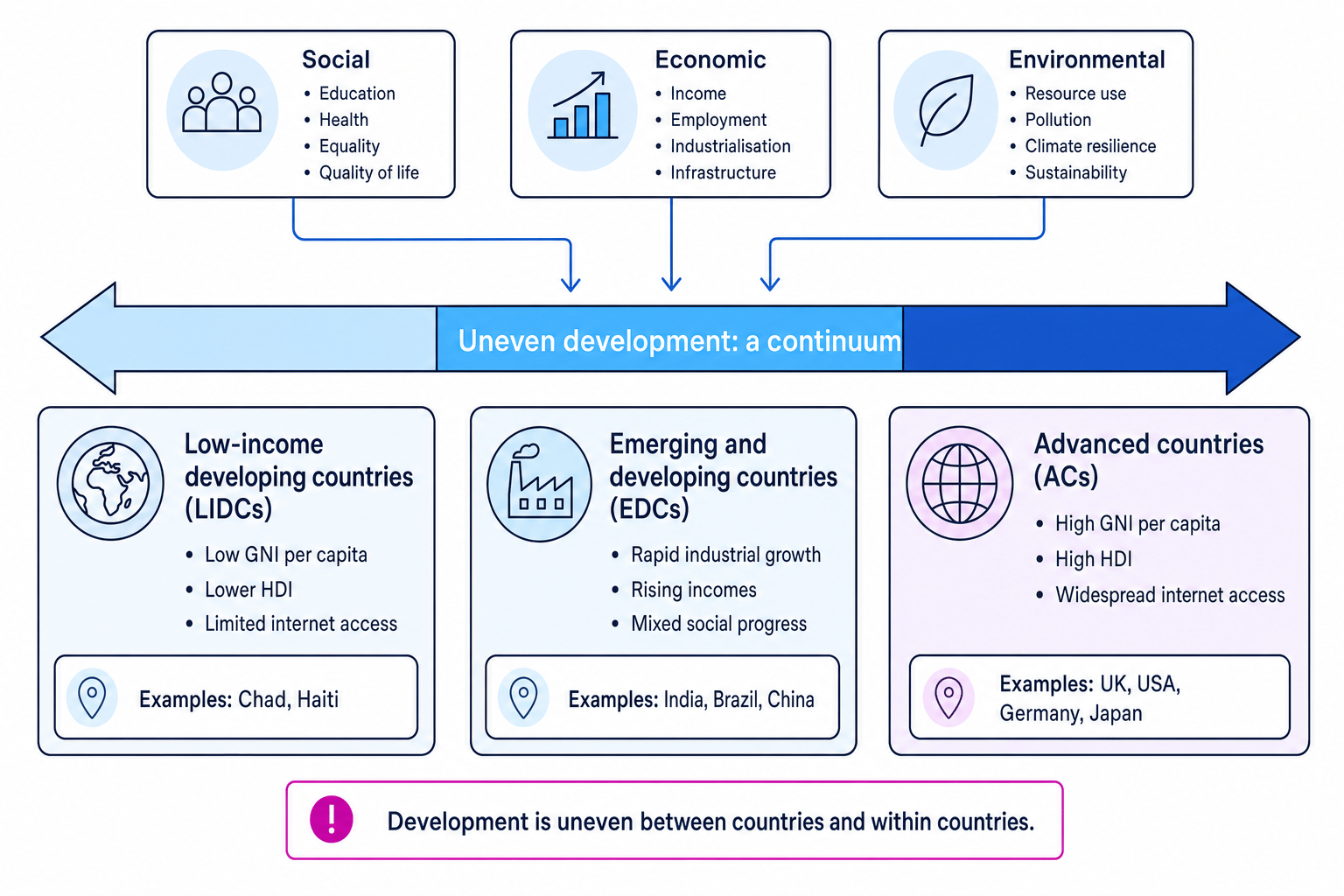
Uneven development means development is not spread equally between places or people. It can happen between countries, between regions within a country, and between groups of people in the same place.
For example, the UK is an advanced country overall, but not every UK region has the same income, health or life expectancy. Similarly, India is an emerging economy with major global cities such as Mumbai and Bengaluru, but there are also rural areas with lower incomes and more limited services.
The key idea is that development is a continuum, not a simple “developed versus undeveloped” split.
Development is more than wealth
A country’s level of development is judged using a range of evidence: income matters, but so do health, education, technology, equality and environmental sustainability.
The three dimensions of development
Social development
Social development is about people’s wellbeing and access to basic services. It includes healthcare, education, clean water, housing, equality and safety.
Social development is often seen in indicators such as life expectancy, literacy rate, school enrolment and infant mortality.
Economic development
Economic development is about money, jobs, trade, industry and infrastructure. It includes how much income a country produces, how many people have secure employment, and whether transport, energy and communications systems support businesses.
A country with high economic development often has a strong tax base, which can help pay for hospitals, schools, roads and public services.
Environmental development
Environmental development is about how well people use and manage the natural environment. It includes pollution levels, access to safe water, energy use, waste management, conservation and resilience to climate change.
This matters because development that damages the environment may improve lives in the short term but create bigger problems later.
Sustainable development
Sustainable development
Sustainable development means meeting the needs of people today without reducing the ability of future generations to meet their own needs.
Sustainable development tries to balance three things:
- Economic needs — jobs, income, trade and investment.
- Social needs — health, education, equality and quality of life.
- Environmental needs — protecting resources, ecosystems and climate stability.
A development project is more sustainable when it improves lives without causing long-term environmental damage or leaving future people with fewer resources.
Judging whether development is sustainable
A country plans to clear rainforest to create cattle ranches, increasing exports and jobs.
- Identify the economic gain: cattle ranching may create jobs, increase exports and raise tax income for the government.
- Check the social effect: some people may benefit from employment, but Indigenous communities or small farmers could lose land or livelihoods.
- Check the environmental effect: deforestation can reduce biodiversity, increase carbon dioxide emissions and damage soil and water cycles.
- Make a balanced judgement: the project may support short-term economic development, but if forest loss is permanent and local communities are harmed, it is unlikely to be fully sustainable.
Assuming growth is always development
Economic growth means an economy is producing more, but it does not automatically mean everyone’s quality of life improves. Always ask: who benefits, and what are the social and environmental costs?
Development indicators
A development indicator is a measurement used to compare development between places. No single indicator tells the whole story, so geographers use several together.
GNI per capita
GNI per capita
Gross National Income per capita is the total income earned by a country’s people and businesses, including income from abroad, divided by the population. It is usually given in US$ per person.
The basic idea is:
GNI per capita=total GNIpopulation\text{GNI per capita} = \frac{\text{total GNI}}{\text{population}}GNI per capita=populationtotal GNIA higher GNI per capita usually suggests a country has more wealth available per person. This can support better housing, healthcare, education and infrastructure.
However, it is an average, so it can hide inequality. A small number of very wealthy people can raise the average even if many people remain poor.
Calculating GNI per capita
A country has a total GNI of US$120 billion and a population of 60 million.
- Convert the figures into comparable numbers: US120billionisUS120 billion is US120billionisUS120,000 million.
- Divide total GNI by population: US$120,000 million ÷ 60 million.
- Calculate the value per person: the GNI per capita is US$2,000.
- Interpret it carefully: this suggests relatively low average income, but it does not show how income is shared between people.
Human Development Index
Human Development Index
The Human Development Index, or HDI, is a combined measure of development using life expectancy, education and income. It gives a score from 0 to 1, where 1 is highest development.
HDI is useful because it combines social and economic data. A country with a high HDI usually has long life expectancy, high levels of education and relatively high income.
Its disadvantage is that it still hides differences within a country. For example, a national HDI score may not show inequality between urban and rural areas, or between rich and poor groups.
Internet Users
Internet Users
Internet Users is the percentage of a population using the internet. It is often used as an indicator of access to technology, information and communication.
High internet access can support education, online banking, business, healthcare information and political participation. Low internet access can create a digital divide, where some people are excluded from opportunities because they cannot get online.
Its disadvantage is that it does not show the quality, speed or affordability of internet access. Two countries might both have high internet use, but one may have faster and more reliable connections.
Advantages and disadvantages of key indicators
| Indicator | What it shows well | Main weakness |
|---|---|---|
| GNI per capita | Average income and economic strength | Hides inequality and does not show quality of life |
| HDI | A broader picture using health, education and income | Hides regional differences and does not include environment |
| Internet Users | Access to technology and communication | Does not show speed, cost or quality of access |
Use indicators together
In exam answers, avoid relying on just one indicator. Stronger answers compare at least two indicators, such as GNI per capita and HDI, then explain what each one shows and what it misses.
How indicators show the consequences of uneven development
Development indicators do more than rank countries. They show real consequences for people’s lives.
If a country has a low GNI per capita, the government may collect less tax, so it may struggle to fund roads, hospitals, schools and clean water systems. If HDI is low, it may suggest shorter life expectancy, fewer years in school and lower incomes. If internet use is low, people may have fewer chances to access online learning, digital jobs, healthcare information or global markets.
These are not just numbers: they show differences in opportunity.
Interpreting mixed development indicators
Three countries have these broad patterns:
- Country A: high GNI per capita, HDI above 0.9, internet use above 90%.
- Country B: middle GNI per capita, HDI around 0.65, internet use rising quickly.
- Country C: low GNI per capita, HDI below 0.5, internet use below 30%.
- Compare income first: Country A has the strongest economy on average, Country B is in the middle, and Country C has the lowest average income.
- Add social evidence: Country A’s high HDI suggests strong health and education, while Country C’s low HDI suggests people face more limits on life chances.
- Add technology evidence: Country B’s rising internet use may show rapid change, while Country C’s low access suggests a digital divide.
- Classify carefully: Country A is likely to be an AC, Country B an EDC, and Country C an LIDC — but final classification should use several indicators, not one number alone.
Current global patterns: ACs, EDCs and LIDCs
Countries are often grouped into broad categories. These categories are useful, but they are simplifications: development changes over time, and every country has internal inequalities.
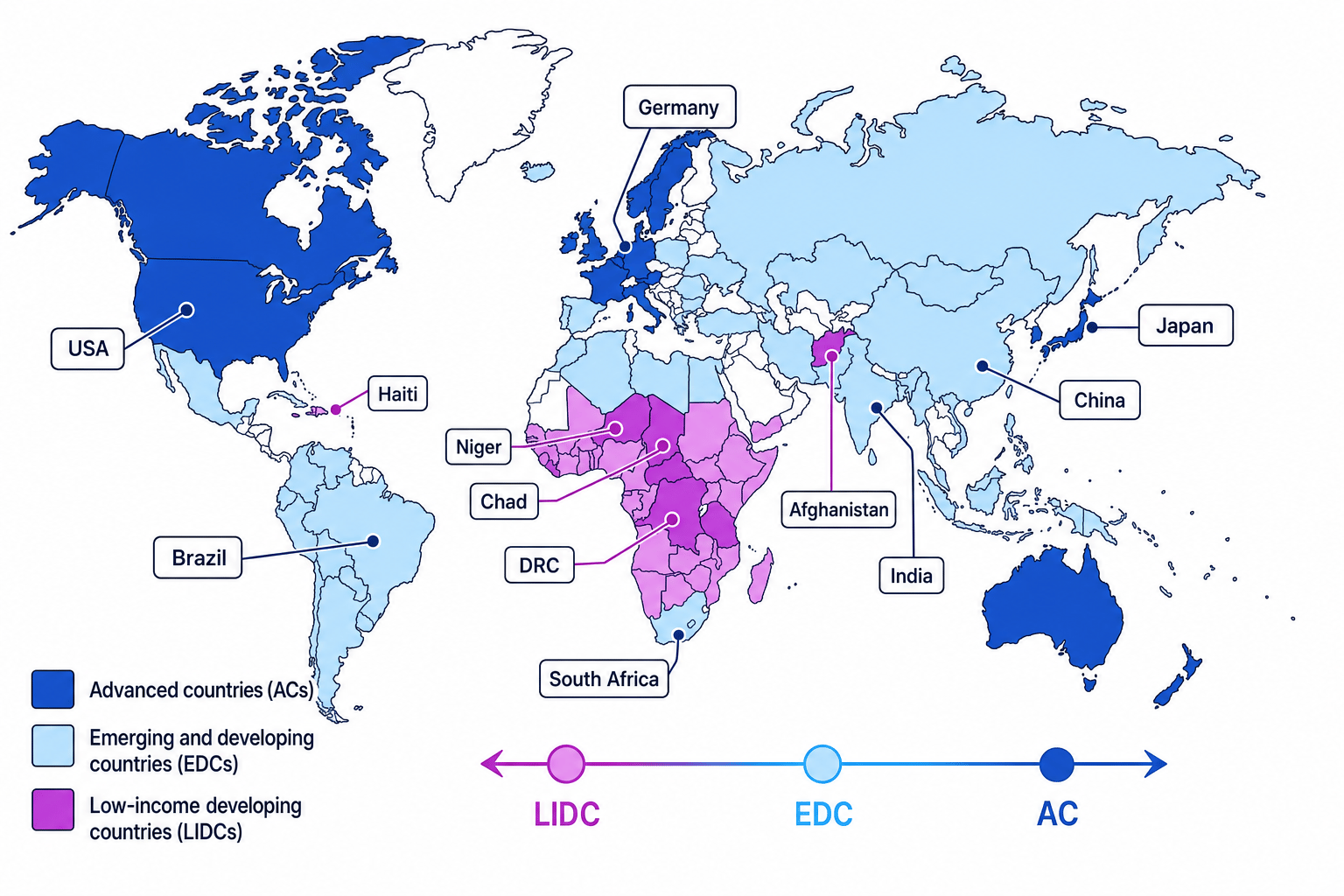
Advanced countries
Advanced countries
Advanced countries, or ACs, are countries with high levels of economic and social development, usually including high incomes, high HDI, strong infrastructure and widespread access to services.
ACs are mainly found in Europe, North America, Japan, South Korea, Australia and New Zealand. Examples include the UK, Germany, the USA and Japan.
Emerging and developing countries
Emerging and developing countries
Emerging and developing countries, or EDCs, are countries with growing economies and improving development indicators, but where living standards may still vary greatly between regions and groups.
EDCs include countries such as China, India, Brazil, Mexico, Indonesia and South Africa. Many have rapid industrial growth, expanding cities and rising middle classes, but also inequality and pressure on housing, transport and the environment.
Low-income developing countries
Low-income developing countries
Low-income developing countries, or LIDCs, are countries with low incomes and generally lower development indicators, often facing challenges such as limited infrastructure, lower life expectancy and less access to education or technology.
Many LIDCs are found in Sub-Saharan Africa, with examples such as Chad, Niger and the Democratic Republic of the Congo. Others include countries such as Haiti and Afghanistan. Exact classifications can change as economies grow or data is updated.
Development categories change
Countries do not stay in one group forever. For example, some countries have moved rapidly from lower income to middle or high income through industrialisation, trade, investment and improved education.
The big picture
At the global scale, development is uneven because wealth, power, resources, trade links, education, technology and political stability are not evenly distributed. Indicators help you describe this pattern clearly, but you should always interpret them critically.
A high-income country can still have poverty and inequality. A lower-income country can still make strong progress in education, healthcare or technology. Good geography answers show this balance.
In the exam
- Define key terms precisely: development is wider than income, and sustainable development balances social, economic and environmental needs.
- Use more than one indicator when comparing countries, and explain what each indicator shows and what it hides.
- When discussing ACs, EDCs and LIDCs, include named examples and remember that global patterns have exceptions.
Check yourself
- Why is GNI per capita useful, but also limited, as a measure of development?
- How does HDI give a broader picture of development than income alone?
- Where are many ACs, EDCs and LIDCs found in the world today?