

What you'll learn
- How tropical rainforests recycle nutrients and water very quickly.
- How coral reefs recycle nutrients despite living in nutrient-poor seas.
- Why climate, soil, water, plants, animals and people are interdependent.
- How the Amazon Rainforest and Great Barrier Reef are valued, threatened and managed.
The big idea: ecosystems are connected systems
An ecosystem is a community of living things and the physical environment they interact with. This includes plants, animals, soil, water, climate and people.
Biodiversity
Biodiversity means the variety of life in a place. A highly biodiverse ecosystem has many different species, genetic variation and habitats.
Interdependence
Interdependence means parts of an ecosystem rely on each other. If one part changes, other parts are affected too.
Tropical rainforests and coral reefs are two of the world’s most biodiverse ecosystems. They are valuable at a local scale for livelihoods, at a national scale for income and resources, and at a global scale for carbon storage, climate regulation and biodiversity.
The core connection
Biodiverse ecosystems stay healthy because energy, water and nutrients move through them. Human activity can break these flows, causing biodiversity to fall.
Tropical rainforests: hot, wet and fast-cycling
A tropical rainforest is a forest ecosystem found close to the Equator, usually with high temperatures, high rainfall and dense evergreen vegetation.
Rainforests are found in places such as the Amazon Basin in South America, the Congo Basin in Africa and parts of Southeast Asia. Their climate is warm and wet all year, so plants grow rapidly and decomposition happens quickly.
Nutrient cycling in tropical rainforests
Nutrient cycle
A nutrient cycle is the movement and reuse of minerals, such as nitrogen, phosphorus and potassium, between living things, dead organic matter and the soil.
In a tropical rainforest, most nutrients are stored in the biomass, meaning the living plants and animals. The litter layer, made of dead leaves and organic matter, is usually thin because it decomposes rapidly in hot, humid conditions. The soil store is often quite low in nutrients because heavy rainfall causes leaching, where dissolved minerals are washed down through the soil.
The diagram shows how the rainforest nutrient and water cycles are linked.
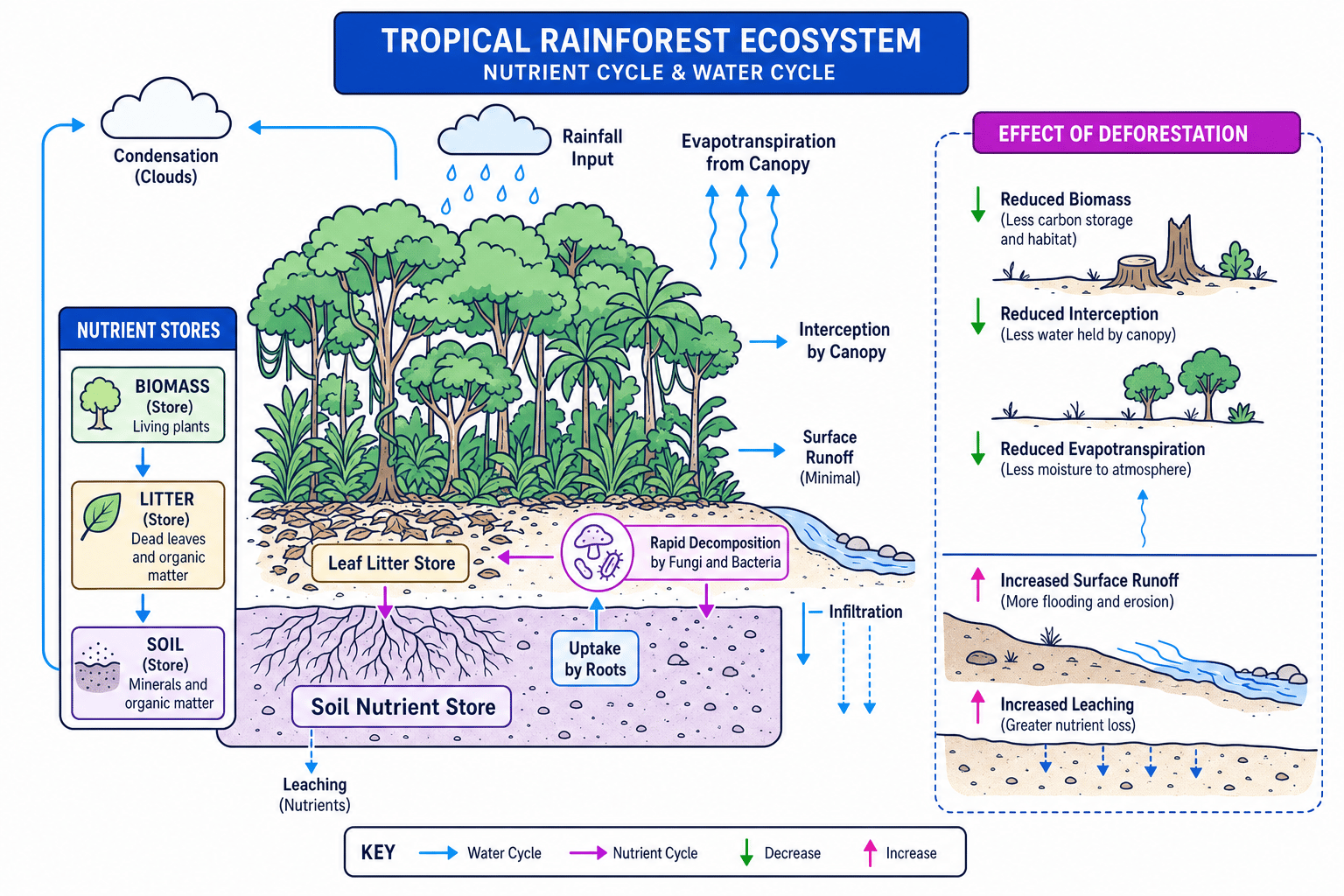
In a healthy rainforest:
- Leaves and branches fall to the ground as litter.
- Fungi and bacteria decompose the litter quickly.
- Nutrients are released into the soil.
- Shallow roots take up nutrients rapidly.
- Dense vegetation stores the nutrients in biomass.
Thinking rainforest soils are naturally fertile
Rainforests look lush, but the soil is often not very fertile once the forest is removed. The nutrients are mainly held in the living vegetation, not stored safely in the soil.
Water cycling in tropical rainforests
The water cycle is the movement of water between the land, living things, rivers and the atmosphere.
In tropical rainforests, water moves quickly because rainfall is high and vegetation is dense. The canopy intercepts rainfall, meaning leaves and branches catch water before it reaches the ground. Trees return water vapour to the atmosphere through transpiration, and the combined loss of water from plants and surfaces is called evapotranspiration.
This recycled moisture helps form clouds and further rainfall. If trees are removed, less water is returned to the atmosphere, and more water flows over the ground as surface runoff. This can increase flooding, erosion and leaching.
Linking deforestation to soil fertility loss
- Start with the change: forest is cleared, so the biomass store becomes much smaller.
- Follow the nutrient flow: fewer trees means less leaf litter, so fewer nutrients are returned to the soil by decomposition.
- Add the water cycle effect: with less canopy interception and root uptake, rainfall hits the soil more directly and runoff increases.
- Explain the outcome: nutrients are washed away by leaching and erosion, so the soil becomes less fertile and forest regrowth is harder.
Coral reefs: nutrient cycling in clear tropical seas
A coral reef is a marine ecosystem built mainly by tiny animals called coral polyps. These polyps produce hard calcium carbonate skeletons, which build the reef structure over time.
Coral reefs usually grow best in warm, shallow, clear seas where sunlight can reach the coral. Many are found in tropical areas, such as the Caribbean, the Indian Ocean and the western Pacific.
Zooxanthellae
Zooxanthellae are microscopic algae that live inside coral tissues. They photosynthesise and provide food for the coral, while the coral gives them shelter and waste nutrients.
This relationship is a form of symbiosis, where two organisms live closely together. In coral reefs, nutrients are often scarce in the surrounding water, so the ecosystem depends on very rapid recycling.
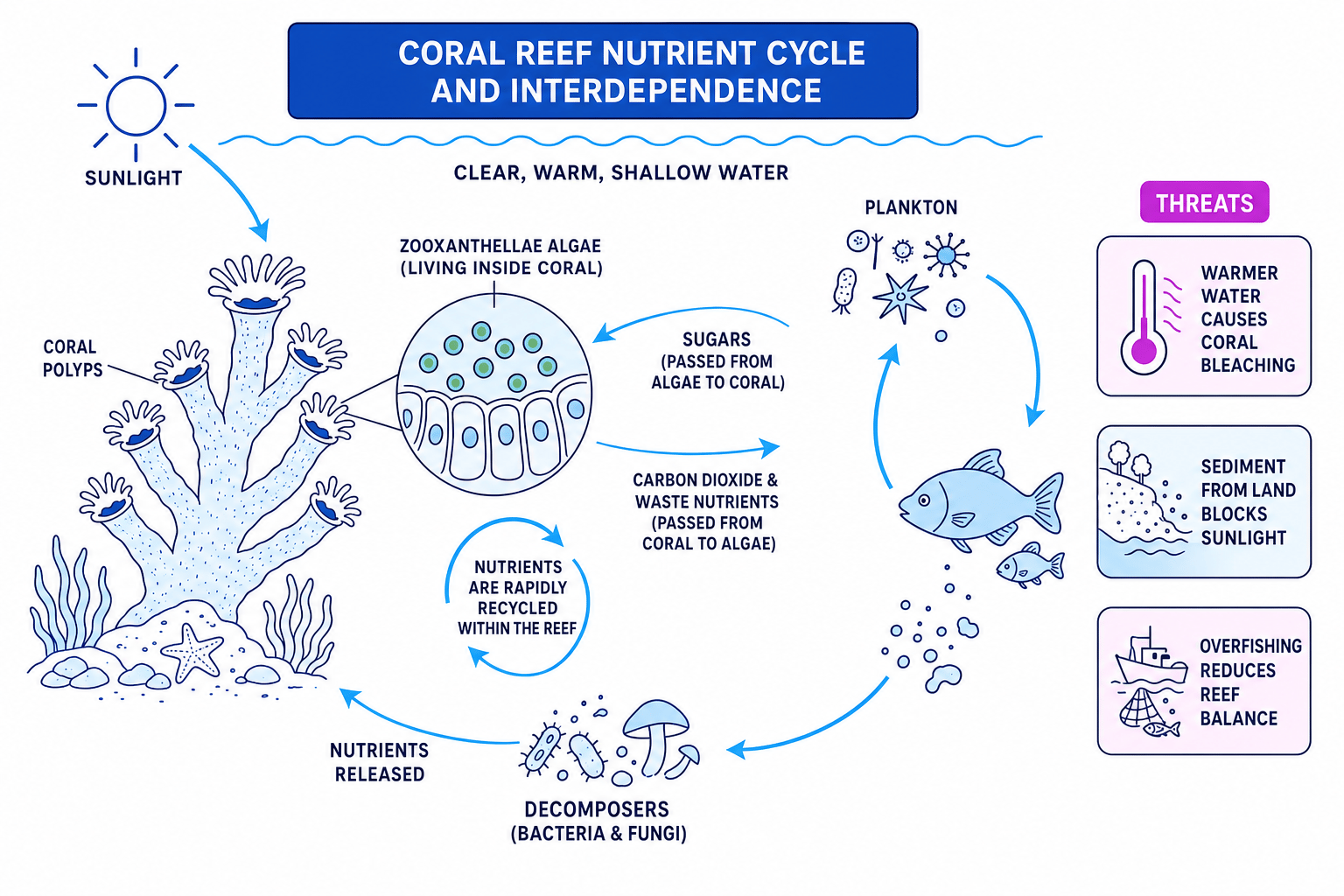
In a healthy coral reef:
- Zooxanthellae use sunlight to photosynthesise.
- Sugars from photosynthesis feed the coral polyps.
- Coral waste provides nutrients for the algae.
- Fish, plankton and decomposers recycle nutrients within the reef.
- Clear water allows sunlight to reach the algae.
Why reefs can be so productive
Coral reefs are productive because nutrients are recycled very efficiently within the ecosystem, not because the surrounding sea is nutrient-rich.
Coral bleaching: a break in interdependence
Coral bleaching
Coral bleaching happens when stressed coral expels its zooxanthellae. The coral turns white and may die if stressful conditions continue.
The most serious cause is unusually warm sea water linked to climate change. Other pressures, such as pollution, sediment and disease, can make coral more vulnerable.
Explaining coral bleaching through interdependence
- Identify the stress: sea temperatures rise above the coral’s normal tolerance for too long.
- Apply the ecosystem link: the coral expels zooxanthellae, which are the algae that provide much of its food.
- Explain the impact: without enough food, coral growth slows and some coral dies.
- Link to biodiversity: dead coral provides less habitat, so fish, invertebrates and other reef species decline.
Case study: Amazon Rainforest, Brazil and wider South America
The Amazon Rainforest is the world’s largest tropical rainforest, stretching across several South American countries. Brazil contains the largest share. It matters locally to forest communities, nationally to Brazil’s economy and globally for biodiversity and climate regulation.
Interdependence in the Amazon
The Amazon’s hot, wet climate supports dense vegetation. The vegetation then affects the climate by returning huge amounts of water vapour to the atmosphere through evapotranspiration. This helps maintain rainfall across the region.
The soil depends on rapid nutrient cycling. Dead leaves decompose quickly, and roots take up nutrients before they are leached away. Animals also support the system: insects pollinate plants, birds and mammals disperse seeds, and predators help keep food webs balanced.
Humans are part of this system too. Indigenous communities often use forest resources through hunting, fishing, small-scale farming and gathering, while maintaining forest cover. Larger-scale activities such as cattle ranching, commercial farming, mining and road building can disrupt the cycles.
Value of the Amazon
The Amazon is valuable because it:
- Stores large amounts of carbon in vegetation and soils.
- Contains a very high proportion of the world’s known species.
- Helps regulate rainfall and regional climate.
- Provides food, fuel, medicines and building materials for local people.
- Supports scientific research, ecotourism and non-timber forest products such as nuts and rubber.
Threats to Amazon biodiversity
Major threats include:
- Cattle ranching: often the biggest driver of forest clearance.
- Soy farming: linked to demand for animal feed and export crops.
- Logging: both legal and illegal removal of valuable hardwoods.
- Mining: causes forest clearance and can pollute rivers.
- Road building: opens remote forest areas to settlement and further deforestation.
- Fires: used to clear land, but they can spread and damage larger areas.
These threats reduce biodiversity by removing habitats, fragmenting forest, increasing edge effects, polluting rivers and interrupting nutrient and water cycles.
Calculating percentage forest loss
If a source says a forest area was 20,000 hectares and 3,000 hectares were cleared, the percentage loss is:
percentage loss=area lostoriginal area×100\text{percentage loss} = \frac{\text{area lost}}{\text{original area}} \times 100percentage loss=original areaarea lost×100- Substitute the values into the formula: 300020000×100\frac{3000}{20000} \times 100200003000×100.
- Calculate the fraction: 300020000=0.15\frac{3000}{20000} = 0.15200003000=0.15.
- Convert to a percentage: 0.15×100=15%0.15 \times 100 = 15\%0.15×100=15%.
- Interpret it geographically: 15% loss is significant because it may fragment habitats and weaken nutrient and water cycling.
Sustainable management in the Amazon
Sustainable management aims to use resources without destroying the ecosystem for the future.
Examples include:
- Protected areas and national parks to conserve habitats.
- Indigenous territories, which often have lower deforestation rates where rights are protected.
- Selective logging, where only certain trees are removed, reducing damage compared with clear-felling.
- Agroforestry, where crops are grown among trees to keep soil covered and maintain biodiversity.
- Satellite monitoring and law enforcement to detect illegal clearance.
- REDD+ schemes, where countries or communities may receive payments for reducing deforestation and protecting carbon stores.
- Ecotourism, which creates income while encouraging forest conservation.
Evaluating management
For higher-quality answers, say whether a strategy works at local, national or global scale. For example, protected areas can be effective locally, but global demand for beef, soy and timber can still drive deforestation elsewhere.
Case study: Great Barrier Reef, Australia
The Great Barrier Reef lies off the north-east coast of Australia. It extends for over 2,300 km and includes thousands of individual reefs and islands. It is important locally for communities, nationally for Australia’s tourism economy and globally as a major marine biodiversity hotspot.
Interdependence in the Great Barrier Reef
The reef depends on warm, clear, shallow water. Coral polyps rely on zooxanthellae for food, while the algae rely on coral for shelter and nutrients. Fish graze algae, recycle nutrients and help maintain balance. Nearby ecosystems such as mangroves and seagrass beds can act as nurseries for marine life.
Humans also depend on the reef through tourism, fishing, cultural connections and coastal protection. Aboriginal and Torres Strait Islander peoples have long-standing cultural links with sea country.
Value of the Great Barrier Reef
The reef is valuable because it:
- Provides habitat for many species of coral, fish, turtles, sharks, rays and invertebrates.
- Supports tourism and recreation.
- Protects parts of the Queensland coast by reducing wave energy.
- Supports fishing and research.
- Has cultural and spiritual importance.
- Acts as a global indicator of climate change impacts on marine ecosystems.
Threats to Great Barrier Reef biodiversity
Key threats include:
- Climate change, causing marine heatwaves and mass coral bleaching.
- Ocean acidification, which makes it harder for corals to build calcium carbonate skeletons.
- Sediment runoff from farming and land clearance, which reduces light.
- Fertilisers and pesticides from agriculture, which can affect water quality.
- Crown-of-thorns starfish outbreaks, which damage coral.
- Cyclones, which can physically break reefs.
- Coastal development and shipping, which can add pollution and disturbance.
Blaming only local management
Local management can reduce pollution, overfishing and tourism damage, but it cannot fully stop bleaching if global greenhouse gas emissions keep raising sea temperatures.
Sustainable management of the Great Barrier Reef
Management includes:
- The Great Barrier Reef Marine Park, with zoning to control fishing, tourism and other activities.
- No-take zones, where fishing is banned to protect biodiversity.
- Water quality improvement plans to reduce sediment, fertiliser and pesticide runoff from Queensland catchments.
- Permits and rules for tourism operators.
- Monitoring by scientists, managers and citizen science projects.
- Crown-of-thorns starfish control programmes.
- Education campaigns to encourage responsible reef use.
The most sustainable approach combines local protection with national and global action on climate change.
Comparing rainforests and coral reefs
| Feature | Tropical rainforest | Coral reef |
|---|---|---|
| Main environment | Hot, wet land ecosystem | Warm, shallow marine ecosystem |
| Main nutrient store | Biomass | Living coral, algae and reef organisms |
| Key process | Rapid decomposition and root uptake | Rapid recycling between coral, algae, fish and decomposers |
| Major global threat | Deforestation and climate change | Warming seas and ocean acidification |
| Example case study | Amazon Rainforest | Great Barrier Reef |
In the exam
- Link causes to effects in chains: human activity → cycle disrupted → habitat change → biodiversity impact.
- Use named places, such as the Amazon Rainforest and Great Barrier Reef, and include management as well as threats.
- Evaluate sustainability by considering scale: local actions help, but some threats need national laws or global climate action.
Check yourself
- Why are most rainforest nutrients stored in biomass rather than soil?
- How do zooxanthellae and coral polyps depend on each other?
- For one case study, can you explain one threat and one sustainable management strategy?
