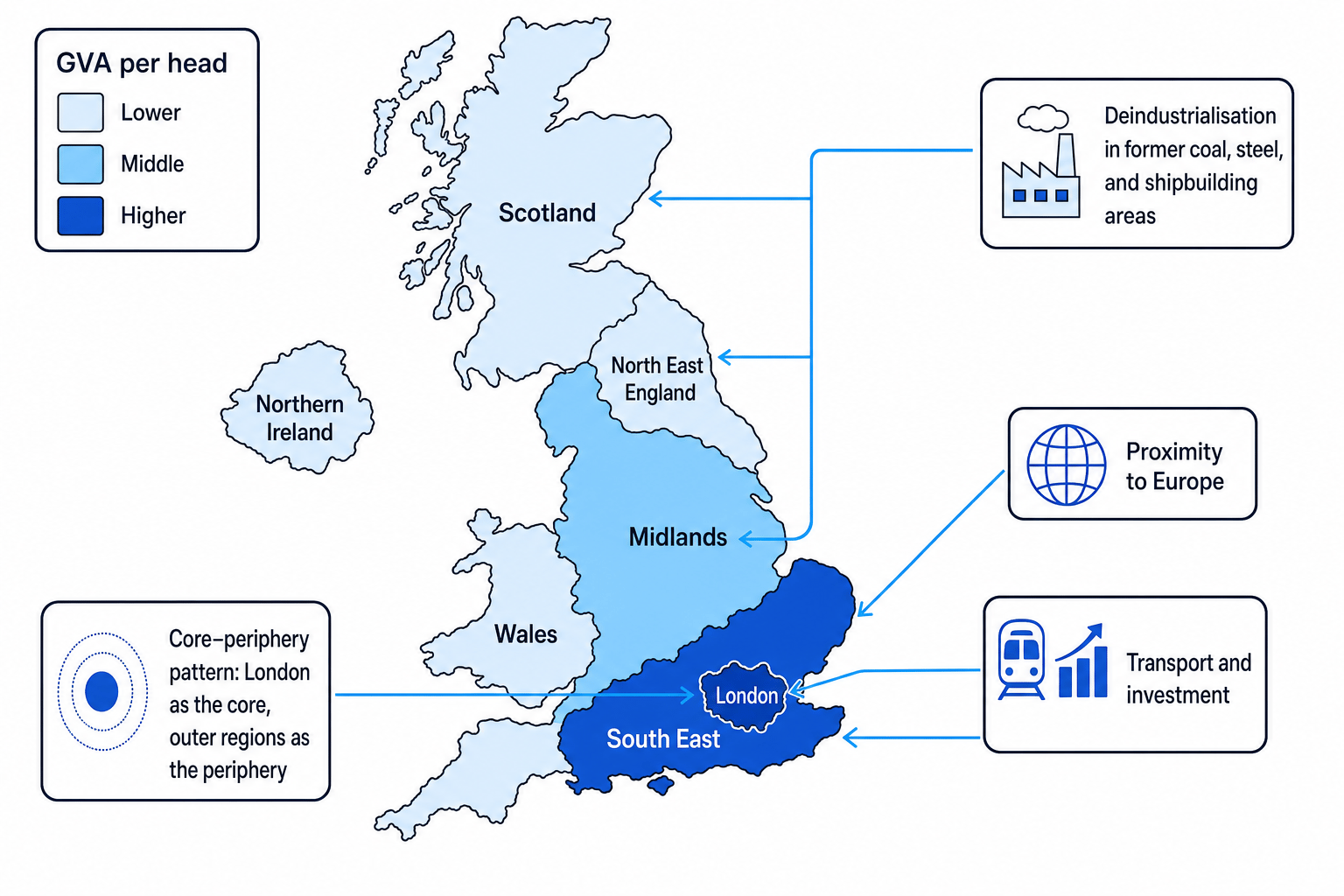
When we think about global development, we often compare high-income countries (HICs) to low-income countries (LICs). However, development is not uniform within a country either. In the UK, there is a significant economic gap between different regions—a concept often called the North-South Divide.
These study notes will explore why the UK developed unevenly at a national scale, and then look closely at a local-scale case study to see how these economic shifts impact real communities.
What you'll learn
- The physical, economic, and political causes behind the UK's uneven regional development.
- How to calculate and interpret economic disparities between UK regions.
- The social, economic, and environmental consequences of economic decline, using North East England as your key case study.
What is Uneven Development in the UK?
Development is not just about wealth; it is about quality of life, access to services, and opportunities. In the UK, we measure regional economic performance using a metric called Gross Value Added (GVA).
Gross Value Added (GVA)
Gross Value Added (GVA) is a measure of the value of goods and services produced in an area, industry, or sector of an economy. It is similar to GDP but calculated at a regional or local scale, usually expressed "per head" (per person) to allow fair comparisons.
For decades, the south and east of England (especially London and the South East) have grown at a much faster rate than the north of England, Scotland, Wales, and Northern Ireland. This has resulted in systemic differences in wages, health outcomes, life expectancy, and employment opportunities.
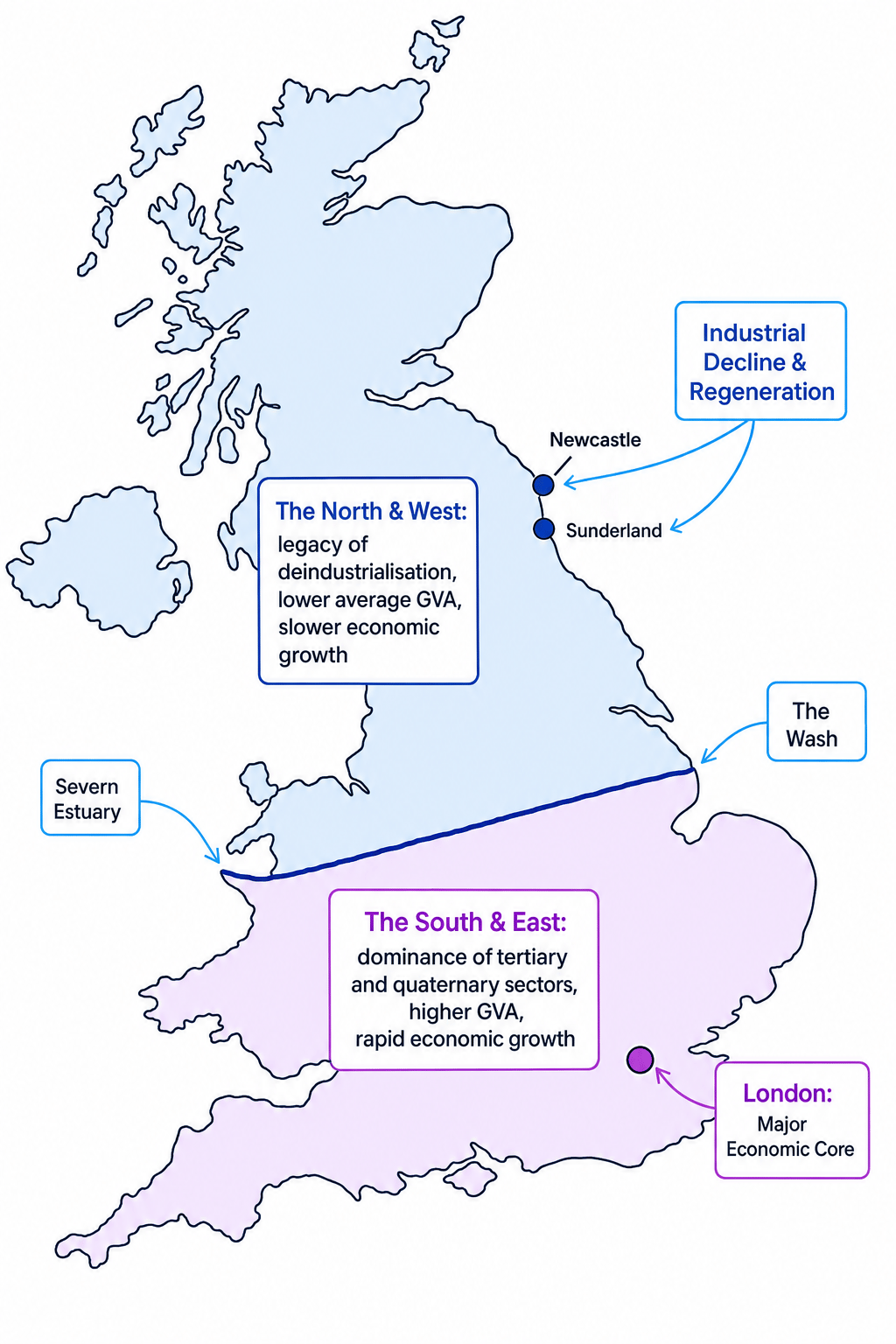
The North-South line isn't a wall
Do not treat the "North-South Divide" as a sharp, literal boundary where everyone on one side is poor and everyone on the other is rich. It is a general economic trend. There are highly affluent areas in the North (such as parts of Cheshire and rural Yorkshire) and pockets of severe deprivation in the South (such as coastal towns like Margate, or inner-city boroughs in East London).
Causes of the UK's Uneven Development
The UK's regional economic gap did not happen by accident. It is the result of four main overlapping factors: geographical location, economic change, infrastructure investment, and government policy.
1. Geographical Location
The South East of England has several natural physical and geographical advantages:
- Proximity to Europe: Being physically closer to mainland Europe makes trading easier and cheaper for businesses located in the South East.
- Flat, Accessible Land: The South East is dominated by flat lowlands, which are easy and cheap to build on. In contrast, parts of the North and West (like Wales, Scotland, and the Pennines) have rugged, mountainous terrain that isolates communities and makes building transport links expensive.
- The "Core" Effect: London has historically been the political and financial capital. This centralises power and creates a "core" region that naturally attracts investment, leaving outer regions as the economic "periphery".
2. Economic Change (Deindustrialisation)
During the Industrial Revolution, the UK's economy was built on heavy secondary industry. Coal mining, steel manufacturing, and shipbuilding were concentrated near natural resources in South Wales, northern England, the Midlands, and central Scotland.
Deindustrialisation
Deindustrialisation is the decline of industrial activity and secondary manufacturing within a region or country, often accompanied by a shift toward a service-based (tertiary) economy.
From the 1970s onwards, the UK underwent rapid deindustrialisation because:
- Globalisation: Manufacturing shifted to emerging countries (like China and India) where labour and production costs were much cheaper.
- Resource depletion: UK coal reserves became deeper and more expensive to mine.
As the factories and mines closed, the North and West suffered massive job losses. Meanwhile, the South East transitioned rapidly into high-value tertiary (services, finance) and quaternary (science, IT, research) industries.
The Cumulative Causation Snowball
Think of economic growth like a snowball rolling down a hill (a process geographers call cumulative causation). London and the South East started with a small advantage. This attracted skilled graduates, which attracted major companies, which generated tax revenue, which allowed the government to build better transport, which attracted even more companies. The snowball keeps growing, leaving peripheral regions behind.
3. Infrastructure Investment
Investment in transport and digital infrastructure has historically favoured the South East, reinforcing its economic advantage.
- Transport: Major investments like the Elizabeth Line (Crossrail) in London and the expansion of Heathrow Airport make the South East highly connected. In contrast, rail and road networks in the North have suffered from underinvestment, resulting in slower, less reliable journeys between northern cities.
- Digital Connectivity: Superfast broadband and 5G networks were rolled out in major southern urban hubs long before reaching rural or northern post-industrial areas, making it harder for high-tech businesses to operate outside the South East.
4. Government Policy
Government decisions have actively shaped the UK's economic landscape:
- 1980s Deregulation: In 1986, the government deregulated the financial markets (known as the "Big Bang"). This allowed London's financial sector to boom, transforming the city into a global financial powerhouse.
- Industrial Strategies & Devolution: Recently, governments have tried to counter this imbalance through policies like Enterprise Zones (areas with tax breaks to attract businesses to struggling regions) and the Northern Powerhouse initiative, which aims to link northern cities to rival London's economic power.
The structural mismatch
The core cause of the UK's uneven development is a structural mismatch: the North lost its industrial identity and struggled to replace those jobs, while the South rapidly captured the highly profitable global financial and technology markets.
Measuring the Gap
To understand how deep this regional divide is, geographers use quantitative skills to analyze regional economic data. In your exams, you might be asked to calculate the percentage difference between two regions to illustrate uneven development.
Calculating regional economic disparity
The table below shows the Gross Value Added (GVA) per head for three UK regions in a recent year:
| Region | GVA per head (£) |
|---|---|
| London | 48,000 |
| West Midlands | 22,500 |
| North East | 21,000 |
Task: Calculate how much higher London's GVA per head is compared to the North East, expressed as a percentage increase over the North East's value.
- Find the absolute difference between the two values by subtracting the lower value from the higher value:
- Divide the difference by the baseline value (since we want the percentage increase over the North East, the North East's GVA is our baseline):
- Convert to a percentage by multiplying by 100 and rounding to one decimal place:
- Write your geographical conclusion: London's GVA per head is 128.6%128.6\%128.6% higher than that of the North East, demonstrating a stark economic divide between the capital and post-industrial northern regions.
Case Study: Consequences of Economic Decline in North East England
To secure top marks, you must be able to write in detail about one place or region. Our chosen case study is North East England (including Newcastle, Sunderland, and County Durham), a region heavily affected by deindustrialisation.
Background: The Rise and Fall
During the 19th and early 20th centuries, the North East was an industrial powerhouse. Towns grew rapidly around coal mines (such as Easington Colliery) and shipyards along the River Tyne and River Wear.
However, by the late 20th century, foreign competition led to the closure of all major shipyards and coal mines. The last deep coal mine in the region closed in 1993, leaving communities without their primary source of employment and identity.
The Consequences of Decline
The consequences of this economic shift can be split into social, economic, and environmental impacts:
1. Economic Consequences
- High Unemployment: The loss of heavy industry led to sudden, mass unemployment. Generations of workers skilled only in manual labor found themselves without jobs.
- Low Weekly Earnings: Jobs that did replace the industries were often in the tertiary sector (e.g., call centres, retail), which tend to be low-wage, zero-hours, or part-time.
- The "Brain Drain": Due to a lack of high-paying professional jobs, young, qualified graduates often migrate out of the region to London and the South East. This leaves the North East with an aging population and a shortage of highly skilled workers.
2. Social Consequences
- Social Deprivation: Many former mining villages became areas of high deprivation. According to the Index of Multiple Deprivation (IMD), the North East consistently has some of the most deprived neighbourhoods in England.
- Poor Health & Lower Life Expectancy: Economic deprivation directly impacts health. Life expectancy in parts of the North East is up to 5 years lower than in the wealthy areas of the South East (e.g., Surrey). Rates of chronic illness, depression, and drug abuse are also statistically higher.
- Services Decline: As household incomes fell, local businesses (shops, pubs, banks) closed down, leaving high streets empty and eroding community cohesion.
3. Environmental Consequences
- Industrial Scarring & Derelict Land: The closure of mines, steelworks, and shipyards left behind vast areas of contaminated, ugly brownfield sites.
- Urban Decay: Decaying housing stock and abandoned commercial buildings created visual pollution in inner-city areas and mining villages.
Structuring your case study answers
Whenever an exam question asks about the "consequences" of economic decline or growth, explicitly divide your points into Social, Economic, and Environmental categories. This ensures a balanced, high-scoring answer.
Attempts to Tackle the Decline (Regeneration)
The North East has not just accepted this decline; local and national governments have worked to regenerate the region:
- Foreign Direct Investment (FDI): In 1986, the government helped secure the opening of the Nissan Car Plant in Sunderland. Today, it employs over 6,000 people directly and supports tens of thousands of jobs in the local supply chain, transforming Sunderland into an advanced manufacturing hub.
- Science and Tech Investment: The Newcastle Helix project is an urban regeneration zone in Newcastle city centre. Built on a former brewery and coal mine site, it is now a hub for scientific research, digital technology firms, and Newcastle University, aiming to replace old industrial jobs with high-paying quaternary sector jobs.
In the exam
- Use precise scale terminology: Clearly distinguish between national-scale causes (like UK-wide economic shifts and government policies) and local-scale consequences (such as specific impacts on Newcastle or Sunderland).
- Back up your case study with data: If writing about the North East, mention specific details like the "Nissan Plant in Sunderland" or "closure of shipyards along the Tyne" to show the examiner you have deep, located knowledge.
- Command Word Focus: If the question asks you to "Explain the causes," do not waste time describing the consequences. Keep your focus on why the gap exists (location, industrial decline, infrastructure spend).
Check yourself
- What is the difference between tertiary and quaternary economic sectors, and how has their growth contributed to the North-South divide?
- List three distinct social consequences that occur in a region experiencing severe economic decline.
- How has geographic location historically aided the economic development of London and the South East?