What you'll learn
- What suburbanisation, counter-urbanisation and re-urbanisation mean.
- Why these trends happen in the UK at national, regional and local scales.
- The social, economic and environmental consequences of each trend.
- How to use place evidence and data to explain urban change in exam answers.
The big picture: UK cities keep changing
The UK is already a highly urbanised country, meaning a large share of the population lives in towns and cities. So, in this topic, you are not mainly studying the first growth of cities. You are studying how people, housing, jobs and investment move within and between urban and rural areas.
Urban trend
An urban trend is a long-term pattern of change in where people live, work or invest in towns and cities.
These changes are “contrasting” because different movements can happen at the same time. For example, some people may move from inner London to commuter villages, while others move into regenerated apartments in Manchester city centre.
The core pattern
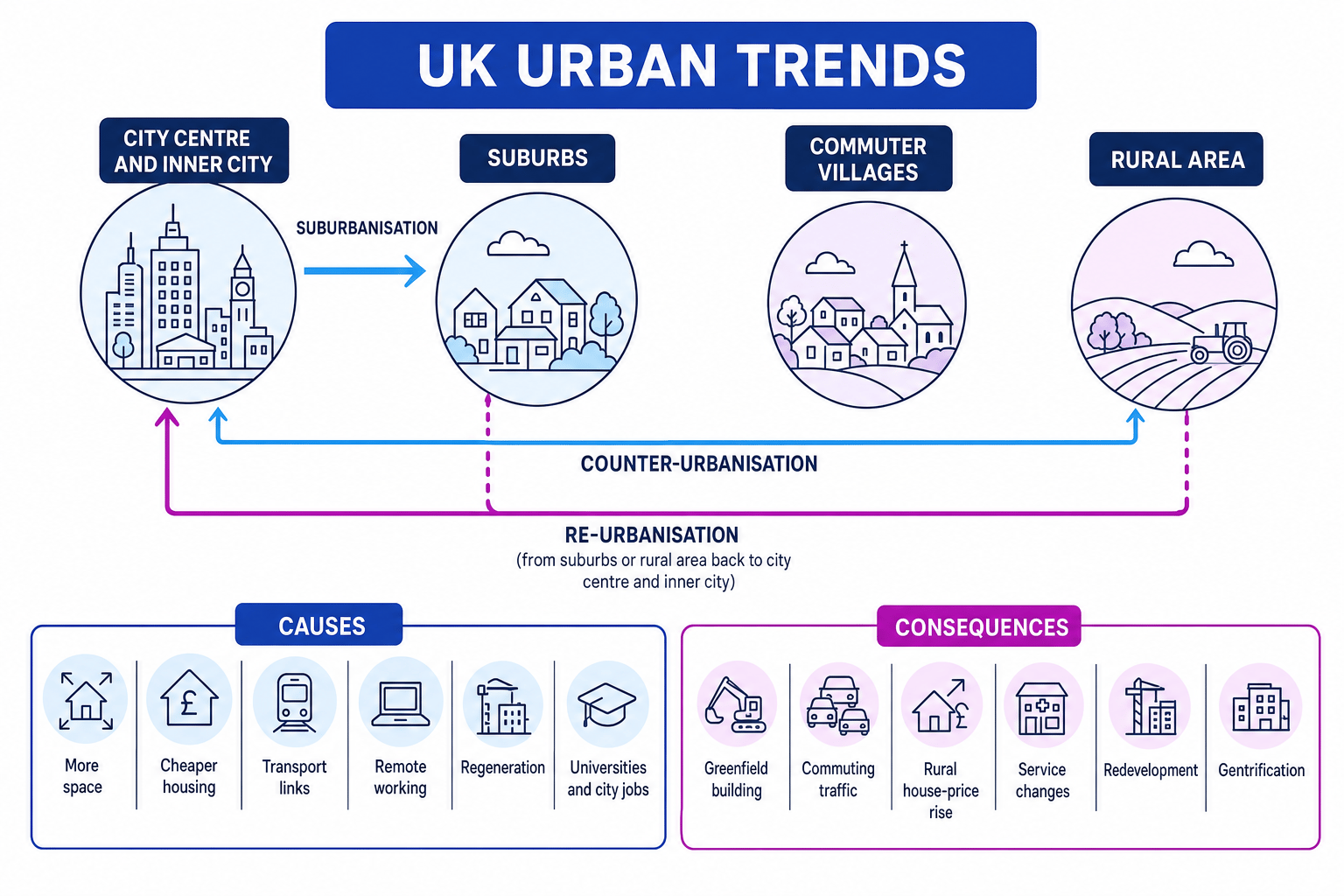
Urban trends are about direction of movement: outwards to suburbs, further out to rural settlements, or back into the inner city.
The settlement words you need first
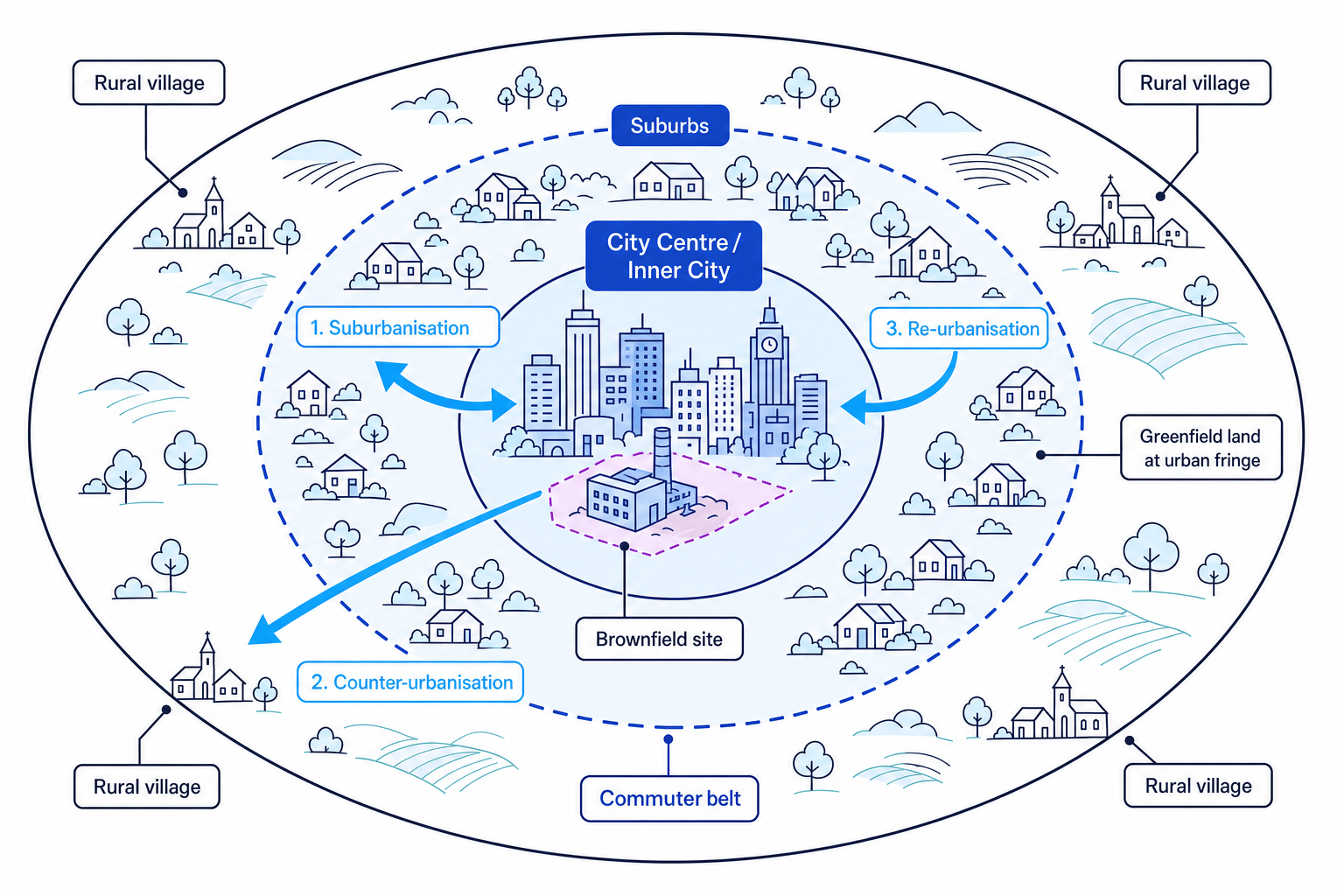
An urban area is a built-up town or city. A rural area is countryside, including villages, hamlets and farmland.
A suburb is a residential area on the outer part of a town or city. Suburbs are still part of the urban area, even though they usually have lower building density than the city centre.
A commuter is someone who travels regularly between home and work. A commuter belt is the area around a city where many residents travel into the city for work.
Brownfield and greenfield land
Brownfield land has been built on before, such as old factories, docks or railway land. Greenfield land has not previously been built on, such as farmland or countryside at the urban fringe.
Suburbanisation
What is suburbanisation?
Suburbanisation is the movement of people, services and businesses from the inner city or city centre to the suburbs and urban fringe.
It was a major UK trend in the 20th century, especially as car ownership increased and people wanted larger homes with gardens. It still happens today through new housing estates, retail parks and business parks on the edges of cities.
Suburbanisation
Suburbanisation is the outward movement of people and activities from central urban areas to the suburbs.
Causes of suburbanisation in the UK
People and businesses may move outwards because suburban areas often offer:
- larger homes and gardens, especially for families
- lower-density housing and more space
- easier access to motorways or ring roads
- newer schools, shopping centres or leisure facilities
- cheaper land than the city centre for businesses and developers
Suburbanisation is also linked to push factors from inner-city areas, such as congestion, older housing, pollution, lack of parking or perceptions of crime.
Named UK examples include suburban growth around cities such as Birmingham, Leeds, Bristol and Glasgow. Places such as Solihull near Birmingham show how attractive suburban areas can be for households with access to city jobs.
Consequences of suburbanisation
Social consequences include improved quality of life for some families, but also social separation if wealthier households leave inner-city areas. Inner areas may lose population, services or community activity.
Economic consequences include investment in suburban shopping centres, retail parks and business parks. However, traditional city-centre shops can lose customers, and councils may need to pay for new roads, schools and services on the edge of the city.
Environmental consequences can be serious. Building on greenfield land can cause loss of farmland and habitats. More commuting by car can increase traffic congestion, air pollution and carbon emissions.
Suburbs are still urban
Do not describe suburbanisation as “moving to the countryside”. Suburbanisation is movement to the outer parts of the town or city, not to a rural village.
Counter-urbanisation
What is counter-urbanisation?
Counter-urbanisation is the movement of people from larger urban areas to smaller towns, villages and rural areas.
This became more common in the UK from the late 20th century onwards. It has been strengthened by better transport, broadband, flexible working and the ability for some people to work from home.
Counter-urbanisation
Counter-urbanisation is movement away from large urban areas to smaller settlements in rural areas.
Causes of counter-urbanisation in the UK
Many people are attracted by the rural idyll, which means an idealised view of countryside life as quieter, safer, greener and more spacious.
Common causes include:
- desire for a larger house or garden
- retirement migration to coastal or rural areas
- high house prices in major cities, especially London and the South East
- improved rail and road links allowing long-distance commuting
- remote and hybrid working, especially since the COVID-19 pandemic
- preference for perceived safety, community and environmental quality
Examples include movement from London to parts of Kent, Essex, Oxfordshire, the Cotswolds, Devon and Cornwall. Around Cambridge and Bristol, some villages have grown as commuter settlements.
Consequences of counter-urbanisation
Social consequences can include ageing rural populations, changing village communities and tension between long-term residents and newcomers. Some villages become dormitory villages, where people live there but work and spend much of their time elsewhere.
Economic consequences include rising house prices, which can price out younger local people. Local shops and cafés may gain customers, but some services can still close if commuters shop in the city or online. There may be growth in construction, home improvement and tourism-related businesses.
Environmental consequences include more traffic on rural roads, pressure for new housing on greenfield land, and changes to village character. More long-distance commuting can increase emissions unless people use public transport or work from home.
Classifying an urban trend
A couple move from an apartment in central Bristol to a village in rural Somerset, while one of them keeps a job in Bristol.
- Compare the start and end points: the move begins in a large urban area and ends in a rural village.
- Match this to the definitions: because the destination is rural, this is counter-urbanisation, not suburbanisation.
- Infer one likely consequence: if the commuter keeps travelling to Bristol, rural road traffic may increase and local house prices may rise.
Re-urbanisation
What is re-urbanisation?
Re-urbanisation is the movement of people and investment back into inner-city areas after a period of decline.
In many UK cities, older industrial areas lost jobs in manufacturing during deindustrialisation, which means the decline of industrial activity. Later, regeneration schemes reused brownfield land for apartments, offices, shops, leisure, universities and cultural attractions.
Re-urbanisation
Re-urbanisation is renewed population growth and investment in inner-city or central urban areas.
Causes of re-urbanisation in the UK
Re-urbanisation is often caused by regeneration, which means improving an area through new investment, building, services and environmental upgrades.
Important causes include:
- redevelopment of brownfield sites, such as old docks or factories
- new city-centre apartments and converted warehouses
- growth of service-sector jobs in finance, media, education and healthcare
- universities attracting students and graduates
- better public transport, cycling routes and walkable city-centre living
- cultural attractions, nightlife, restaurants and shopping
- government and private-sector investment
Examples include London Docklands, Stratford in East London, Salford Quays near Manchester, Manchester city centre, Birmingham Eastside and Liverpool’s waterfront. Exact population and investment figures depend on the chosen case study and data year, but these are widely used examples of UK inner-city regeneration.
Consequences of re-urbanisation
Social consequences include more people living in city centres, often students, young professionals and smaller households. Services may improve, and derelict areas can feel safer. However, poorer residents may be displaced if rents rise.
Gentrification
Gentrification is when wealthier residents and businesses move into a previously lower-income area, often increasing house prices and changing the character of the community.
Economic consequences include new jobs, higher property values, tourism and increased business investment. However, local independent shops may be replaced by more expensive restaurants, offices or chain stores.
Environmental consequences can be positive when brownfield land is reused instead of building on greenfield land. Old contaminated land may be cleaned up, and public transport use may increase. However, construction can cause noise, dust and waste, and high-density living can put pressure on services.
Think in threes
For any trend, try to explain one social, one economic and one environmental consequence. This helps you avoid writing a one-sided answer.
Comparing the three trends
| Trend | Direction of movement | Typical UK causes | Typical consequences |
|---|---|---|---|
| Suburbanisation | Inner city to suburbs | More space, car ownership, cheaper edge-of-city land | Urban sprawl, greenfield loss, commuting, suburban service growth |
| Counter-urbanisation | City to rural towns and villages | Rural lifestyle, remote working, retirement, high city prices | Rural house-price rise, service change, longer commuting, pressure on countryside |
| Re-urbanisation | Back to city centre or inner city | Regeneration, city jobs, universities, brownfield redevelopment | Gentrification, new jobs, brownfield reuse, higher rents |
Reading data about urban trends
In exams, you may be given a map, graph, table or photograph. You need to use the evidence to identify the trend and explain what it suggests.
A common skill is calculating percentage change, which shows how much a value has increased or decreased compared with its starting value.
percentage change=new value−old valueold value×100\text{percentage change} = \frac{\text{new value} - \text{old value}}{\text{old value}} \times 100percentage change=old valuenew value−old value×100Calculating and interpreting population change
A census-style table shows that an inner-city ward had 12,000 residents in 2011 and 15,600 residents in 2021.
- Find the change in population: 15,600 minus 12,000 gives an increase of 3,600 people.
- Compare the increase with the starting population: 3,600 divided by 12,000 gives 0.3.
- Convert to a percentage: 0.3 multiplied by 100 gives a 30% increase.
- Interpret the geography: because the growth is in an inner-city ward, it could be evidence of re-urbanisation, especially if the source also mentions new apartments or brownfield redevelopment.
How you could investigate this locally
This topic links well to local fieldwork. You could compare a regenerated city-centre area, a suburb and a nearby commuter village.
Useful methods include:
- land-use surveys to record shops, housing, offices and services
- environmental quality surveys to compare noise, litter, traffic and green space
- traffic or pedestrian counts to measure movement
- questionnaires about why people live or shop in an area
- using secondary data such as Census population change, house prices or public transport maps
This helps you see that urban trends operate at different scales: national patterns across the UK, regional differences such as London and the South East, and very local changes from one neighbourhood to the next.
Re-urbanisation is not the same as urbanisation
Urbanisation means the increasing share of people living in urban areas overall. Re-urbanisation means renewed growth of inner-city areas after decline.
In the exam
- Name the trend clearly first: suburbanisation, counter-urbanisation or re-urbanisation.
- Use direction language: say where people or investment move from and to.
- Link each consequence to a category: social, economic or environmental.
- Add named UK place evidence, such as London Docklands, Salford Quays, a commuter village, or a suburban area you have studied.
- If given data, quote it and interpret it rather than just copying numbers.
Check yourself
- How is suburbanisation different from counter-urbanisation?
- Why can re-urbanisation lead to both regeneration and gentrification?
- What is one social, one economic and one environmental consequence of counter-urbanisation?