

What you'll learn
- How to build a strong UK major city case study, using London as the example.
- How London is influenced at local, regional, national and global scales.
- How migration shapes the city’s growth, culture and character.
- How to explain urban challenges such as housing, transport and waste, then evaluate a sustainable strategy.
1. Starting point: what makes a city “distinct”?
A city is not just “a big place”. It has its own mix of people, buildings, jobs, transport links, culture and problems. That mix gives it a distinct character, meaning the features that make it recognisably different from other places.
Major city
A major city is a large urban settlement that has importance beyond its own boundary, often because of its population size, economy, transport links, political role or cultural influence.
For this section, you need one major city in the UK in detail. These notes use London. If your class uses Birmingham, Manchester, Bristol or another UK city, keep the same headings but swap in your own evidence.
What your case study must do
A good city case study links where the city is, who lives there, how it is changing, what challenges it faces, and how one challenge is being managed sustainably.
2. London: a major UK city case study
London is the UK’s capital city, located in south-east England on the River Thames. Greater London had about 8.8 million people in the 2021 Census, although the wider built-up and commuter region is larger depending on the boundary used.
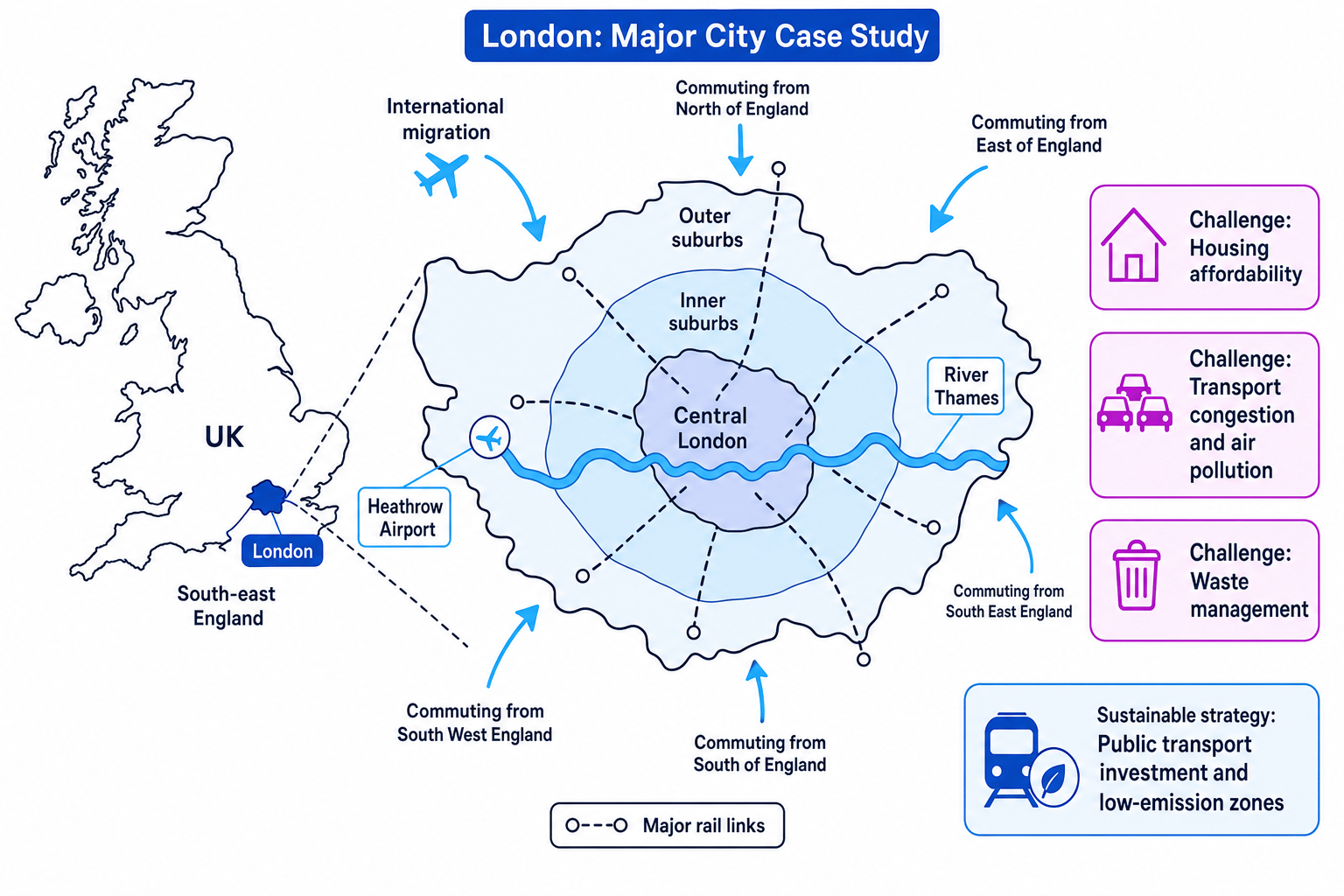
London is not the same as the City of London
The City of London is a very small financial district and local authority. In this case study, “London” usually means Greater London, unless your teacher tells you to use another boundary.
London at different scales
Scale
Scale means the geographical level you are discussing, such as local, regional, national or global.
London’s importance can be explained at several scales:
- Local scale: London is made up of boroughs, which are local authority areas. Examples include Newham, Camden, Brent and Croydon. Different boroughs have different housing, incomes, ethnic communities and services.
- Regional scale: London strongly influences south-east England. Many people commute into London from places such as Kent, Essex, Surrey, Hertfordshire and Berkshire.
- National scale: London is the UK capital, where Parliament, major banks, national media, museums and many headquarters are based.
- Global scale: London is a world city with international finance, universities, airports, tourism, migration and cultural influence.
Linking London across scales
- At the global scale, Heathrow Airport connects London to international business, tourism and migration.
- At the regional and national scales, these links create jobs in aviation, hotels, logistics, finance and business services.
- At the local scale, this can increase traffic, noise, air pollution and housing demand in west London boroughs near the airport.
3. Migration and London’s growth
Migration
Migration is the movement of people from one place to another to live for a period of time. Internal migration happens within one country, while international migration happens between countries.
London’s population has been shaped by both migration and natural increase, which means births minus deaths. Young adult migrants often have children in the city, so migration can affect population growth directly and indirectly.
London has attracted people from across the UK and from around the world because of jobs, universities, safety, family links and cultural opportunities. International migration has included people from the Caribbean, South Asia, Africa, Europe and many other regions. Internal migration includes students and graduates moving in, while some families move out to surrounding regions because housing is expensive.
Calculating London’s population increase
Using rounded Census figures, Greater London grew from about 8.2 million in 2011 to about 8.8 million in 2021.
-
Find the change in population: 8.8 million − 8.2 million = 0.6 million.
-
Use the percentage increase formula:
Percentage increase=new value−old valueold value×100\text{Percentage increase} = \frac{\text{new value} - \text{old value}}{\text{old value}} \times 100Percentage increase=old valuenew value−old value×100 -
Substitute the values:
0.68.2×100≈7.3%\frac{0.6}{8.2} \times 100 \approx 7.3\%8.20.6×100≈7.3% -
Interpret it: London’s population increased by about 7% over the decade, which helps explain growing pressure on housing, transport and services.
How migration affects London’s character
London’s character is the overall feel and identity of the city. Migration has helped create:
- diverse languages, religions and ethnic communities
- food, music, fashion and festivals from many cultures
- neighbourhood identities, such as Southall, Brixton, Brick Lane and Chinatown
- a large labour force for sectors such as health, construction, hospitality, finance, education and transport
Do not treat migrants as one group
Avoid saying “migrants cause…” as if everyone has the same experience. Migration is diverse: people arrive with different ages, skills, incomes, languages, legal statuses and reasons for moving.
4. Ways of life within London
Ways of life
Ways of life are the everyday patterns of living in a place, including housing, work, travel, leisure, culture, shopping and social life.
Culture and ethnicity
Culture means the shared customs, beliefs, food, language, art and traditions of a group. Ethnicity means a shared identity linked to culture, ancestry, language or nationality.
London is one of the UK’s most ethnically diverse cities. A widely used figure is that over 300 languages are spoken in London, though exact counts vary by source. This diversity is visible in places of worship, restaurants, festivals such as Notting Hill Carnival, and local high streets.
Housing and neighbourhoods
London’s housing varies hugely. Inner areas may include flats, terraced housing, social housing estates and expensive redeveloped apartments. Outer suburbs often include semi-detached housing and lower-density streets.
Housing tenure means whether people own their home, privately rent it, or live in social housing. London has a large private rented sector, which can make life flexible for some people but insecure and expensive for others.
Gentrification
Gentrification is when a poorer urban area becomes more attractive to wealthier residents and businesses, often causing rising rents, new cafés or shops, renovation, and sometimes displacement of existing residents.
Leisure and consumption
Leisure means free-time activities, while consumption means buying and using goods and services. London has theatres in the West End, Premier League football clubs, museums, parks, music venues, shopping centres such as Westfield, and major tourist attractions.
However, access is unequal. A young professional in Zone 2, a low-income family in temporary accommodation, and an elderly person in outer London may experience the city very differently.
Think unevenly
For “ways of life”, do not describe London as if everyone lives the same way. Strong answers show variation within the city by income, age, ethnicity, housing and location.
A fieldwork link
At a local scale, you could investigate ways of life using land-use mapping, pedestrian counts, traffic counts, questionnaires, or an environmental quality survey, which scores features such as noise, litter, traffic, green space and building condition.
5. Contemporary challenges affecting urban change
Urban change
Urban change is the way a city’s population, economy, land use and built environment alter over time. Contemporary means happening now or in recent decades.
Challenge 1: housing availability
Housing availability means whether there are enough homes of the right type, price and location for people who need them.
London has very high demand for housing because of population growth, jobs, universities and international investment. Supply is limited by land costs, planning rules, protected open land around the city called the green belt, and the cost of redeveloping brownfield sites, which are areas previously used for buildings or industry.
Impacts include high rents, overcrowding, homelessness, longer commutes and difficulty for key workers such as nurses, teachers and care workers to live near their jobs.
Challenge 2: transport provision
Transport provision means the amount, quality, cost and accessibility of transport available. London has a huge public transport network, including the Underground, buses, Overground, Docklands Light Railway, national rail and the Elizabeth line.
Even so, London faces congestion, crowded services, high costs, air pollution and unequal access. Congestion means too many vehicles or passengers using transport space at the same time, causing slow journeys and delays.
Challenge 3: waste management
Waste management is the collection, treatment, recycling or disposal of unwanted materials.
London produces large amounts of household, commercial, food, packaging and construction waste because it has millions of residents, commuters, tourists and businesses. Waste creates challenges because landfill space is limited, recycling rates vary between boroughs, and transporting waste can create emissions.
Use challenge chains
For any urban challenge, build a chain: cause → challenge → impact → response. This stops your answer becoming a list of random facts.
6. Sustainable strategy: managing London’s transport challenge
Sustainable strategy
A sustainable strategy tries to solve a problem while balancing environmental protection, people’s quality of life and economic costs over the long term.
London’s transport strategy uses several linked actions. The aim is to reduce congestion and air pollution while still allowing people to move around the city.
Examples include:
- the Congestion Charge, which charges many vehicles to enter central London at certain times
- the Ultra Low Emission Zone, usually called ULEZ, which charges vehicles that do not meet emissions standards
- investment in public transport, including the Elizabeth line, buses, Overground and Tube upgrades
- cycleways, walking routes and bike hire schemes
A low-emission zone is an area where the most polluting vehicles are restricted or charged. The idea is to encourage cleaner vehicles or a modal shift, meaning a change from one type of transport to another, such as from car to train, bus, cycling or walking.
Evaluating a sustainable transport strategy
- Match the strategy to the challenge: congestion and air pollution are partly caused by high car, van and taxi use, so charging polluting vehicles and improving public transport targets the cause.
- Consider environmental effects: if fewer people drive, or if vehicles become cleaner, air pollution should fall and streets may become safer and quieter.
- Consider social and economic effects: better transport can improve access to jobs and education, but charges can be difficult for low-income drivers or small businesses that rely on older vehicles.
- Make a judgement: London’s approach is partly sustainable because it combines cleaner vehicles with alternatives to car use, but it works best when public transport is affordable, reliable and accessible across all boroughs.
Do not just name the strategy
Writing “London has ULEZ” is not enough. Explain how it works, which challenge it tackles, and whether it is successful or limited.
7. Pulling the case study together
For this topic, your best answers will show that London is a city of contrasts. It is wealthy, globally connected and culturally diverse, but it also faces serious challenges linked to inequality, housing pressure, congestion and waste.
A strong case study paragraph usually includes:
- a named place: London, and ideally a borough or location within it
- a process: migration, commuting, investment, regeneration or population growth
- evidence: a rounded population figure, example of a strategy, or named transport scheme
- impacts: social, economic and environmental
- evaluation: who benefits, who loses out, and whether the strategy is sustainable
In the exam
- Locate the city clearly: name London and place it in south-east England, on the River Thames, as the UK capital.
- Use scale deliberately: link local borough impacts to regional commuters, national importance or global connections.
- Explain, don’t list: connect causes to effects, such as migration increasing cultural diversity but also adding pressure to housing.
- Evaluate sustainability: for a strategy such as ULEZ, consider environmental benefits as well as social and economic limitations.
Check yourself
- How has internal and international migration influenced London’s growth and character?
- Why is housing availability such a serious challenge in London?
- How does one sustainable transport strategy in London try to reduce congestion or air pollution?

