What you'll learn
- How UK energy supply and demand have changed from 1950 to today.
- Why government decisions and international organisations have influenced the UK’s energy mix.
- How renewable and non-renewable energy sources affect people and the environment.
- How to evaluate future UK energy supply using economic, political and environmental factors.
1. The basic energy picture
The UK needs energy for homes, transport, industry, services, farming and public infrastructure. Energy decisions matter because they affect bills, jobs, pollution, climate change, landscapes and national security.
Energy supply, demand and energy mix
Energy supply means the amount of energy available from sources such as gas, oil, wind, solar, nuclear and imports. Energy demand means how much energy people, businesses and transport systems need. The energy mix is the proportion of energy supplied by each source.
The UK’s energy challenge is not just “produce more energy”. It is to provide energy that is reliable, affordable and lower-carbon, while reducing waste.
Energy security
Energy security means having a reliable and affordable supply of energy, with low risk of shortages or sudden price rises.
2. Changing UK energy supply and demand since 1950
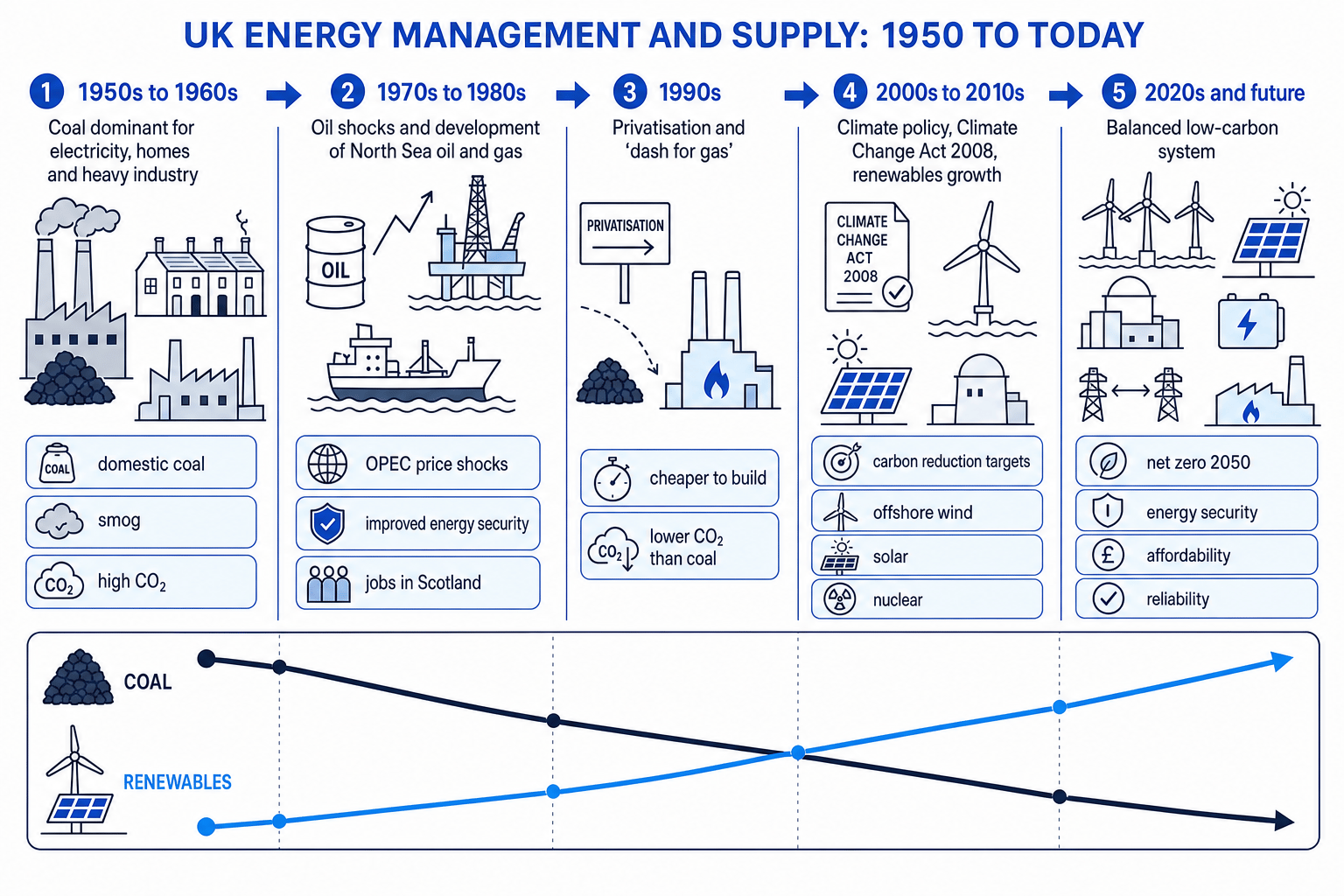
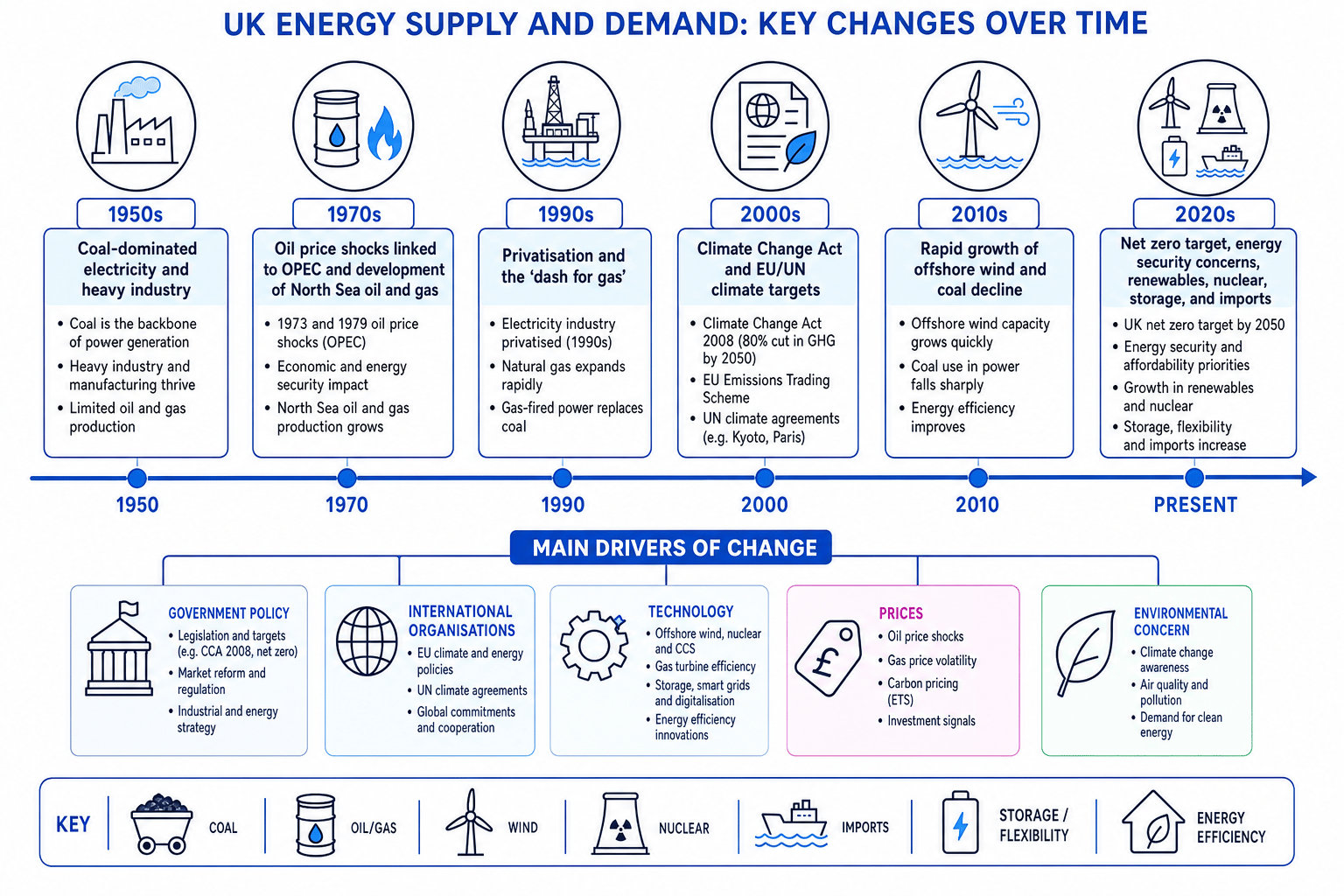
The broad story is a move away from coal, towards oil and gas, then towards lower-carbon electricity such as wind, solar and nuclear. Demand has also changed as the UK has become less dependent on heavy industry and more focused on services, technology and efficiency.
1950s and 1960s: coal dominance
In the 1950s, the UK relied heavily on coal. Coal powered electricity stations, factories, railways and many homes. This suited a UK economy with large areas of heavy industry, such as steel, shipbuilding and manufacturing.
Coal had advantages: it was available within the UK, supported many jobs, and provided a secure domestic supply. But it also caused severe air pollution, including smog, and released large amounts of carbon dioxide.
1970s and 1980s: oil shocks and North Sea energy
In the 1970s, global oil prices rose sharply. This was partly linked to OPEC, an international organisation of oil-producing countries that can influence oil supply and prices.
At the same time, the UK developed North Sea oil and gas. This improved national energy security because more fuel could be produced close to home. It also created jobs and government revenue, especially in areas such as Aberdeen and the north-east of Scotland.
1990s: privatisation and the “dash for gas”
In the 1990s, the electricity industry was privatised, meaning it moved from state ownership towards private companies operating in a market. New gas-fired power stations were built quickly.
This shift is often called the dash for gas. Gas power stations were cheaper and quicker to build than coal or nuclear stations, and they released less carbon dioxide than coal. As a result, coal declined rapidly in electricity generation.
2000s to today: climate policy and renewable growth
Since the 2000s, UK energy policy has been strongly influenced by climate change. The Climate Change Act 2008 created legally binding targets to reduce greenhouse gas emissions. The UK later adopted a net zero by 2050 target, meaning the country aims to balance the greenhouse gases it emits with the amount removed from the atmosphere.
International organisations have also mattered. The European Union influenced renewable energy targets and carbon pricing when the UK was a member. The United Nations climate agreements, including the Paris Agreement, encouraged countries to reduce emissions.
By the 2010s and 2020s, offshore wind expanded rapidly, especially in the North Sea. Coal-fired electricity fell to almost nothing, and the UK’s last coal-fired power station closed in 2024.
Energy data changes each year
Do not memorise one exact percentage as if it is permanent. In exams, use the data source you are given, then describe the overall trend: coal has declined sharply, renewables have grown, and oil and gas still matter for heating, transport and backup electricity.
3. Reading change in energy data
Graphs about energy often ask you to describe change over time. You may need to calculate percentage point change or percentage decrease.
Percentage points
A change from 40% to 30% is a fall of 10 percentage points. The percentage decrease is different because it compares the fall with the original value.
Calculating a percentage decrease in coal use
Suppose a graph shows coal supplied 75% of electricity at one date and 2% at a later date.
- Work out the absolute fall in percentage points: 75−2=7375 - 2 = 7375−2=73 percentage points.
- Use the percentage decrease formula:
- Substitute the values:
- Interpret the result: coal’s share fell by 73 percentage points, which is about a 97% decrease from the original share.
Percentage points vs percentage decrease
If a value falls from 50% to 40%, that is a fall of 10 percentage points, not a 10% decrease. The percentage decrease is 1050×100=20%\frac{10}{50} \times 100 = 20\%5010×100=20%.
4. Why UK energy demand has changed
UK energy demand has not simply risen in a straight line. Several factors have changed it:
- Deindustrialisation: the UK has less heavy industry than in the 1950s, so industrial energy demand has fallen.
- Energy efficiency: appliances, lighting, vehicles and buildings have become more efficient, so they can do the same job using less energy.
- Population and lifestyle: more people, more devices and higher expectations of comfort can increase demand.
- Prices: high energy prices can reduce demand because households and businesses try to save money.
- Weather: cold winters increase heating demand; hot summers can increase demand for cooling.
- Transport change: petrol and diesel still dominate many journeys, but electric vehicles are increasing electricity demand.
Energy efficiency
Energy efficiency means using less energy to provide the same service, such as lighting a room, heating a house or moving a vehicle.
5. Sustainable energy management
Sustainable energy management
Sustainable energy management means meeting today’s energy needs without damaging the ability of future generations to meet theirs. It balances environmental protection, economic cost and social wellbeing.
At the national scale, the UK uses several strategies:
- Reducing demand through insulation, efficient appliances, smart meters and building regulations.
- Increasing low-carbon supply through offshore wind, solar power, nuclear power and biomass.
- Using market incentives, such as Contracts for Difference, which reduce financial risk for low-carbon energy companies.
- Improving the grid with storage, interconnectors to other countries, and demand management.
At the local scale, strategies include home insulation, LED lighting, rooftop solar panels, heat pumps, cycle routes, public transport, district heating and community energy schemes.
For example, some UK councils support district heating, where heat is produced centrally and piped to homes or public buildings. Nottingham has used a district heating network linked to energy-from-waste. This can reduce reliance on individual gas boilers, although success depends on cost, maintenance and public support.
Judging whether home insulation is sustainable
A council wants to fund loft insulation for older homes.
- Consider the environmental effect: better insulation reduces heat loss, so homes need less gas or electricity for heating. This lowers emissions.
- Consider the social effect: warmer homes can reduce fuel poverty and improve health, especially for elderly residents or low-income households.
- Consider the economic effect: insulation has an upfront cost, but households may save money on bills over time.
- Make a balanced judgement: the strategy is sustainable if it is targeted at homes that lose the most heat and if funding helps households that cannot afford the upfront cost.
Use three sustainability lenses
When evaluating an energy strategy, check environmental, economic and social impacts. This helps you avoid writing only about climate change.
6. Renewable energy development in the UK
Renewable energy
Renewable energy comes from sources that are naturally replaced on a human timescale, such as wind, sunlight, flowing water and tides.
The UK has strong renewable potential because it is windy, has a long coastline and has shallow seas suitable for offshore wind turbines. The North Sea is especially important.
Important UK renewable examples include:
| Renewable source | UK examples | Benefits | Concerns |
|---|---|---|---|
| Offshore wind | Hornsea wind farms, North Sea | Large electricity output, low emissions during operation, jobs in coastal regions | Visual impact, effects on seabirds and marine habitats, grid connections needed |
| Onshore wind | Whitelee Windfarm, Scotland | Cheaper than many sources, quick to build | Local opposition over landscape and noise |
| Solar | Rooftops and solar farms in southern/eastern England | Useful for homes and businesses, low operating emissions | Output varies by season and weather; land-use conflicts |
| Hydroelectric power | Scotland and Wales | Reliable in suitable upland areas | Limited sites; can affect river ecosystems |
| Biomass | Drax Power Station, North Yorkshire | Can use existing power station infrastructure | Sustainability depends on fuel source; imported wood pellets are controversial |
| Tidal power | UK estuaries and coasts | Predictable tides | High cost; possible impacts on mudflats, fish and birds |
Renewables can benefit people by creating jobs, reducing air pollution and reducing dependence on imported fossil fuels. However, they are not impact-free. Wind and solar output is intermittent, meaning it varies with weather and time of day. This means the UK also needs storage, flexible demand, interconnectors and backup generation.
Renewable does not mean impact-free
Renewable energy usually has lower greenhouse gas emissions than fossil fuels, but it can still affect landscapes, wildlife, local communities and resource use.
7. Should non-renewable energy have a future role?
Non-renewable energy
Non-renewable energy comes from sources that will run out or take millions of years to form, such as coal, oil, natural gas and uranium for nuclear power.
The question is not only whether non-renewables could contribute, but whether they should.
Coal
Coal is high-carbon and polluting. In the UK, coal is no longer needed for electricity generation in the way it once was. Its future role should be extremely limited.
Oil and gas
Oil and gas still matter for transport, heating, industry and backup electricity. Gas power stations can respond quickly when wind or solar output is low. This makes gas useful for short-term energy security.
However, oil and gas release greenhouse gases, and global prices can be unstable. North Sea production is also declining compared with its peak. New extraction can support jobs and reduce some imports, but it may conflict with climate targets unless demand also falls sharply.
Nuclear power
Nuclear power uses uranium, so it is non-renewable, but it produces very low carbon emissions during operation. It can provide reliable electricity when wind and solar output are low. Hinkley Point C in Somerset is a major new UK nuclear project.
The disadvantages are high construction costs, long build times, radioactive waste and public concern about safety.
Could vs should
Non-renewables could help the UK manage reliability in the short and medium term, especially gas and nuclear. But their long-term role should decline or be carefully limited because of climate targets, costs, waste and environmental impacts.
8. Future factors affecting UK energy supply
Future UK energy supply will depend on factors operating at global, national, regional and local scales.
Economic factors
Energy choices depend on costs. Offshore wind has become much cheaper, but grid upgrades, storage and new nuclear power are expensive. High energy prices can increase fuel poverty, where households struggle to afford adequate heating and power.
Jobs also matter. Oil and gas support employment in places such as Aberdeen, while renewables create new jobs in ports, engineering and maintenance.
Political factors
Government policy strongly shapes the energy mix. Planning rules, subsidies, taxes, carbon pricing and net zero targets all influence what is built.
Energy security is also political. The UK may want to reduce dependence on imported gas, especially when international conflicts or market shocks increase prices. Interconnectors with countries such as Norway, France and the Netherlands can help balance supply, but they also link the UK to wider European energy markets.
Environmental factors
Climate change is the biggest long-term environmental factor. The UK must reduce emissions from electricity, transport, heating and industry to meet net zero.
Local environmental impacts also matter. Wind farms, solar farms, pylons, tidal schemes and nuclear stations can all create planning debates. Future energy supply must therefore balance national need with local environmental protection and public acceptance.
Fieldwork link
A local energy enquiry could investigate home insulation, solar panels, traffic flows, public transport access or school energy use. You could collect primary data through surveys, environmental quality scoring, land-use mapping or energy audits.
In the exam
- Use the language of change: increase, decrease, fluctuate, rapid, gradual, peak, overall trend.
- When evaluating an energy source, cover at least two sides: cost, reliability, emissions, jobs, landscape and wildlife.
- Link scales together: global oil prices, national government policy, regional resources such as the North Sea, and local acceptance of projects.
Check yourself
- Why did the UK move away from coal after 1950?
- How can a renewable energy project benefit people but still damage the environment?
- To what extent should natural gas remain part of the UK’s future energy supply?