What you'll learn
- Why the UK is milder and wetter than many places at a similar latitude.
- How air masses, the North Atlantic Drift and continentality shape UK weather.
- How different air masses can lead to extreme wind, temperature and precipitation.
- How to build clear explanation chains for GCSE answers.
1. Start with the basics: weather, climate and latitude
The UK sits roughly between 50°N and 60°N. That is quite far north: parts of Canada and Russia at similar latitudes can have much colder winters. The UK is different because it has a temperate maritime climate — it is strongly influenced by the sea.
Key starting terms
- Weather is the short-term state of the atmosphere in a place, such as today’s temperature, rainfall, cloud and wind.
- Climate is the average weather of a place, usually calculated over about 30 years.
- Latitude is distance north or south of the Equator, measured in degrees.
- A temperate maritime climate means moderate temperatures, frequent rainfall and a strong sea influence.
The UK’s climate is not just controlled by its latitude. It is also shaped by global-scale ocean currents and wind patterns, then modified at the national scale by the UK’s island position and relief.
2. The North Atlantic Drift: why the UK is mild for its latitude
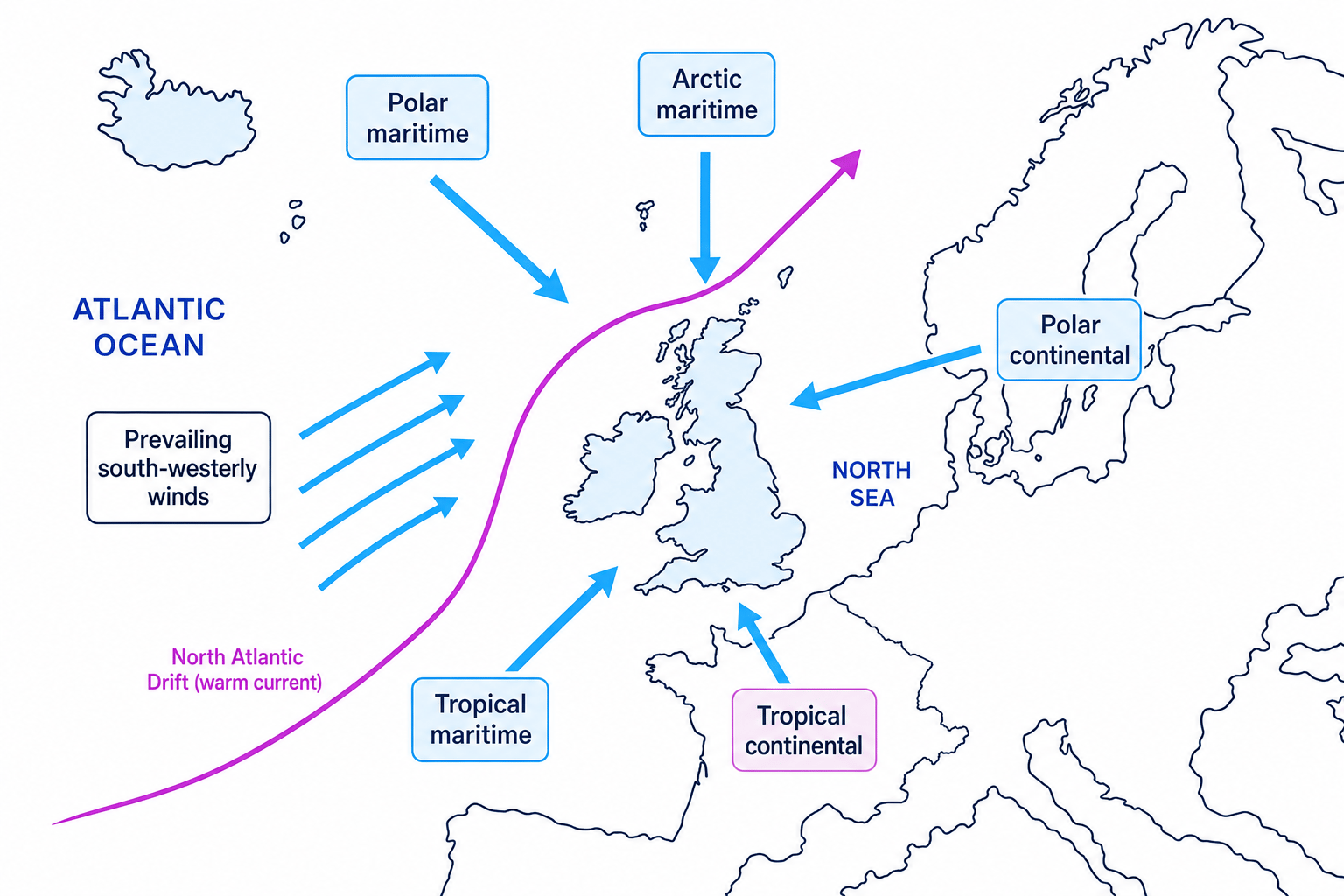
The North Atlantic Drift is a warm ocean current in the North Atlantic Ocean. It is linked to the Gulf Stream and transfers heat from lower latitudes towards north-west Europe.
Warm ocean water heats the air above it. The UK’s prevailing wind — the most common wind direction — is from the south-west. These south-westerly winds carry relatively mild, moist air from the Atlantic towards the UK.
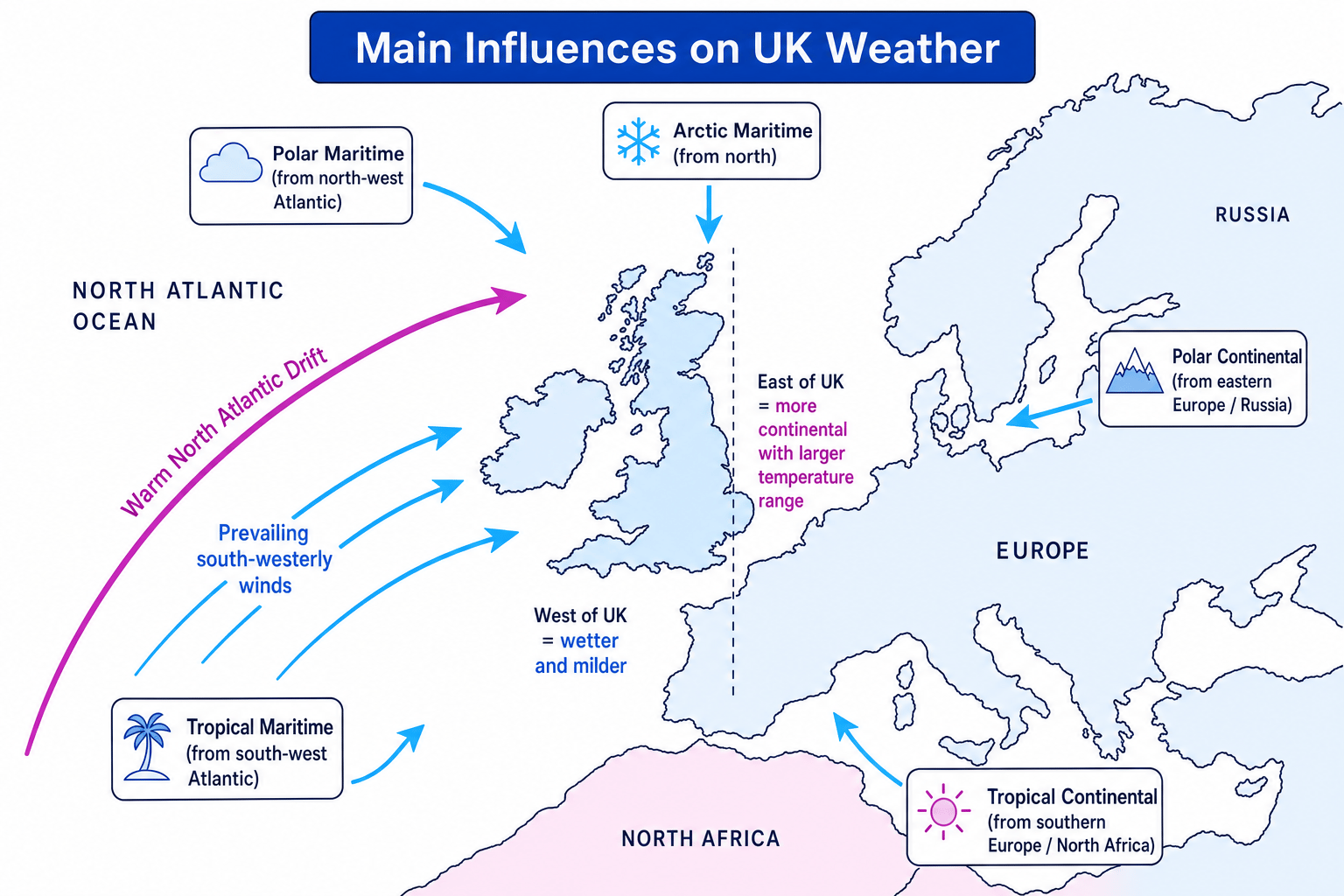
This is why western parts of the UK often have mild winters, even though the UK is quite far north. Glasgow and Moscow are at a similar latitude, but Moscow has much colder winters because it is far from the Atlantic and is more affected by continental air.
The UK’s mildness
The UK is unusually mild for its latitude because warm Atlantic water and prevailing south-westerly winds bring heat and moisture towards the country.
3. Continentality: why west and east Britain can feel different
Continentality means the effect that distance from the sea has on climate. Land heats up and cools down faster than water. The sea changes temperature more slowly, so it acts like a “temperature buffer”.
Continentality
Continentality is the tendency for places further from the sea to have a larger annual temperature range: hotter summers, colder winters and often lower rainfall than coastal places.
In the UK, continentality is weaker than in large landmasses like Russia because the UK is an island. However, there is still a pattern:
- Western UK: more maritime, milder, wetter, smaller temperature range.
- Eastern and inland UK: slightly more continental, drier, colder winter nights and warmer summer days.
- Western uplands, such as Snowdonia, the Lake District and the Scottish Highlands, are especially wet because moist Atlantic air is forced to rise over high land.
This rising-air rainfall is called orographic rainfall: moist air is pushed up over hills, cools, condenses and forms rain.
Calculating annual temperature range
-
Identify the warmest and coldest average monthly temperatures for each place. Suppose a west-coast station has a warmest month of 15°C and a coldest month of 5°C, while an eastern station has 18°C and 4°C.
-
Subtract the coldest month from the warmest month. The west-coast range is 10°C. The eastern range is 14°C.
-
Compare the two ranges. The eastern station has the larger annual temperature range, so it shows a stronger continental influence. The west-coast station is more maritime because the Atlantic reduces temperature extremes.
4. Air masses: where UK weather comes from
An air mass is a large body of air with similar temperature and moisture characteristics. It gets these characteristics from its source region, meaning the area it has travelled over.
Air mass
An air mass is a large body of air with similar temperature and humidity, shaped by the surface it forms over or travels across.
The name of an air mass tells you a lot:
- Tropical means it comes from warmer, lower latitudes.
- Polar or Arctic means it comes from colder, higher latitudes.
- Maritime means it has travelled over sea, so it is usually moist.
- Continental means it has travelled over land, so it is usually drier and can have stronger temperature extremes.
Decode the air-mass name
The first word usually tells you the temperature source: tropical is warm, polar or Arctic is cold. The second word tells you the surface influence: maritime is moist from the sea, continental is drier from land.
Main air masses affecting the UK
| Air mass | Direction | Usual UK weather | Possible extremes |
|---|---|---|---|
| Tropical maritime | South-west | Mild, cloudy, wet | Heavy rain, flooding, strong winds with Atlantic depressions |
| Polar maritime | North-west | Cool, showery, windy | Hail, snow showers in winter, stormy conditions |
| Arctic maritime | North | Very cold, unstable | Snow showers, icy conditions |
| Polar continental | East or north-east | Cold and dry in winter | Severe cold, snow if it picks up moisture over the North Sea |
| Tropical continental | South or south-east | Hot and dry in summer | Heatwaves, drought stress, thunderstorms if unstable air develops |
Easterly does not always mean dry
A polar continental air mass starts cold and dry over land, but if it crosses the North Sea it can pick up moisture. That moisture can fall as snow over eastern Britain.
5. How air masses create temperature extremes
Temperature extremes happen when an air mass brings air that is much warmer or colder than the UK average, especially if the weather pattern gets “stuck” for several days.
Extreme heat
A tropical continental air mass can bring very hot, dry air from southern Europe or North Africa. In summer, high pressure can make this worse because sinking air reduces cloud, allowing strong sunshine. The July 2022 heatwave brought the UK’s first recorded temperature above 40°C, with 40.3°C recorded at Coningsby, Lincolnshire.
Extreme cold
A polar continental or Arctic maritime air mass can bring freezing conditions. The “Beast from the East” in 2018 was linked to very cold easterly air from continental Europe and Russia. As the air crossed the North Sea, it gained moisture and produced heavy snow in parts of the UK.
Linking an air mass to snow showers
-
Start with the direction and source region. An easterly wind in winter suggests a polar continental air mass from eastern Europe or Russia, so the air is very cold.
-
Consider the path to the UK. If that air crosses the North Sea, it can pick up moisture from the relatively warmer sea surface.
-
Link the properties to the weather. Cold air plus added moisture can produce snow showers, especially in eastern England and Scotland where the air first reaches land.
6. How air masses create precipitation extremes
Precipitation means water falling from the atmosphere, including rain, snow, sleet and hail.
The UK’s heaviest rainfall often comes from moist maritime air. A tropical maritime air mass can hold lots of water vapour because warm air can contain more moisture. When this air is forced to rise over hills or along weather fronts, it cools and condenses, leading to heavy rain.
A depression is a low-pressure weather system where air rises, producing cloud, rain and wind. Depressions often form where warm tropical air and colder polar air meet along the polar front, the boundary between these contrasting air masses.
Storm Desmond in December 2015 brought exceptional rainfall to Cumbria; over 300 mm fell in 24 hours in some upland areas, with Honister Pass recording about 341 mm. The exact figures you use may depend on the case study your class has chosen, but the explanation chain is the same: moist Atlantic air, uplift over high ground, prolonged rainfall and flooding.
7. How air masses create wind extremes
Extreme winds in the UK are usually linked to deep Atlantic depressions. When air pressure changes quickly over a short distance, the wind becomes stronger. On a weather map, isobars are lines joining places with equal air pressure; closely spaced isobars mean a steep pressure gradient and strong winds.
Air masses matter because strong contrasts between warm tropical maritime air and cold polar maritime air can intensify depressions. The jet stream high in the atmosphere can also steer these systems towards the UK.
Storm Eunice in February 2022 is a useful located example. It brought damaging winds across parts of England and Wales, including a recorded gust of 196 km/h at The Needles on the Isle of Wight.
Air masses and extremes
Air masses do not just bring “types” of weather. When their temperature and moisture contrasts are strong, they can help create extreme wind, heavy precipitation, heatwaves or severe cold.
8. Bringing the factors together
The UK’s climate is unique for its latitude because several influences overlap:
- Latitude gives the UK a cool temperate starting point.
- North Atlantic Drift adds warmth to the nearby ocean.
- Prevailing south-westerlies bring mild, moist maritime air.
- Continentality creates differences between western/coastal and eastern/inland areas.
- Air masses bring short-term changes and can trigger extremes.
Do not confuse weather and climate change
Air masses help explain individual weather events, such as a snow spell or heatwave. Climate change affects the longer-term likelihood and intensity of some extremes, especially heatwaves and heavy rainfall, but it is not the same thing as today’s weather.
In the exam
-
Build explanation chains: source region → air-mass properties → route to the UK → weather effect → possible hazard.
-
Use accurate named examples where you can, such as the 2018 Beast from the East, the July 2022 heatwave, Storm Desmond 2015 or Storm Eunice 2022.
-
Separate the big controls clearly: North Atlantic Drift explains mildness, continentality explains west–east differences, and air masses explain changing weather and extremes.
Check yourself
- Why is the UK milder than many places at the same latitude?
- Which air mass is most likely to bring very hot, dry summer weather to the UK?
- How can a polar continental air mass cause snow in eastern Britain?