

What you'll learn
- What rapid urbanisation means in a GCSE Geography answer.
- How push factors and pull factors cause rural-to-urban migration.
- Why natural increase — more births than deaths — also grows cities.
- How to outline social, economic and environmental consequences using named places.
Start with the basics
Rapid urbanisation is easiest to understand if you separate two ideas:
- Where people live — rural areas or urban areas.
- Why the urban population grows — migration and natural increase.
Core terms
- LIDC means Low Income Developing Country: a country with relatively low average incomes and lower levels of industrial and service-sector development than richer countries.
- An urban area is a town or city: a built-up place with many people, services and non-farming jobs.
- Urbanisation is the increase in the proportion of a country’s population living in urban areas.
- Rapid urbanisation is when that urban proportion rises quickly, often over just a few decades.
Urbanisation is happening quickly in many LIDCs because cities can attract people from rural areas, while the people already living in cities also have children. This creates fast growth at national, regional and local scales: a country’s urban share rises, people move between regions, and individual neighbourhoods face pressure.
Urbanisation is not just a bigger city
A city can get larger without the country necessarily becoming more urbanised. Urbanisation is about the share of people living in urban areas. In exam answers, mention the proportion or percentage if you are discussing urbanisation.
Measuring rapid urbanisation
Geographers often use the percentage of the population living in urban areas to show urbanisation. If this percentage rises quickly, the country is urbanising rapidly.
A useful skill is spotting the difference between:
- Percentage-point change: the direct difference between two percentages.
- Percentage increase: how much the original value has grown relative to its starting point.
Measuring urbanisation speed
-
World Bank and UN estimates put Bangladesh’s urban population share at roughly 29% in 2010 and around 39% in 2023, though exact figures vary slightly by source.
-
The percentage-point change is 39% - 29% = 10 percentage points. This tells you the urban share of the population rose by about 10 points.
-
To estimate the percentage increase from the 2010 value, use:
39−2929×100≈34.5%\frac{39 - 29}{29} \times 100 \approx 34.5\%2939−29×100≈34.5%
-
This means the urban share grew by roughly one-third compared with its 2010 level, which helps explain why housing, water supply and transport can struggle to keep up.
The two main causes of rapid urbanisation
Rapid urbanisation in LIDCs usually has two linked causes:
- Rural-to-urban migration: people moving from countryside to towns and cities.
- Natural increase: births being higher than deaths within the urban population.
The diagram summarises how these causes feed into rapid urbanisation and then create different types of consequences.
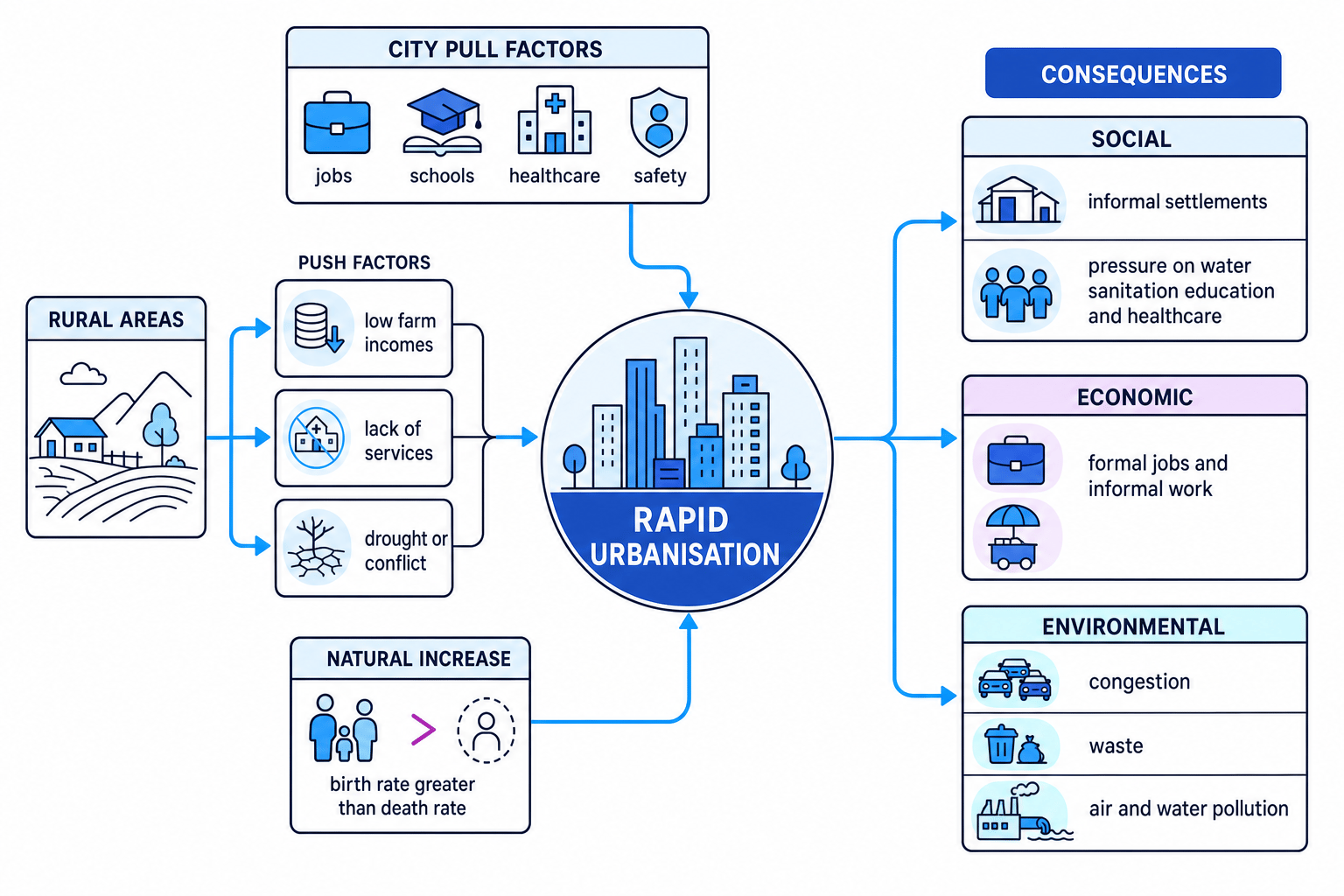
Cause 1: push and pull migration factors
Migration means the movement of people from one place to another to live, usually for a long period of time. In many LIDCs, a key pattern is rural-to-urban migration, where people move from villages and farming regions to towns and cities.
Push and pull factors
Push factors are negative conditions that encourage people to leave a place. Pull factors are positive attractions that encourage people to move to a place.
Common push factors in rural areas
People may leave rural areas because of:
- Low farm incomes or lack of secure work.
- Drought, flooding, soil erosion or crop failure.
- Poor access to schools, clinics, electricity or clean water.
- Conflict or insecurity in some regions.
- Mechanisation of farming, meaning fewer workers are needed.
Common pull factors in cities
People may move to cities because they expect:
- More jobs in factories, construction, transport, services or trade.
- Better schools, hospitals and universities.
- Higher wages, even if work is informal.
- Better transport, communications and social opportunities.
- Safety or support from relatives already living in the city.
Dhaka in Bangladesh is often used as an example of rapid urban growth in a lower-income developing context. People have moved there from rural and delta regions partly because of low rural incomes and environmental hazards, while the city offers garment-industry jobs, services and education.
Classifying migration causes in Dhaka
-
If a rural household leaves after repeated river flooding damages crops and homes, that is mainly a push factor because a problem in the origin area is forcing people away.
-
If the same household chooses Dhaka because garment factories may offer paid work, that is a pull factor because an opportunity in the destination is attracting them.
-
If many young adults make this move, Dhaka’s population grows directly, and the national urban share may rise if city growth is faster than rural population growth.
Cause 2: natural increase
Natural increase is also very important. It can be easy to forget because migration is more obvious, but many cities continue growing even when migration slows.
Natural increase
Natural increase is population growth caused when the birth rate is higher than the death rate. Birth rate and death rate are usually measured per 1000 people per year.
Natural increase can be high in LIDC cities because:
- Many migrants are young adults, so a large share of the urban population is of child-bearing age.
- Healthcare, vaccination and clean water may improve, reducing death rates.
- Birth rates may remain relatively high for a time, especially where access to family planning and education varies.
- Infant mortality may fall, so more children survive into adulthood.
Calculating natural increase
-
Suppose a fast-growing city has a birth rate of 31 per 1000 and a death rate of 9 per 1000. Natural increase is 31 per 1000 - 9 per 1000 = 22 per 1000 per year.
-
For a city of 1,000,000 people, that rate would add about 22÷1000×1,000,000=22,00022 \div 1000 \times 1{,}000{,}000 = 22{,}00022÷1000×1,000,000=22,000 people in one year, before considering migration.
-
If rural-to-urban migration adds more people as well, the total urban population can rise very quickly.
Why the growth is so fast
Rapid urbanisation in LIDCs is usually not caused by one factor alone. Migration adds people from outside the city, while natural increase adds people already born in the city.
Consequences of rapid urbanisation
A consequence is an effect or result. For this topic, group consequences into three categories: social, economic and environmental. The strongest exam answers show that rapid urbanisation creates both opportunities and problems.
Key terms for consequences
- An informal settlement is an area of housing built without full legal permission or planning, often with limited services.
- Sanitation means safe systems for toilets, sewage and waste water.
- The informal sector is work that is not officially registered, regulated or taxed, such as street vending or casual day labour.
Social consequences
Social consequences affect people’s quality of life. Rapid urban growth can mean:
- Housing shortages, leading to overcrowding and informal settlements.
- Pressure on clean water, sanitation, healthcare and schools.
- Higher risk of disease where drainage and waste disposal are poor.
- Longer journeys and more crowded public transport.
- Better access to hospitals, education and social networks for some migrants.
In cities such as Dhaka or Lagos, informal settlements may grow on marginal land, including flood-prone areas or land near polluted waterways. This can make people more vulnerable to disease, eviction and flooding.
Economic consequences
Economic consequences affect jobs, money, trade and investment.
Rapid urbanisation can bring benefits:
- A larger workforce for factories, construction and services.
- More customers for businesses.
- Growth of transport links, markets and industries.
- More tax revenue if the formal economy expands.
But it can also create problems:
- Not enough formal jobs for everyone.
- Growth of low-paid and insecure informal work.
- Underemployment, where people work fewer hours or in lower-skilled jobs than they need.
- Congestion, which wastes time and increases transport costs.
- Inequality between wealthy districts and poorer informal settlements.
Lagos in Nigeria, for example, is a major economic centre with ports, finance, manufacturing and creative industries. However, rapid growth also produces pressure on roads, housing and employment, so many residents depend on informal work.
Environmental consequences
Environmental consequences affect the physical surroundings and ecosystems.
Rapid urbanisation can lead to:
- Air pollution from traffic, generators and industry.
- Water pollution from sewage, chemicals and waste entering rivers, lakes or lagoons.
- More solid waste than local authorities can collect safely.
- Loss of farmland or green space as the city spreads outwards.
- Greater flood risk as concrete and tarmac create impermeable surfaces, so rainfall runs off quickly.
- Urban heat island effects, where built-up areas are warmer than surrounding rural areas.
Building a consequence chain for Lagos
-
Lagos grows quickly as people move in for work and the existing population also increases through natural increase.
-
Housing demand rises faster than planned housing supply, so informal settlements such as Makoko can expand on marginal land. This creates social pressures, including overcrowding and limited sanitation.
-
The larger population provides workers and customers, supporting economic growth, but not everyone finds secure formal employment, so informal work remains important.
-
More traffic, waste and sewage can increase air and water pollution, especially around roads and the lagoon, creating environmental costs.
Develop impacts with a chain
Instead of writing a list like “slums, pollution, traffic”, link ideas: rapid growth → pressure on services → informal settlements → health risks. This shows explanation, not just recall.
A simple structure for exam paragraphs
When you are asked to outline causes or consequences, keep your answer clear and balanced.
For causes, use:
- One point on push factors.
- One point on pull factors.
- One point on natural increase.
For consequences, use:
- One social consequence.
- One economic consequence.
- One environmental consequence.
- A named place if possible, such as Dhaka, Lagos, Nairobi or the specific LIDC example your class has studied.
In the exam
-
For causes, do not stop at migration: include push factors, pull factors and natural increase.
-
For consequences, label your impacts as social, economic or environmental, then add one developed link explaining why the impact happens.
-
Use named places and approximate figures carefully: “Dhaka has over 20 million people in its wider city region” is safer than inventing an exact statistic.
Check yourself
- What is the difference between a push factor and a pull factor?
- Why can a city keep growing even if rural-to-urban migration slows down?
- For one LIDC city, can you outline one social, one economic and one environmental consequence of rapid urbanisation?
