

What you'll learn
- How a major city in an EDC is shaped by its regional, national and global connections.
- How migration affects city growth, character and daily life.
- Why housing, transport and waste are major challenges in rapidly growing cities.
- How one sustainable strategy can reduce an urban challenge.
Your case study: Lagos, Nigeria
For this section, we’ll use Lagos as the case study of a major city in an EDC.
LIDC and EDC
An LIDC is a low-income developing country, while an EDC is an emerging and developing country with growing industry, services and global links. Nigeria is usually treated as an EDC because it has a large, fast-growing economy but still has major development inequalities.
Lagos is in south-west Nigeria, on the coast of the Gulf of Guinea in West Africa. It is no longer Nigeria’s capital — that is Abuja — but Lagos remains Nigeria’s largest city and its main economic centre. Exact population figures vary depending on whether you count Lagos city, Lagos State, or the wider urban area, but the metropolitan area is widely estimated at over 15 million people in the early 2020s.
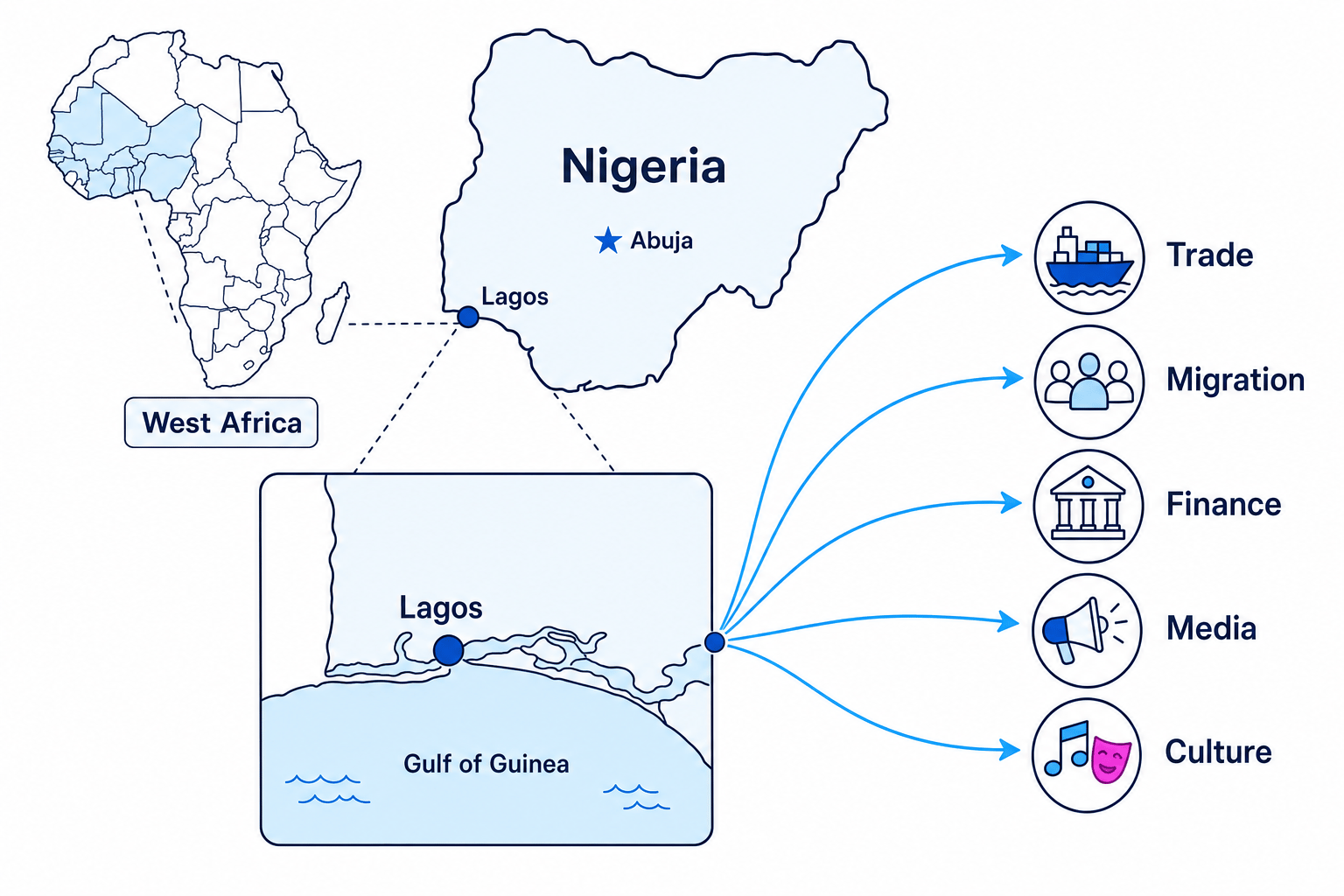
Major city
A major city is an important urban area with a large population and strong economic, political, transport or cultural influence beyond its immediate surroundings.
Building the basics: urbanisation and megacities
Urbanisation
Urbanisation is the increasing proportion of a country’s population living in towns and cities.
A megacity is a city with more than 10 million people. Lagos is one of Africa’s largest megacities. Its rapid growth has happened because of migration, natural increase, and economic investment.
Natural increase means the population grows because the birth rate is higher than the death rate. In a young city population, this can add large numbers of people each year.
Calculating Lagos's population increase
-
Use comparable rounded figures from the same type of source: for example, Lagos urban agglomeration rising from about 1.4 million in 1970 to about 15.0 million in the early 2020s.
-
Apply the percentage increase formula:
percentage increase=new value−old valueold value⋅100\text{percentage increase}=\frac{\text{new value}-\text{old value}}{\text{old value}}\cdot 100percentage increase=old valuenew value−old value⋅100 15.0−1.41.4⋅100≈971%\frac{15.0-1.4}{1.4}\cdot 100 \approx 971\%1.415.0−1.4⋅100≈971% -
Interpret the result: the population has grown by about 970%, meaning it is now roughly 11 times its 1970 size. That helps explain why services such as housing, roads and waste collection struggle to keep up.
Mixing city boundaries
Population figures for Lagos vary because different sources use different boundaries. In your answer, use rounded figures and focus on the trend: very rapid growth.
Lagos within its region, country and the wider world
Lagos matters at several scales.
Regional influence: south-west Nigeria and West Africa
Lagos is a major centre for the south-west of Nigeria. It attracts workers, traders and students from surrounding states and from nearby West African countries. Its ports and markets connect inland Nigeria to coastal trade.
National influence: Nigeria’s economic hub
Nationally, Lagos is vital because it contains major banks, company headquarters, media industries, universities, ports and an international airport. It contributes a very large share of Nigeria’s economic output, even though it is one of 36 states.
Global influence: trade, culture and migration
Globally, Lagos is linked through shipping, oil-related business, finance, migration networks, music, film and digital technology. Lagos is important in Nollywood film production and in the global spread of Afrobeats music.
Cities are connected at different scales
A strong case study answer explains how a city matters locally, nationally and globally — not just where it is on a map.
Migration and the growth of Lagos
Migration
Migration is the movement of people from one place to another to live or work. Internal migration happens within a country; international migration happens between countries.
Lagos has grown partly because people move there from rural areas and smaller towns across Nigeria. This is often called rural-to-urban migration.
People are attracted by pull factors such as jobs, universities, markets, hospitals, entertainment and the hope of a better income. They may leave other areas because of push factors such as limited job opportunities, low farm incomes, conflict, environmental stress or poor services.
Lagos also receives international migrants, especially from other West African countries such as Benin, Ghana and Togo.
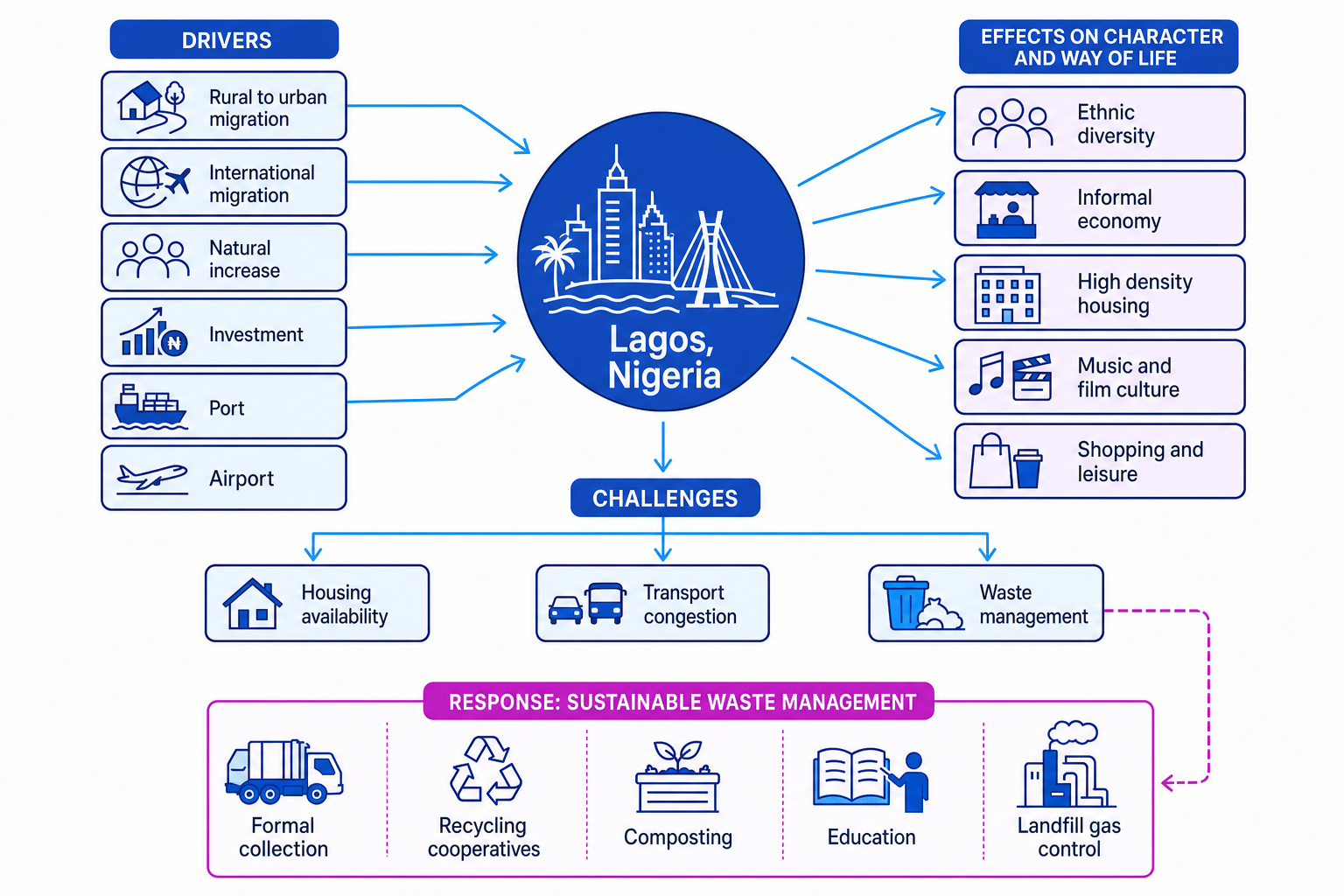
Explaining how migration changes a city
-
Select a migration flow: many people move to Lagos from other Nigerian states to find work, education and better services.
-
Apply the impact on growth: migrants add to natural increase, so demand for housing, transport, water, schools and healthcare rises faster than planned services can expand.
-
Apply the impact on character: migrants bring different languages, foods, religions and skills, helping Lagos become diverse and culturally vibrant, but also increasing pressure on jobs and housing.
Ways of life in Lagos
A city’s way of life means the everyday patterns of living: housing, work, culture, food, leisure, transport, shopping and social life.
Culture and ethnicity
Lagos is historically linked to the Yoruba people, but it is now highly diverse. Many residents are Yoruba, Igbo, Hausa-Fulani or from other Nigerian and West African groups. English is widely used, and Nigerian Pidgin is common in everyday communication.
This diversity affects music, food, religion, festivals, markets and neighbourhood identity. Lagos is known for energy, enterprise and cultural creativity, especially in music, film and fashion.
Housing and inequality
Housing in Lagos is very unequal. Wealthier residents may live in areas such as Ikoyi, Victoria Island or parts of Lekki, where there are expensive apartments, gated estates, offices and shopping centres.
Lower-income residents may live in high-density neighbourhoods or informal settlements such as Makoko and Ajegunle. An informal settlement is housing built without formal planning permission, often with limited access to safe water, sanitation, drainage and secure land rights.
Leisure and consumption
Consumption
Consumption means the goods and services people buy and use, such as food, transport, entertainment, electricity, phones, clothing and leisure activities.
Lagos has shopping malls, street markets, beaches, cinemas, restaurants, churches, mosques, sports venues and nightlife. However, consumption is unequal. A wealthy household may use private cars, air conditioning and imported goods, while a low-income household may rely on informal markets, shared transport and small daily purchases.
Use contrast for ways of life
For Lagos, strong answers often compare wealthy, formal urban lifestyles with lower-income, informal urban lifestyles. This shows you understand inequality within the same city.
Contemporary challenges affecting urban change
Rapid growth brings opportunities, but it also creates serious challenges. For Lagos, three key challenges are housing availability, transport provision and waste management.
| Challenge | What it means in Lagos | Why it matters |
|---|---|---|
| Housing availability | Demand for affordable housing is higher than supply, so informal settlements and overcrowding grow. | Poor housing can increase disease risk, fire risk, insecurity and vulnerability to flooding. |
| Transport provision | Roads, buses, ferries and rail systems struggle to move millions of people efficiently. | Congestion wastes time, increases air pollution and makes it harder for people to reach work or school. |
| Waste management | The city produces large amounts of solid waste, but collection and recycling do not reach everyone. | Uncollected waste can block drains, worsen flooding, pollute waterways and harm health. |
Transport provision
Transport provision means the availability, quality and capacity of transport systems, including roads, buses, trains, ferries, walking routes and traffic management.
Lagos has tried to improve transport through schemes such as Bus Rapid Transit routes and the Lagos Rail Mass Transit system, including the Blue Line. These help, but congestion remains severe because growth is so fast and many journeys still depend on roads.
Only describing the problem
For higher marks, do not just say “there is traffic” or “there is waste”. Explain why the problem happens and how it affects people, the economy and the environment.
Sustainable strategy: improving waste management
Sustainable strategy
A sustainable strategy meets people’s needs now while reducing environmental damage and avoiding unfair costs for future generations.
One major Lagos challenge is waste. A more sustainable approach includes regular formal collection, recycling, composting, public education, better landfill management and support for informal waste workers.
In Lagos, waste management involves the Lagos Waste Management Authority, private collection operators and recycling initiatives. Social enterprises such as Wecyclers have worked in Lagos to collect recyclable materials from households and reward participation. The exact schemes and coverage can change over time, so focus on the overall idea: reducing dumping by making collection and recycling more organised.
Evaluating sustainable waste management
-
Consider the environmental benefits: recycling reduces the amount sent to landfill, while composting organic waste can reduce methane emissions and blocked drains.
-
Consider the social benefits: regular collection improves health and living conditions, especially in dense neighbourhoods where waste can attract pests or contaminate water.
-
Consider the economic benefits: recycling can create jobs and income for waste collectors, sorting workers and small businesses using recovered materials.
-
Make a judgement: the strategy is most sustainable when it includes low-income communities and informal workers, but it is limited if funding, enforcement and collection coverage are too weak.
Sustainability has three sides
When evaluating a strategy, check the environmental, social and economic effects. A strategy is not truly sustainable if it only works for wealthy areas.
Pulling the case study together
Lagos has a distinctive identity because it is shaped by rapid growth, migration, cultural diversity and strong global connections. Its people create a lively economy and rich urban culture, but fast growth also puts huge pressure on housing, transport and waste services.
A strong case study answer should therefore balance both sides: Lagos is not only a city of problems, and it is not only a city of opportunity. It is both.
In the exam
-
Name the city and locate it clearly: Lagos, south-west Nigeria, on the Gulf of Guinea in West Africa.
-
Use place detail rather than generic phrases: mention examples such as Makoko, Victoria Island, Bus Rapid Transit, LAWMA or Wecyclers where relevant.
-
Link causes and effects: show how migration and natural increase lead to pressure on housing, transport and waste systems.
-
For sustainability, evaluate using all three dimensions: environmental, social and economic.
Check yourself
- How is Lagos important at regional, national and global scales?
- How has migration changed both the population size and character of Lagos?
- Why might a recycling-based waste strategy be sustainable, but still limited?
